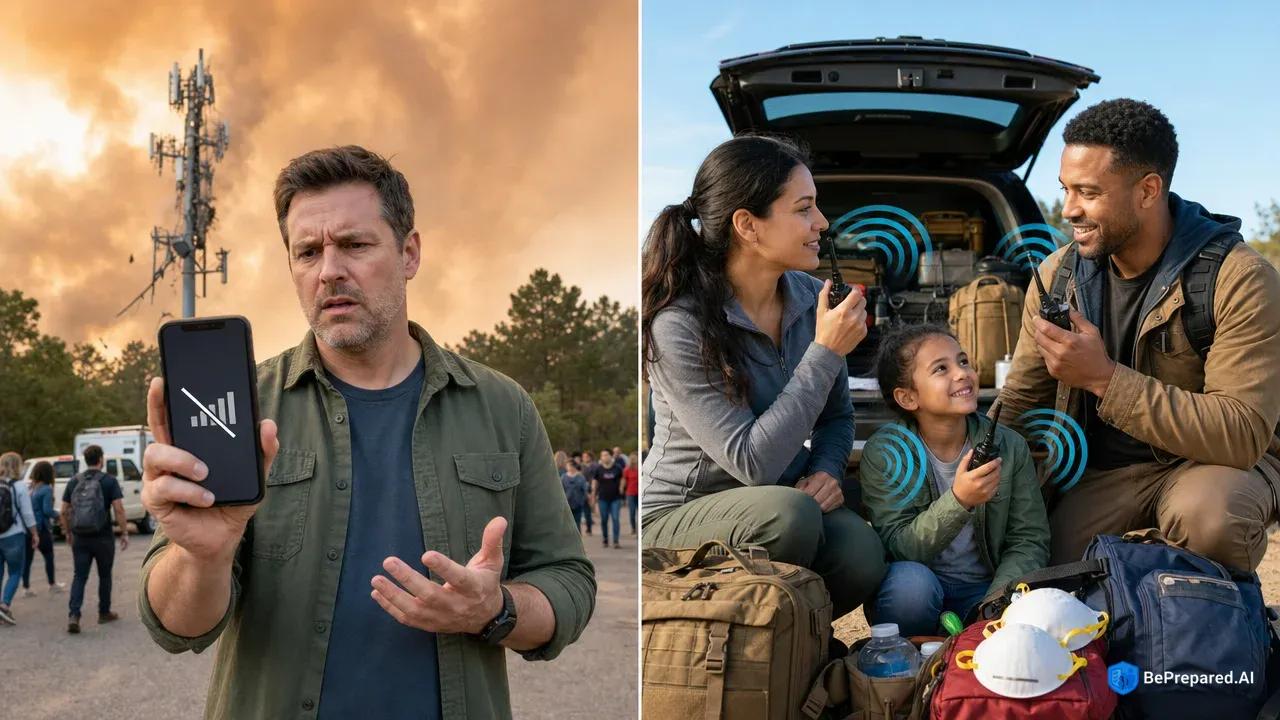
Communication Lifelines: When Networks Fail, Backup Plans Save Lives
The Martinez family learned about communication redundancy the hard way. When the Creek Fire tore across California's Sierra National Forest in September 2020, they watched their cell phone signals flicker and die just as evacuation orders arrived. Their neighbors, equipped with handheld two-way radios, coordinated their escape convoy while the Martinez family drove blind, separated from loved ones, unsure which roads remained passable. They reunited safely hours later at an evacuation center, but the experience transformed their understanding of emergency preparedness forever.
Wildfires don't just consume forests and structures—they systematically dismantle the communication infrastructure we depend on daily. During the 2020 wildfire season, over 40% of cell sites in affected areas experienced service disruptions, leaving thousands of people unable to call for help, coordinate evacuations, or notify family members of their safety . The smoke-choked air that forces you to reach for an N95 mask also carries embers that can damage cell towers miles from the fire's edge. Power outages cascade through the network. Panicked residents overwhelm remaining capacity. Within hours, the smartphone in your pocket becomes little more than a camera and flashlight.
Understanding how different communication systems fail—and which alternatives remain operational when infrastructure crumbles—represents the difference between coordinated evacuation and dangerous confusion. Cell phone networks become overloaded or damaged during emergencies, making calls and texts unreliable precisely when you need them most . This reality doesn't mean abandoning your smartphone, but it demands a more sophisticated approach: layered communication systems that provide multiple pathways to reach your family, receive emergency updates, and coordinate with neighbors during the critical hours when wildfires threaten your community.
The families who navigate wildfire evacuations most successfully aren't necessarily the ones with the most expensive equipment or the most elaborate plans. They're the ones who understand that communication resilience comes from redundancy—from having backup systems that operate independently of the infrastructure most likely to fail. They've thought through the specific ways wildfires disrupt communications, and they've built practical solutions that work when nothing else does.
- Tower Infrastructure Damage
- Physical destruction of cell towers and equipment from direct fire exposure, heat damage, and falling debris compromising signal transmission
- Power Grid Failure
- Loss of electrical power to cell towers and network infrastructure due to damaged power lines, substations, and backup generator fuel depletion
- Network Congestion Overload
- System capacity exceeded as emergency users simultaneously attempt calls, texts, and data usage, causing service degradation and connection failures
- Device Battery Depletion
- Rapid battery drain from increased usage, poor signal conditions requiring higher transmission power, and lack of charging infrastructure during evacuation
- Cascading System Dependencies
- Interconnected failure points where one compromised component triggers multiple system breakdowns across the cellular network infrastructure
- Critical Communication Windows
- Time-sensitive periods when communication systems transition from functional to failed states, impacting emergency response coordination
Cell Phone Reality Check: When Towers Fall Silent
Cell phone networks represent marvels of engineering, but they're built on assumptions that wildfires violate systematically. Every call you make, every text you send, travels through a complex chain of infrastructure: your phone connects to the nearest cell tower, which links to switching centers, which route your communication through fiber optic cables or microwave relays to reach its destination. When wildfire conditions stress this system, it fails through multiple, often simultaneous mechanisms.
The most obvious vulnerability involves direct physical damage. Cell towers may lose power or be damaged by flames and smoke during wildfires, transforming those tall structures that usually provide coverage into useless metal skeletons . But fires don't need to reach a tower to disable it. Radiant heat can damage sensitive electronics hundreds of feet away. Smoke and ash infiltrate equipment housings, causing shorts and overheating. Flying embers—those wind-driven fragments of burning material that can travel miles ahead of the main fire front—land on equipment shelters and ignite secondary fires. A single tower going offline might seem manageable, but wildfires often damage multiple towers simultaneously across broad areas, creating communication dead zones precisely where people need connectivity most.
Power infrastructure fails even faster than the towers themselves. Most cell sites include backup battery systems designed to maintain operations during brief outages. Larger sites might have diesel generators for extended operation. But wildfire scenarios quickly exceed these backup capacities. When fires damage electrical transmission lines—which happens frequently since power lines often run through the same forested areas where fires burn most intensely—entire regions lose grid power. Fuel trucks can't reach remote tower sites to refill generators when roads are blocked by fire or evacuation traffic. Backup batteries drain, generators run dry, and towers go dark even when the fire never touches them directly.
Network overload occurs when too many people attempt to use cell services simultaneously during disasters, creating a different but equally debilitating failure mode . Picture a highway system designed for normal traffic suddenly flooded with vehicles as an entire community evacuates simultaneously. The infrastructure simply cannot handle the demand. During the initial hours of a wildfire emergency, everyone tries to call loved ones, text friends, check emergency information, and access social media for updates. The finite capacity of surviving cell towers gets overwhelmed. Calls fail to connect. Text messages queue for hours. Data services slow to unusability. Even if the physical infrastructure remains intact, the network becomes functionally useless.
The smartphone dependency that defines modern life becomes a critical weakness during extended emergencies. Your phone's battery might last eight to twenty-four hours under normal use, but emergency conditions drain power rapidly . Constant signal searching as you move through areas with degraded coverage. Repeated call attempts when connections fail. Navigation apps running continuously as you seek evacuation routes. Within the first several hours of emergency use, most smartphones approach critical battery levels—and charging them becomes problematic when you've lost grid power at home, you're stuck in evacuation traffic, or you've reached a crowded shelter where electrical outlets are scarce and jealously guarded.
The 2018 Camp Fire that destroyed Paradise, California, demonstrated these vulnerabilities with devastating clarity. Survivors reported cell service failing within the first hour of evacuation as towers lost power and became overwhelmed. People drove through smoke so thick they couldn't see beyond their hood ornaments, unable to call for help or coordinate with family members. Some residents made life-or-death navigation decisions based on outdated information because they couldn't access real-time updates. The communication breakdown didn't just cause inconvenience—it contributed directly to confusion and casualties during those desperate hours when information meant survival.
Text messages often work when voice calls fail because they require less network bandwidth . During the initial stages of an emergency, before complete network failure, sending texts instead of calling can improve your chances of getting messages through. Keep messages brief and essential. Avoid sending photos or videos that consume bandwidth. Check messages periodically rather than constantly refreshing, which drains your battery faster. This strategy buys you time, extending your window of cellular communication before the network collapses entirely or your battery dies.
Two-Way Radio Advantages: Independent Communication Networks
Two-way radios operate on fundamentally different principles than cellular networks, principles that make them remarkably resilient during the exact conditions that cripple cell service. When you press the transmit button on a handheld radio, your voice converts to radio waves that travel directly from your antenna to your family member's radio—no towers, no switching centers, no infrastructure required. This direct communication path remains operational when everything else fails, providing a lifeline that works independently of the systems wildfires destroy.
The Family Radio Service (FRS) and General Mobile Radio Service (GMRS) frequencies provide the foundation for civilian emergency communications. FRS radios require no licensing and operate with limited power output. Handheld radios using FRS/GMRS frequencies can maintain family communication within evacuation areas, typically providing reliable contact across one to three miles in developed areas or three to five miles in open terrain . GMRS expands these capabilities significantly, allowing higher power output and the use of repeaters—mountaintop installations that receive your transmission and rebroadcast it across much larger areas. A GMRS license requires no exam, covers your entire family, and dramatically extends your communication range.
Range represents the most critical specification for emergency radios, but manufacturers' claims require translation into realistic expectations. Those maximum range figures assume perfectly flat terrain with no obstructions, both radios elevated, and ideal atmospheric conditions—scenarios that rarely exist in the real world. In wildfire country, terrain matters enormously. Hills and mountains block radio signals. Dense forest attenuates them. Buildings and vehicles create dead zones. Two-way radios remain limited by physics and terrain, typically providing one to five miles of handheld-to-handheld range . Using a GMRS repeater can extend your range significantly, but only if the repeater remains operational and accessible during the emergency.
Battery life represents another decisive advantage for two-way radios compared to smartphones. Purpose-built two-way radios can operate for extended periods—often multiple days—on a single charge or set of batteries, compared to the eight to twenty-four hours typical for smartphones under emergency use . This difference stems from fundamental design priorities. Smartphones pack enormous computing power, bright screens, and multiple radios into compact packages, all demanding constant energy. Two-way radios do one thing—transmit and receive voice—and they do it efficiently. Most emergency radios accept standard AA or AAA batteries, allowing you to carry spares and swap them quickly. Some models include rechargeable battery packs plus AA battery trays, providing flexibility to use whatever power source you can find. When you're facing extended evacuations or multi-day power outages, this flexibility transforms equipment from paperweight to lifeline.
Mesh networking represents an emerging technology that addresses traditional radio limitations through clever engineering. Mesh networking radios can create communication networks that route around damaged infrastructure, with each radio acting as both an endpoint and a relay . When you transmit a message, nearby mesh radios automatically receive and retransmit it, creating multiple pathways for your communication to reach its destination. If one path gets blocked by terrain or distance, the message routes through alternative paths. This creates remarkably resilient networks that maintain connectivity even when individual nodes fail or move out of range.
The practical implications for wildfire scenarios prove compelling. Imagine your family evacuating in multiple vehicles, spread across several miles of congested highway. Traditional radios might maintain contact only between adjacent vehicles. Mesh radios allow the lead vehicle to communicate with the trailing vehicle by routing messages through the middle vehicles automatically. If someone takes a different route or gets separated, the network adapts, finding new paths to maintain contact. Several manufacturers now offer mesh-capable radios specifically designed for emergency use. These systems require more setup and practice than basic radios, but they provide communication capabilities approaching cellular networks without depending on any fixed infrastructure.
Understanding these systems' limitations proves equally important as appreciating their advantages. Two-way radios require line-of-sight or near-line-of-sight communication paths. You can't reliably talk through mountains or across valleys the way cell phones can by routing through distant towers. Radio communication lacks privacy—anyone with a radio tuned to your channel can hear your conversations. Coordinating multiple radios requires planning: everyone needs to know which channels to use, when to check in, and how to interpret pre-arranged signals. These aren't insurmountable challenges, but they demand preparation and practice that cell phones never required.
NOAA Weather Radio can provide 24/7 weather updates and emergency alerts even when cell service is unavailable . These specialized receivers monitor continuous broadcasts from the National Weather Service, automatically alerting you to watches, warnings, and emergency information. Many emergency radios include NOAA weather band reception alongside FRS/GMRS communication channels, giving you both person-to-person communication and official weather information in a single device. During rapidly evolving wildfire situations, having access to official weather updates about wind conditions, fire progression, and evacuation orders can prove lifesaving even when your cell phone can't connect to the internet.
Head-to-Head Performance Analysis
Comparing cell phones and two-way radios requires examining specific performance metrics under both normal and emergency conditions. The winner depends entirely on which scenario you're facing, but understanding these tradeoffs allows you to build systems that leverage each technology's strengths while compensating for its weaknesses.
Range capabilities differ dramatically based on infrastructure availability. Under normal conditions, cell phones provide effectively unlimited range—you can call someone across the country as easily as someone across the street. Two-way radios remain limited by physics and terrain, typically providing one to five miles of handheld-to-handheld range or extended distances when using repeaters . But during wildfire emergencies, these equations reverse. Cell phone range collapses to zero when towers fail or become overloaded. Two-way radio range remains constant because it never depended on infrastructure. The radio that reaches three miles on a sunny Tuesday reaches three miles when smoke blocks the sun and flames consume the forest. This consistency proves invaluable when you're coordinating evacuation convoys or checking on neighbors.
Battery life and power consumption create stark contrasts. Smartphones under emergency use may drain their batteries within eight to twenty-four hours, sometimes faster if you're constantly checking for signals in areas with poor coverage . Two-way radios can operate for multiple days on a single charge or set of batteries. More importantly, radios offer flexible power options. Most accept standard alkaline batteries available at any store. Many include both rechargeable packs and AA battery trays, allowing you to switch between power sources. Some feature USB charging ports that work with portable battery banks or solar panels. When you're facing extended evacuations or multi-day power outages, this flexibility transforms equipment from paperweight to lifeline.
Cost analysis reveals surprising economics. Quality smartphones typically cost several hundred dollars or more, require monthly service plans, and become obsolete within a few years. Basic two-way radios cost considerably less with no monthly fees and functional lifespans measured in decades. GMRS licensing adds minimal cost for multi-year family coverage. Even if you invest in premium radios, you're spending less than a year of cell phone service for equipment that works independently of any network. Adding mesh networking radios increases initial investment, but you're building capabilities that function when infrastructure fails.
Ease of use strongly favors cell phones for everyday communication but shifts toward radios for emergency scenarios. Smartphones offer intuitive interfaces, contacts lists, and communication methods ranging from voice calls to video chats. Two-way radios require learning channel assignments, understanding squelch settings, and mastering push-to-talk discipline. The learning curve isn't steep—most people become comfortable with basic radio operations within an hour—but it requires practice that cell phones never demanded. However, this simplicity advantage disappears during emergencies. When your cell phone can't connect, its sophisticated interface becomes irrelevant. A radio with a push-to-talk button and volume knob provides immediate, reliable communication without menus to navigate or apps to troubleshoot.
Integration with emergency services creates complex considerations. Cell phones connect directly to 911 dispatch centers, providing professional emergency response with a single call. Your phone automatically transmits your location to dispatchers. The system routes you to appropriate services. Two-way radios don't connect to 911, requiring you to either relay emergency information through someone with working phone service or contact emergency services through dedicated channels. Amateur radio operators can communicate across hundreds of miles without relying on infrastructure . Ham radio networks often serve as backup communication for emergency services when primary systems fail . During major wildfires when 911 systems become overwhelmed with calls, this distinction matters less. Dispatchers may be unable to send help regardless of how you contact them. Your immediate needs—coordinating with family, navigating to safety, checking on neighbors—often depend on person-to-person communication that radios provide reliably.
Data transmission capabilities heavily favor cell phones. Smartphones excel at capturing photos, accessing maps, receiving emergency alerts, and consulting weather information. Radios transmit voice and nothing else. For wildfire preparedness, this limitation means you need your smartphone for pre-evacuation documentation—photographing your home's contents, capturing insurance information, recording serial numbers on valuable items. But you need radios for real-time communication when you're actually evacuating and cell networks have failed.
Weather resistance and durability often favor purpose-built radios over consumer smartphones. Many emergency radios feature rugged construction, water resistance, and operation across extreme temperatures. They survive drops that would shatter smartphone screens. They function in smoke and ash that would clog smartphone ports. Some include built-in flashlights and emergency alert functions. While rugged smartphones exist, they cost premium prices and still suffer from the battery and infrastructure dependencies that limit their emergency utility.
The optimal solution becomes clear through this analysis: you need both technologies, deployed strategically to leverage their respective strengths. Smartphones serve as your primary communication device and information platform during normal conditions and the early stages of emergencies. Two-way radios provide backup communication that remains operational when infrastructure fails. This redundancy—this layered approach to communication—transforms your emergency preparedness from fragile to resilient.
- Establish Family Radio Check-In Schedule
- Set predetermined times for family members to communicate via two-way radios when cell towers may be compromised during evacuation
- Designate Primary & Secondary Meeting Points
- Identify two evacuation rally points outside fire zones with GPS coordinates shared among all family members and emergency contacts
- Prepare Go-Bag Communication Kit
- Pack battery-powered radio, extra batteries, portable phone chargers, emergency contact list, and backup communication devices
- Install Vehicle Emergency Antenna System
- Mount mobile radio antenna and test reception range to maintain communication capability during evacuation transport
- Implement N95 Mask Communication Protocols
- Practice clear speech techniques and hand signals for effective communication while wearing respiratory protection in smoke
- Test Multi-Channel Communication Backup
- Verify functionality of satellite messengers, ham radio frequencies, and social media check-in systems as cellular alternatives
Wildfire-Specific Communication Strategies
Wildfire scenarios create unique communication challenges that demand specialized strategies beyond general emergency planning. The speed at which fires spread, the infrastructure damage they cause, and the specific coordination needs during evacuation require purpose-built communication protocols that account for these distinct characteristics.
Pre-positioning equipment begins months before fire season arrives. Your emergency go-bag should include a fully charged two-way radio with spare batteries, a written list of communication protocols, and contact information that doesn't depend on accessing your phone. Many families make the mistake of storing emergency radios in closets or garages where they sit untouched for years, batteries corroding, programming forgotten. Instead, designate one family member as the communication coordinator responsible for monthly radio checks. On the first Sunday of each month, test every radio, verify battery condition, confirm everyone remembers which channels to use, and practice basic communication procedures. This routine identifies failing equipment before you need it and maintains familiarity with systems you'll operate under stress.
Establishing communication protocols means creating simple, memorable plans that work when confusion reigns. Smoke and heat can interfere with radio propagation at certain frequencies, making it essential to designate both primary and backup channels . Your protocol might specify: "Use GMRS channel 15 for family communication. If you can't reach anyone on channel 15, switch to FRS channel 3 and call every fifteen minutes." Assign specific check-in times: "If we get separated during evacuation, check in at the top of every hour." Define rally points: "If we can't reach each other by radio, meet at the Safeway parking lot on Highway 99, then at Uncle Tom's house in Sacramento if that's not safe." Write these protocols down. Laminate the cards. Store copies in every vehicle, in every family member's wallet, in the go-bags.
Evacuation communication plans must account for the chaos of departure. When you receive an evacuation order, you might have fifteen minutes to leave. Family members might be scattered—some at work, some at school, some at home. Your communication plan should specify: Who goes where? Who picks up the kids? Which vehicle carries which emergency supplies? How do separated family members reconnect? If cell service remains operational during these initial moments, use it to coordinate. But immediately switch to radios once you're on the road, preserving cell phone batteries and avoiding the network overload that typically develops within the first hour of mass evacuations.
Convoy communication transforms evacuation from isolated vehicles into coordinated groups. If you're evacuating with neighbors or extended family in multiple vehicles, assign vehicles numbers: "Vehicle One, Vehicle Two, Vehicle Three." The lead vehicle navigates and reports road conditions ahead. The trailing vehicle monitors for anyone falling behind. Middle vehicles relay messages between front and back. Practice this before emergencies: take a weekend afternoon and drive somewhere as a convoy, using radios to coordinate. You'll discover that effective convoy communication requires discipline—not everyone talking at once, keeping transmissions brief, confirming that messages were received. These skills feel awkward initially but become natural with practice.
Air quality monitoring and mask coordination represent wildfire-specific communication needs. Smoke conditions can change rapidly as winds shift, requiring real-time information sharing among family members. If you're sheltering in place while waiting for evacuation orders, someone monitoring air quality apps might radio: "AQI just jumped to 300, everyone put on N95 masks now." If you're evacuating through heavy smoke, the lead vehicle might warn: "Visibility dropping to near zero, slowing to twenty miles per hour, everyone turn on hazard lights." These specific, actionable communications help coordinate protective measures across your group.
Insurance documentation and photo transmission needs highlight the importance of maintaining your smartphone despite its limitations. Before evacuating, spend five minutes photographing every room in your home, capturing contents, valuables, and the property's condition. Film a video walking through your house describing items and their approximate values. These records prove invaluable for insurance claims if your home burns. Upload photos immediately to cloud storage if you have internet access. Email them to yourself and out-of-state relatives. The goal is getting documentation off your phone and into remote storage before infrastructure fails. Once you're evacuating, your smartphone becomes primarily a camera and reference device, while radios handle real-time communication.
Creating communication trees extends your reach beyond immediate family. Designate one family member as the information hub who maintains contact with extended family, friends, and neighbors. This person's job is collecting status updates and relaying information, preventing the scenario where everyone tries to call everyone else, overwhelming available communication systems. The hub might check in with each household via radio, then send a single text or email update to a broader group: "Everyone evacuated safely. The Johnsons are at the Red Cross shelter on Oak Street. The Garcias are heading to their daughter's house in Fresno. The Patels are at the hotel near the airport. Will update again in three hours."
Signal testing before emergencies reveals coverage gaps and range limitations. Drive your typical evacuation routes with a family member, testing radio communication at various points. Identify dead zones where terrain blocks signals. Note locations where you lose contact and need to switch to backup channels. Test from your home to common destinations—schools, workplaces, grocery stores, gas stations. This reconnaissance tells you where your radios work reliably and where you'll need alternative plans. Document your findings on maps that you store with your emergency supplies.
Building Your Redundant Communication Plan
Building a genuinely resilient communication system isn't about buying the most expensive equipment or creating the most elaborate plans—it's about thoughtfully layering multiple communication methods so that when one fails, others remain operational. Think of it like a safety net woven from different materials: if one strand breaks, the others catch you.
Your foundation starts with the devices you already own. Your smartphone remains your primary communication tool during normal conditions and the early stages of emergencies. Keep it charged, maintain a current backup of your contacts and important information, and invest in a quality portable battery bank that can recharge it at least twice. Add a car charger for every vehicle your family owns. These simple steps extend your phone's operational window during emergencies. But accept the smartphone's limitations: plan for it to become unreliable or non-functional within the first several hours of a major wildfire event.
The next layer adds two-way radios as your infrastructure-independent backup. For most families, a set of four to six GMRS radios provides the right balance of capability and cost. Quality radios should include rechargeable batteries, AA battery trays, and decent antennas. GMRS licensing covers everyone in your immediate family for multiple years. Resist the temptation to buy the cheapest radios available. Budget models work for letting kids play in the backyard but lack the range, battery life, and durability you need for actual emergencies.
Specific equipment selection requires balancing capability against budget. Entry-level GMRS radios provide basic functionality at accessible prices. Mid-range models offer improved range, better build quality, and useful features like weather alerts. Premium radios deliver maximum range, rugged construction, and advanced capabilities. Mesh networking devices provide sophisticated communication that routes around obstacles and extends range through relay functions, though at higher cost. Buy enough radios so every vehicle, every adult family member, and your home base have dedicated units. Radios sitting in a drawer at home don't help when you're evacuating.
Training and practice requirements separate effective emergency communication from expensive paperweights gathering dust. Schedule quarterly family communication drills where you practice your protocols under realistic conditions. One effective drill: on a Saturday morning, have family members drive to different locations around your community—the grocery store, the park, the library, the gas station. Use only radios to coordinate meeting at a predetermined location, simulating evacuation rally point procedures. You'll quickly discover whether your radios actually reach across the distances you assumed they would, whether everyone remembers which channels to use, and whether your communication protocols make sense under pressure.
Another valuable drill involves a simulated evacuation where everyone packs their go-bags, loads vehicles, and drives a predetermined evacuation route while maintaining radio communication. Assign roles: one person navigates, another monitors traffic apps and reports conditions, another tracks family member locations. Practice convoy procedures if you're coordinating with neighbors. These drills feel awkward the first time but reveal gaps in your planning. Maybe you discover that radios work fine in your neighborhood but lose contact once you're on the highway. Maybe you realize that your designated rally point has poor cell coverage and no clear parking area. Maybe you find that your communication protocols are too complicated to remember under stress. Better to learn these lessons during practice than during actual emergencies.
Maintenance and testing schedules keep your communication systems ready for deployment. Create a monthly checklist: test every radio by communicating between units, verify battery condition, confirm programming hasn't been accidentally changed, check that spare batteries remain fresh, ensure portable battery banks hold charges. Every six months, conduct more thorough maintenance: clean radio contacts, inspect antennas for damage, verify that chargers still function properly, replace any aging batteries, update phone contact lists and backup systems. This routine maintenance takes perhaps an hour every month and fifteen minutes weekly, but it ensures your equipment works when you need it.
Budget considerations shouldn't prevent you from building redundant communication systems—you can implement effective solutions at multiple price points. A minimal investment buys basic GMRS radios, licensing, spare batteries, and portable phone chargers. This provides fundamental redundancy that dramatically improves your emergency preparedness. A moderate investment adds better radios with longer range, more sophisticated features, and greater durability. Premium systems might include mesh networking radios, base station equipment, and specialized antennas that extend your range significantly. Start where your budget allows and expand over time, prioritizing functional basic systems over expensive equipment you can't afford yet.
Integration with broader emergency preparedness creates synergies that multiply effectiveness. Your communication equipment lives in your emergency go-bags alongside N95 masks for smoke, copies of insurance documents, prescription medications, and other wildfire-specific supplies . Your communication protocols connect to your evacuation plans, your family reunification strategies, and your neighborhood mutual aid networks. The same radios you use for evacuation communication help coordinate defensible space work parties before fire season, building community relationships that prove invaluable during actual emergencies. Your quarterly communication drills become opportunities to review and update other aspects of your preparedness, creating comprehensive readiness rather than isolated equipment purchases.
The families who navigate wildfires most successfully share a common characteristic: they've invested time and thought into building layered systems that remain operational when individual components fail. They understand that their smartphone provides amazing capabilities right up until it doesn't, and they've prepared backup systems that work independently. They've practiced using these backups so the equipment feels familiar rather than foreign during emergencies. They've accepted that preparedness requires ongoing effort—testing, maintenance, training, updating—rather than one-time purchases that sit forgotten until disaster strikes.
Pros and Cons: Cell Phones vs. Two-Way Radios
Understanding the strengths and limitations of each communication technology helps you deploy them strategically during wildfire emergencies.
Cell Phone Advantages:
- Unlimited range under normal conditions
- Direct connection to 911 emergency services
- Intuitive interface requiring no special training
- Data capabilities for maps, weather, and information access
- Photo and video documentation for insurance purposes
- Text messaging works when voice calls fail
Cell Phone Disadvantages:
- Depends entirely on functioning infrastructure
- Vulnerable to tower damage and power outages
- Network overload during mass emergencies
- Limited battery life under emergency conditions
- Requires grid power or specialized equipment for charging
- Becomes non-functional when networks fail
Two-Way Radio Advantages:
- Infrastructure-independent direct communication
- Extended battery life, often multiple days
- Flexible power options including standard batteries
- Consistent range regardless of emergency conditions
- Rugged construction survives harsh environments
- No monthly service fees or subscription costs
- NOAA weather alerts on many models
Two-Way Radio Disadvantages:
- Limited range based on terrain and power
- No connection to 911 services
- Requires licensing for GMRS frequencies
- Learning curve for effective operation
- No data transmission or internet access
- Conversations lack privacy on shared channels
- Requires pre-planning and coordination
The optimal approach combines both technologies, using cell phones as primary communication during normal conditions and early emergency stages, while relying on two-way radios as infrastructure-independent backup when networks fail.
Taking Action: Your Next Steps
Your communication lifelines during wildfire emergencies won't appear magically when you need them��you build them now, during calm seasons when you have time to research, purchase, learn, and practice. The Martinez family learned this lesson the hard way, driving through smoke and flame with dead cell phones and no backup plan. You have the opportunity to learn it the easier way: by reading their story, understanding the vulnerabilities, and taking action before the next wildfire season arrives.
Start with assessment. Evaluate your current communication capabilities honestly. Do you have working two-way radios? Does everyone in your family know how to use them? Have you tested them recently? Do you have spare batteries and charging equipment? Have you established communication protocols that everyone understands? Most families discover significant gaps during this assessment—gaps that become obvious only when you examine your preparedness critically.
Move to equipment acquisition. Research GMRS radios that fit your budget and needs. Read reviews from other emergency preparedness enthusiasts. Compare features like battery life, range, durability, and weather resistance. Purchase enough radios for your family's needs—remember that radios stored at home don't help when you're evacuating. Apply for your GMRS license through the FCC website. Budget for spare batteries, charging equipment, and protective cases. This investment costs less than many weekend activities but provides capabilities that could save your life.
Proceed to training and practice. Schedule your first family communication drill within two weeks of receiving your equipment. Start simple: have everyone learn to turn radios on, adjust volume, select channels, and transmit messages. Progress to more complex scenarios: coordinating while driving, maintaining contact across distances, switching to backup channels when primary channels fail. Make these drills regular events, not one-time activities. Muscle memory and familiarity develop through repetition.
Establish maintenance routines. Set calendar reminders for monthly equipment checks. Create checklists that ensure nothing gets forgotten. Assign responsibility clearly—someone needs to own this task or it won't happen consistently. Replace batteries before they fail. Update contact lists as information changes. Revise protocols based on lessons learned during drills. Preparedness isn't a destination you reach; it's an ongoing process you maintain.
Connect with your community. Share your communication preparedness with neighbors. Organize neighborhood radio networks where multiple families coordinate during emergencies. Exchange radio contact information with nearby households. Practice convoy evacuations with neighbors who live along your evacuation route. These relationships multiply your effectiveness during actual emergencies, creating mutual aid networks that help everyone survive and recover.
Document your plans. Write down your communication protocols in clear, simple language. Create laminated cards that survive harsh conditions. Store copies in every vehicle, in every go-bag, in every family member's wallet. Include channel assignments, check-in schedules, rally points, and contact information. When stress and confusion reign during actual emergencies, these written references provide clarity and direction.
The equipment costs less than a weekend vacation. The training takes less time than binge-watching a television series. The payoff—the ability to coordinate with your family, navigate to safety, and know your loved ones are okay even when all the infrastructure has failed—proves literally priceless when smoke fills the sky and evacuation orders arrive.
Create a personalized preparedness plan based on your location and family needs.
The next wildfire season will arrive whether you're prepared or not. The communication networks will fail under the same stresses they've always failed under. The only variable you control is whether you've built the backup systems that keep working when everything else stops. Start building those systems now, while you have time to do it right. Your family's safety during the next evacuation might depend on the decisions you make today.