When Every Second Counts: Staying Safe Outside During a Tornado
The sky turns an eerie shade of green, and the wind suddenly dies to an unsettling calm. You're driving home from work when your phone erupts with a shrill emergency alert: tornado warning in your area. Your heart races as you scan the horizon and spot it—a dark funnel descending from the clouds, closer than you ever imagined possible. You're exposed, vulnerable, and nowhere near home.
This nightmare scenario happens to hundreds of people every year across tornado-prone regions. While being caught outside during a tornado ranks among the most dangerous weather situations you can face, it's absolutely survivable if you know what to do. The difference between life and death often comes down to the decisions you make in the first 30 seconds after spotting the threat.
Here's what you need to understand right from the start: tornadoes can develop rapidly, sometimes catching even experienced meteorologists off guard. The National Weather Service confirms that flying debris—not the wind itself—causes most tornado-related injuries and deaths . That piece of information changes everything about how you should respond. You're not trying to withstand the wind; you're trying to avoid becoming a target in nature's most violent shooting gallery. Every second you spend confused or making the wrong choice increases your exposure to projectiles that can turn ordinary objects into deadly weapons.
The good news? You can learn these survival steps in just a few minutes. Once you know them, you'll feel more confident and prepared whenever severe weather threatens. Let's break down exactly what to do, step by simple step.
Abandon Your Vehicle Immediately
Your instincts are screaming at you to stay in your car. It feels solid, protective, familiar. You might even think about trying to speed away from the approaching tornado, pushing the accelerator to the floor and racing for safety. Stop. Take a breath. And do the exact opposite of what your panic is telling you.
Vehicles offer absolutely no protection from tornadoes—vehicles can be lifted and thrown by tornado winds . We're not talking about your car sliding across the road. We're talking about your two-ton vehicle becoming airborne, tumbling, and crashing with you trapped inside. Documented cases show cars tossed far from roadways, wrapped around trees, and stacked on top of each other like crushed soda cans.
The math is simple but counterintuitive: you're safer lying in a ditch than sitting in a car, even though every fiber of your being wants to stay in that enclosed space. Your vehicle is a metal box with windows that will shatter, sending glass shrapnel in every direction. It has no anchoring to the ground. It presents a large profile for the wind to grab. If in a vehicle, get out immediately and find the lowest ground available .
Here's a myth that has literally cost lives: highway overpasses are NOT safe shelter locations . Despite viral videos and persistent rumors suggesting otherwise, overpasses create a wind tunnel effect that actually concentrates and accelerates the tornado's winds . The narrow space beneath the overpass bridge becomes a deadly funnel where debris accumulates and wind speeds increase. People who have sheltered under overpasses during tornadoes have been killed by the very structure they thought would protect them.
This might sound scary, but remember: you're learning these facts so you can make smart choices. Knowledge removes the guesswork and helps you act quickly when it matters most.
Find the Lowest Ground and Get Down
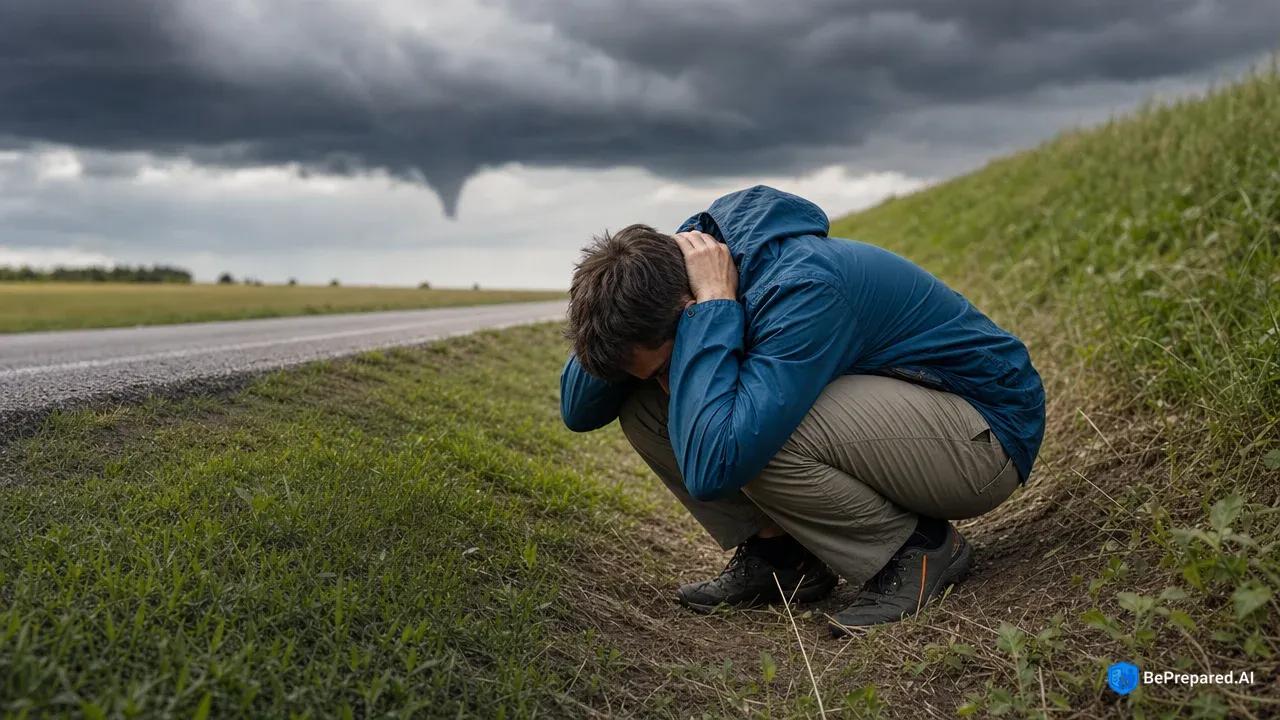
Once you've abandoned your vehicle, you have one goal: get lower than the surrounding landscape. Scan your immediate surroundings with purpose. You're looking for ditches alongside the road, culverts, ravines, or any depression in the ground. Even a shallow roadside drainage ditch is better than standing upright or staying in your car.
The physics here work in your favor. Getting below ground level—even by just a few feet—significantly reduces your exposure to debris, which travels in roughly horizontal trajectories as the tornado's winds whip objects through the air . Think of it like being in a war zone where bullets are flying overhead. The lower you can get, the more likely those projectiles will pass above you rather than striking you directly.
When you reach the lowest point you can find, don't just crouch or sit. Lie completely flat on your stomach with your face pressed toward the ground . Your body should be as horizontal and low-profile as possible. This position serves multiple purposes: it minimizes your wind resistance, making it less likely you'll be lifted or rolled by the wind, and it reduces the target area you present to flying debris.
Getting low and staying flat gives you the best chance of letting the storm pass over you safely. Every inch matters when debris is flying through the air at dangerous speeds. A piece of wood that might sail over your prone body could strike you squarely if you're crouched just slightly higher. Your goal is to become as close to part of the ground as physically possible, almost pressing yourself into the earth.
- Get Low and Stay Low
- Drop to your knees and crouch down as low as possible. Keep your head below window level and away from large roof spans.
- Protect Your Head and Neck
- Cover your head with both hands, interlacing fingers behind your neck. Use a helmet, thick book, or sturdy cushion if available.
- Shield with Clothing and Items
- Wrap a thick jacket, blanket, or mattress around your torso. Use backpacks, pillows, or couch cushions as additional barriers.
- Face Down Position
- Lie face-down with your body pressed against the floor. This protects your chest and vital organs from flying debris.
- Choose the Right Location
- Find the lowest floor interior room, closet, or bathroom. Stay away from windows, doors, and outside walls.
- Stay Put Until It's Over
- Remain in protective position until the tornado completely passes. Don't get up during brief calm periods - it may be the eye.
Protect Your Head and Vital Areas
You're down in the lowest ground you could find, lying flat with your face pressed toward the earth. Now comes the critical part that will determine whether you walk away with minor injuries or face life-threatening trauma: protecting your head and neck.
Cover the back of your head and neck with your hands and arms , interlocking your fingers if possible to create a protective shell. Your brain and spinal cord are irreplaceable, and even relatively small debris can cause serious damage when accelerated by powerful winds. Studies show that objects as ordinary as roof shingles, tree branches, and pieces of metal siding become dangerous projectiles in tornado conditions.
If you have anything with you—a jacket, backpack, briefcase, or even a thick sweater—use it as additional protection over your head and neck. Layer whatever you can find. A backpack might stop or deflect debris that would otherwise strike your skull directly. A thick coat wrapped around your head provides padding that could mean the difference between a minor injury and something more serious.
Keep your face down, pressed as close to the ground as possible. This protects your airways from debris and reduces the chance of inhaling dust, dirt, and small particles that the tornado kicks up. Breathing becomes difficult in the chaos of a tornado, and you don't want to add the complication of choking on debris while trying to survive the storm's passage.
These protective measures are straightforward and use whatever you have on hand. You don't need special equipment—just the knowledge of what to do and the willingness to act quickly.
What NOT to Do: Deadly Mistakes to Avoid
In the chaos and terror of a tornado bearing down on you, your brain will grasp for solutions, sometimes latching onto ideas that seem logical but are actually fatal mistakes. Let's be absolutely clear about what you should never do.
Never seek shelter under highway overpasses. We've already mentioned this, but it bears repeating because this myth persists despite numerous deaths. The confined space accelerates wind speeds and concentrates debris. You're essentially putting yourself in the worst possible position—elevated off the ground, confined in a space with increased wind velocity, and surrounded by concrete and steel that can collapse.
Don't try to outrun the tornado in your car [1]. Tornadoes can move quickly and unpredictably, and they don't follow roads. They can change direction without warning, cut across terrain that your vehicle can't navigate, and move faster than you can drive on congested or damaged roads. Attempting to flee in your vehicle wastes precious seconds you should be using to find ground-level shelter, and it puts you at risk of being caught in the worst possible situation: trapped in a vehicle in the tornado's direct path.
Avoid seeking shelter near trees, power lines, or structures that could collapse. That grove of trees might look sturdy, but trees and power lines can become dangerous projectiles in strong winds. A falling tree or snapped power line can cause serious injury. Similarly, that small shed or unstable building might seem better than nothing, but structures that aren't properly anchored become sources of additional debris. You're better off in an open ditch than next to a tree or under a weak structure that could collapse on top of you.
Don't stay in a mobile home under any circumstances. Mobile homes offer virtually no protection from tornadoes, even when tied down . If you're in a mobile home when a tornado warning is issued, evacuate immediately to a sturdy building or, if that's not possible, to the nearest ditch or low-lying area.
These "don'ts" are just as important as the "dos." Knowing what to avoid helps you make better decisions under pressure and keeps you from wasting time on actions that won't help.
After the Tornado Passes: Your Next Steps
The roar fades. The wind calms. Your ears are ringing, and your heart is pounding so hard you can feel it in your throat. But you're alive. The instinct to immediately jump up and assess the damage is overwhelming, but hold on just a moment longer.
Stay down until you're absolutely certain the tornado has completely passed. Tornadoes can change direction unpredictably, sometimes moving in ways that surprise even weather experts. Listen carefully—if you still hear that characteristic freight train roar or if the wind remains intense, the danger hasn't passed. Wait until the air is genuinely calm and the sound has moved clearly into the distance.
Once you're confident the immediate threat has passed, carefully check yourself for injuries before attempting to move. Adrenaline is surging through your system right now, and it can mask pain from significant injuries. Look for bleeding, check your limbs for mobility, and assess whether you can stand safely. If you're injured, try to stay calm and call for help if your phone is still functional.
Be aware that severe weather events can produce more than one tornado. Don't assume that because one tornado has passed, you're now safe for the rest of the day. Stay alert to weather conditions and be prepared to take shelter again if warnings continue. Keep monitoring weather updates through your phone, radio, or other sources.
As you emerge from your shelter, survey your surroundings carefully. Watch for downed power lines, which may still be live and deadly. Avoid damaged buildings that could collapse. Be cautious of broken glass, sharp metal, and other debris scattered across the landscape. Your immediate goal is to move to a safe location—ideally a sturdy building that wasn't damaged—and then assess your situation more thoroughly.
Take your time with these steps. There's no rush once the immediate danger has passed. Moving carefully and deliberately helps you avoid injuries in the aftermath.
- Battery-Powered Radio & Phone Charger
- Stay informed with weather updates and keep your phone charged for emergency calls when power is out
- First Aid Kit & Medications
- Basic bandages, pain relievers, and any prescription medications you need in case of injury or delays
- Blankets & Weather Protection
- Warm blankets, rain ponchos, and sturdy shoes in case you need to shelter in place or walk to safety
Building Your Tornado Awareness for the Future
Surviving a tornado encounter changes you. The experience sears into your memory the reality that these storms are not abstract threats from news reports—they're real, immediate dangers that can appear with terrifying speed. Use this awareness to prepare yourself better for the future.
Start by learning to recognize tornado warning signs and understanding the difference between watches and warnings. A tornado watch means conditions are favorable for tornado formation. A tornado warning means a tornado has been spotted or detected on radar and you need to take shelter immediately. This distinction matters because it tells you how urgently you need to act.
Weather radios can provide reliable alerts during severe weather events. Consider investing in a NOAA Weather Radio that will alert you even when you're sleeping or don't have cell service. These radios are designed specifically for emergency alerts and can be more dependable than smartphone apps during severe weather when networks become congested.
During tornado season in your area, plan your routes to avoid high-risk situations when severe weather is forecast. If you know thunderstorms are expected in the afternoon, consider taking a route home that passes near sturdy buildings where you could take shelter if needed. Identify potential shelter locations along your regular routes: public buildings, stores, or even the homes of friends or family members. This simple planning takes just a few minutes but gives you options when you need them.
Keep emergency supplies in your vehicle during tornado season. A basic kit should include a flashlight, first aid supplies, water, sturdy shoes (in case you need to walk through debris), and a battery-powered weather radio. A thick blanket or sleeping bag can serve as head protection in an emergency. These items won't prevent a tornado, but they'll give you resources to survive and recover if you're caught outside.
Most importantly, trust your instincts and take warnings seriously. When a tornado warning is issued, act immediately. Don't wait to see the funnel cloud or hear the wind. Don't spend precious minutes debating whether the threat is real. The few times you take shelter unnecessarily are a small price to pay for the one time that immediate action saves your life.
You're More Prepared Than You Think
Here's the truth: you've just learned the essential survival steps that could save your life. You now know more about tornado safety than most people ever take the time to learn. That's something to feel good about.
Review these steps once or twice more, and they'll stick with you. When severe weather threatens, you won't freeze up wondering what to do. You'll have a clear plan: get out of your vehicle, find the lowest ground, lie flat, and protect your head. Simple, actionable, and effective.
Preparedness isn't about living in fear. It's about having confidence that you can handle whatever comes your way. You've taken an important step today by learning these skills. That's the kind of practical knowledge that transforms anxiety into empowerment.
The next time you hear a tornado warning, you'll know exactly what to do. And that knowledge makes all the difference.
Want to learn more about tornado preparedness? Check out our guide on creating a family tornado safety plan to ensure everyone in your household knows exactly what to do when severe weather threatens. We'll walk you through the basics in plain language, with simple steps anyone can follow.