Flood Emergency Kit + Preparedness Checklist
In July and August 2026, flooding sent out more alerts in our archive than any other hazard our preparedness guides cover, and the National Weather Service calls it a coast-to-coast threat to some part of the country nearly every day of the year. Some floods rise over days along a river; flash floods can arrive within hours of the rain. Either way, the decisions that matter are made before the water shows up: whether you carry flood insurance, where your documents live, and which road takes you to higher ground. This is the calm, complete flood preparedness checklist we built for real families.
Last reviewed
Flood risk is local. Start with the official maps: FEMA's Flood Map Service Center lets you search your address for the flood hazard map your community uses for the National Flood Insurance Program. High-risk areas are marked with zones starting with A or V; moderate and lower-risk areas are B, C, or X. A lower-risk zone is not a no-risk zone. FloodSmart.gov reports that nearly a third of NFIP flood claims from 2014 to 2024 came from outside the high-risk areas.
Then check the insurance clock. Standard homeowners policies do not cover flooding, and a new NFIP flood policy generally takes effect 30 days after you buy it. A policy bought when the rain is already in the forecast will usually not be in force when it arrives.
BeAware brings the pieces together for your exact address: FEMA flood zones, USGS stream-gauge and peak-flow history, official flood stages, and the upstream dam inventory. It then monitors the address for National Weather Service flood watches and warnings, so what reaches you is about your home rather than your whole county.
Check flood risk at my addressBuild your flood emergency kit
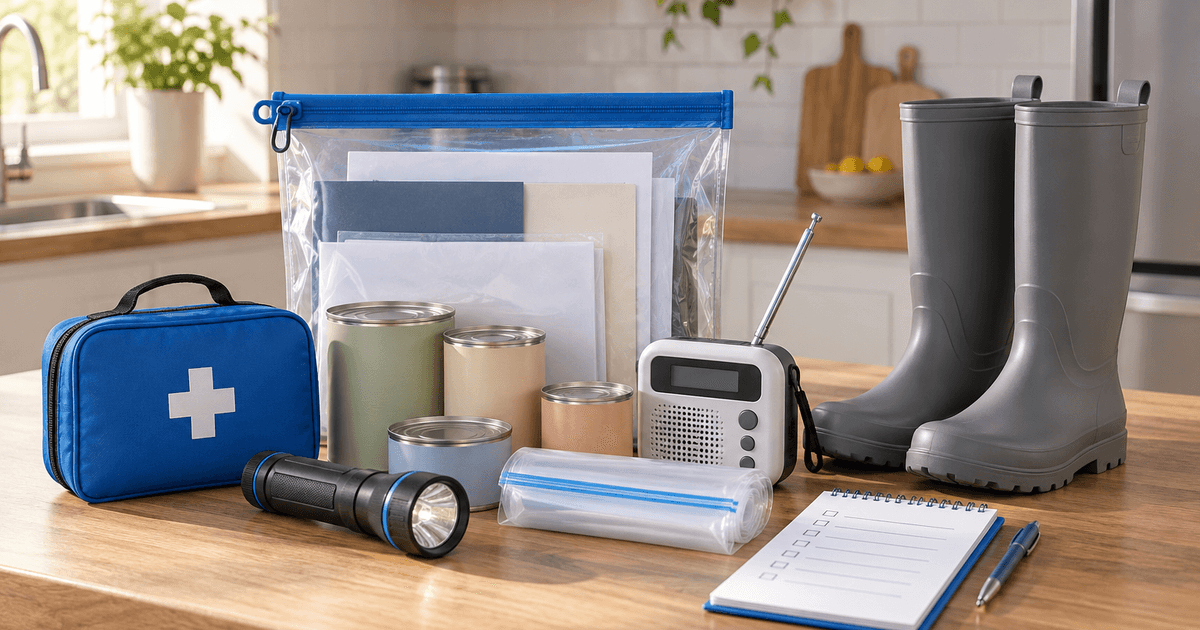
A flood kit has two jobs. It has to leave the house with you in a few minutes if you are told to evacuate, and it has to keep your documents dry whether you leave or not. Everything below fits in a go-bag and one waterproof container that sit together near the door you would actually use. Tap each item to check it off; progress is saved on this device.
Flood Preparedness Checklist
BePrepared Solutions · bepreparedsolutions.co/flood-preparedness
Check off each item as you go.
0 of 23 checked
Documents in waterproof storage
Evacuation go-bag
Power, light, and communication
Water and food
Sanitation and cleanup
Want the kit picked out for you, sized for your household, with the waterproof document storage, weather radio, and cleanup gear already chosen? BeEquipped curates kits for the hazards your address actually faces, and every kit hands off to your own Amazon cart at our cost, with no markup added.
Flood response: before the season through cleanup
Some floods build slowly over days. Flash floods generally develop within 6 hours of the rain that causes them, and cities are especially prone to them because pavement does not let water soak in. The timeline below works for both; the difference is how fast you move from one step to the next. For the long-form version of each stage, see our complete flood preparedness and recovery guide.
Before the rainy season
Look up your flood zone on the FEMA Flood Map Service Center and check whether water collects on the roads you use most. Buy or renew flood insurance well ahead of any storm, since a new policy usually takes 30 days to take effect. Pack the kit above, keep documents in a waterproof container, and pick two routes to higher ground.
When a flood watch is issued
A watch means conditions are favorable for flooding. Charge phones and battery packs, move the go-bag and documents to the door, bring pets inside, and move valuables off the lowest floor. Keep the NOAA Weather Radio on and be ready to act if a warning is issued.
When a flood or flash flood warning is issued
A warning means flooding is happening or about to happen. If you are in a flood-prone or low-lying area, get to higher ground now. If you are told to evacuate, leave immediately and lock your home behind you. Do not drive into flooded roads or around barricades: Turn Around, Don’t Drown.
If water reaches you
Move to higher ground or a higher floor. If you are trapped in a building, go to the highest level, but not into a closed attic where rising water can trap you. Stay out of floodwater, and stay off bridges over fast-moving water. If your car is caught in rapidly moving water, stay inside; if water rises inside the car, get on the roof.
After the water goes down
Return only when authorities say it is safe. Make sure the electrical system is off before you step into standing water, and do not touch wet electrical equipment. Photograph and video all damage before cleaning or throwing anything out. Start drying and cleaning within 24 to 48 hours to limit mold, and run generators only outside, more than 20 feet from windows, doors, and vents.
Make this plan household-specific
The timeline above works once it has names on it: which two roads lead to higher ground from your street, where you go if you evacuate, who grabs the documents container and who loads the pets, and who your out-of-area check-in contact is. Write those decisions down and drive the evacuation route once in daylight. Flood dangers are harder to see at night, which is when you least want to be finding the way for the first time.
BeReady builds that document for your household: a per-person plan built from your address, your home, and the people who live with you, with a printable sheet for every family member.
Build my household flood planTurn Around, Don't Drown: how little water it takes
The National Weather Service's flood safety message fits on a road sign because it has to: Turn Around, Don't Drown. Most flash flood deaths happen when people drive into flood water, and from behind the wheel you cannot see whether the road under the water has collapsed.
These are the NWS figures. Two of its pages put the threshold for large vehicles slightly differently, so both are shown.
| Water depth | What it can do | Source |
|---|---|---|
| 6 inches, moving | Can knock an adult off their feet. | NWS; Ready.gov |
| 12 inches (1 foot), rushing | Can float a car or small SUV, and carry away most cars. | NWS |
| 18 inches | Can carry away large vehicles. | NWS, During a Flood |
| 2 feet, rushing | Can carry away SUVs and trucks. | NWS, Turn Around Don’t Drown |
- Never drive into water of unknown depth, and never drive around a barricade.
- Do not walk or swim through flood water. Six inches of moving water is enough to take your feet out from under you.
- Stay off bridges over fast-moving water. Fast-moving water can wash a bridge away without warning.
- Be especially careful at night, when it is harder to recognize flood dangers on the road ahead.
Flood watch vs. warning vs. flash flood emergency
These are the main flood alerts the National Weather Service issues, and each one asks something different of you. A watch usually covers several counties; a warning is usually a smaller, more specific area. The short version: advisory means be aware, watch means be prepared, warning means take action.
| Alert | What it means | What to do |
|---|---|---|
| Flood Advisory | Flooding is expected but less urgent than a warning; it may be a nuisance and still cause significant inconvenience. | Be aware. Watch low spots on your route and around the house. |
| Flood Watch | Conditions are favorable for flooding. Flooding is possible, not certain. | Be prepared. Charge devices, stage the go-bag and documents, move valuables up, and keep the radio on. |
| Flood Warning | Flooding is imminent or already happening and poses a serious threat to life or property. | Take action. Move to higher ground, and leave if you are told to evacuate. |
| Flash Flood Warning | A flash flood is in progress, imminent, or highly likely. Flash floods generally develop within 6 hours of the rain that causes them. | Move to higher ground immediately. Do not wait to see the water. |
| Flash Flood Emergency | Exceedingly rare. A severe threat to human life and catastrophic damage from a flash flood is happening or will happen soon. | Get to higher ground now by the safest route that avoids water. |
Special cases: basements, cars, manufactured homes, and the people who need help
Basements and the lowest floor
When a watch is issued, move valuables, documents, and anything you cannot replace off the lowest floor. Once water is inside, treat a flooded basement as an electrical hazard: do not step into standing water or touch wet electrical equipment until the power is off, and have a qualified electrician deal with the wiring. If water is rising and you are trapped, go up to the highest level of the building, but not into a closed attic, where rising water can trap you. Our guide to waterproofing a basement before flood season covers the work worth doing while it is dry.
In a car
The best choice is made before the water: turn around. If your car stalls in rising water, the National Weather Service advises abandoning it and getting to higher ground. If the car is caught in rapidly moving water, Ready.gov advises staying inside, and getting onto the roof if water rises inside the car.
Manufactured and mobile homes
FEMA's guidance for residents of the manufactured housing units it provides is direct: never take shelter in one during a flood, and if a flash flood warning is issued, evacuate immediately to higher ground. If you live in a manufactured home, plan as though that applies to you. Know where you will go and plan more than one route there, in case a road is closed.
People who need help evacuating
If someone in the household uses a wheelchair, oxygen, or other powered medical equipment, or cannot drive, plan the evacuation around them first. Ready.gov suggests building a support network of people who can help, arranging accessible transportation ahead of time, and asking your power company about priority restoration for powered medical equipment. Many communities keep a voluntary registry for residents who may need help in an emergency; your local emergency management office can tell you how to join.
Pets
If officials ask you to evacuate, your pets should evacuate too. Many public shelters and hotels do not allow pets inside, so find a pet-friendly place to stay, or a boarding facility well away from the flooding, before you need one. Keep each pet's food, medicine, and records in a waterproof container in the go-bag.
Camping or near a creek
If you are camping in a low-lying area and a flash flood warning is issued, get to higher ground right away. Do not wait to see the water rise.
Flood insurance basics
Flood insurance is the one part of flood preparedness with a hard deadline, and it is the part most households learn about after the fact. Four things to know:
- Homeowners insurance generally does not cover floods. Flood coverage is a separate policy, most often through the National Flood Insurance Program (NFIP).
- There is a 30-day waiting period. An NFIP policy normally goes into effect 30 days after purchase. The exceptions are narrow: no wait when the policy is bought as part of a mortgage transaction or a coverage change at renewal, and a one-day wait in some cases after an area is newly mapped into a high-risk zone, or for a flood caused or worsened by a wildfire on federal land when the policy is bought within 60 days of the fire's containment.
- Building and contents are separate coverages. Building coverage protects the structure and built-in systems such as the furnace, water heater, and electrical system. Contents coverage protects belongings such as clothing, furniture, and electronics. Check that your policy has both if you need both.
- Renters can buy flood coverage too. A contents-only policy protects your belongings even though the building is not yours.
FloodSmart.gov, the NFIP's own site, has the current limits and a way to find an agent. If you are outside a mapped high-risk zone, ask about coverage anyway: the NFIP says there is still a risk of flooding in areas with low or moderate flood risk.
After the flood: getting back in safely
The cleanup has hazards of its own. Go back only when authorities say it is safe, and work through these in order. Our first-48-hours recovery checklist goes deeper on each.
Electricity first
Make sure the electrical system is turned off before anyone steps into standing water, and do not touch electrical equipment that is wet or while you are standing in water. Have the power company or a qualified electrician repair wiring. Snakes and other animals may have come into the house with the water, so move carefully.
Photograph before you clean
Before cleaning, fixing, or throwing anything out, take clear photos and video: wide shots and close-ups of walls, floors, and furniture, the water line, and the serial numbers on appliances and electronics. Keep small samples of damaged carpet, drywall, or insulation for the adjuster, then call your insurer to start the claim.
Treat the water as contaminated
Floodwater often carries sewage or chemicals. Use stored water until local officials say the tap is safe, and follow any boil-water notice. Throw out food that may have touched floodwater, food in packages that are not waterproof, and home-canned food. Undamaged commercial cans and pouches can be kept if you wash and sanitize them first. When in doubt, throw it out.
Dry out within 48 hours
Mold can start within 24 to 48 hours, so the CDC advises drying and cleaning the home fully within that window. Wear an N-95 respirator at a minimum, goggles, and protective gloves. Clean hard surfaces with soap and water or a solution of no more than 1 cup of household bleach in 1 gallon of water, and never mix bleach with ammonia or other cleaners. People who are immune-compromised or have chronic lung disease face higher risk from mold, so plan the cleanup around them. If the job is bigger than a weekend, our comparison of DIY cleanup and professional restoration helps you decide.
Generators stay outside
Carbon monoxide poisoning is one of the leading causes of death after storms that knock out power. Never run a generator inside the home or garage, even with doors and windows open. Keep it outside and more than 20 feet from windows, doors, and vents, and use a battery-powered or battery-backup carbon monoxide detector inside.
Wireless emergency alerts (WEA) for floods
The National Weather Service sends flash flood warnings to phones as Wireless Emergency Alerts, but only when the damage threat is considerable or catastrophic. That means a flash flood warning can be in effect for your area without your phone making a sound, and ordinary flood watches and warnings do not go out as WEA at all. When a WEA does arrive, it comes with a special tone and vibration, both repeated twice.
No signup is required, but alerts can be switched off in phone settings, so check every phone in the house:
- iPhone: Settings → Notifications → scroll to Government Alerts and turn on the emergency alert categories.
- Android: Settings → Notifications → Wireless Emergency Alerts and turn on every category.
Because WEA covers only the most severe flash flood warnings, pair it with a NOAA Weather Radio with tone alert and with local alerts from your county or city. BeAware adds a third layer by monitoring the NWS flood alerts for your specific address.
From the Alert Pulse archive
Flood alerts by the numbers
From July 2026 through September 2026, 22,058 distinct flood alerts went out across the United States: 8,189 Flash Flood Warnings, 7,896 Flood Advisories and 21 other kinds. They reached 2,808 counties in 54 states and territories.
Figures v2 · frozen · covering July 2026 – September 2026. Summed from our monthly Alert Pulse reports on the public emergency alerts sent in the United States.
- distinct flood alerts
- 22,058
- messages carrying them
- 25,552
- counties reached
- 2,808
- states and territories
- 54
Month by month
| Month | Alerts | Counties |
|---|---|---|
| July 2026 | 8,746 | 2,308 |
| August 2026 | 7,219 | 1,827 |
| September 2026 | 6,093 | 1,835 |
Each month links to the Alert Pulse edition it comes from.
By alert type
| Alert type | Distinct alerts | Messages |
|---|---|---|
| Flash Flood Warning | 8,189 | 8,189 |
| Flood Advisory | 7,896 | 7,897 |
| Flood Warning | 3,356 | 4,685 |
| Flood Watch | 1,884 | 2,587 |
| Coastal Flood Advisory | 401 | 1,108 |
| Flash Flood Watch | 140 | 243 |
| Coastal Flood Statement | 94 | 216 |
| Coastal Flood Warning | 56 | 495 |
| Coastal Flood Watch | 25 | 115 |
| 14 other alert types | 17 | 17 |
The 14 other alert types
- Flood: 4
- *CCEM - Museum - Threshold #2 - Flooding: 1
- Beulah Flash Flood WATCH: 1
- City of Kerrville Flood Event: 1
- Flash Flood: 1
- FLASH FLOOD EMERGENCY IN YOUR AREA: 1
- Flood watch: 1
- Flooding in the Area: 1
- Indy Flood: 1
- INDY FLOOD 2026: 1
- Lakeshore Flood Warning: 1
- Local flooding: 1
- Local Flooding: 1
- Pipeline/Schultz Area Flooding: 1
A message is each issue, update or re-issue of an alert. Distinct alerts count each one once.
The busiest days
The days with the most flash flood warnings, counted as UTC calendar days.
229
on
228
on
227
on
By state
A county-alert is one alert counted once in each county it covered, so a warning over five counties adds five. That is why the state rows add up to more than the alert total.
| Rank | State | Counties reached | County-alerts | |
|---|---|---|---|---|
| 1 | Kentucky | 120 | 4,887 | |
| 2 | Ohio | 88 | 4,719 | |
| 3 | West Virginia | 55 | 4,253 | |
| 4 | Indiana | 92 | 4,172 | |
| 5 | Texas | 237 | 4,168 | |
| 6 | New Mexico | 33 | 3,090 | |
| 7 | Virginia | 133 | 3,007 | |
| 8 | Arizona | 15 | 2,870 | |
| 9 | Pennsylvania | 67 | 2,771 | |
| 10 | Iowa | 99 | 2,642 |
Show all 54 states and territories
| Rank | State | Counties reached | County-alerts | |
|---|---|---|---|---|
| 11 | Illinois | 93 | 2,559 | |
| 12 | Colorado | 63 | 2,295 | |
| 13 | North Carolina | 100 | 2,214 | |
| 14 | Tennessee | 93 | 2,157 | |
| 15 | New Jersey | 21 | 1,450 | |
| 16 | Missouri | 112 | 1,389 | |
| 17 | Utah | 29 | 1,304 | |
| 18 | Florida | 66 | 1,255 | |
| 19 | New York | 61 | 1,156 | |
| 20 | Georgia | 125 | 946 | |
| 21 | Kansas | 89 | 818 | |
| 22 | Nebraska | 83 | 741 | |
| 23 | South Carolina | 44 | 728 | |
| 24 | Montana | 54 | 716 | |
| 25 | California | 34 | 714 | |
| 26 | Puerto Rico | 64 | 590 | |
| 27 | Wisconsin | 55 | 526 | |
| 28 | Maryland | 24 | 472 | |
| 29 | Wyoming | 21 | 439 | |
| 30 | Louisiana | 53 | 407 | |
| 31 | Nevada | 17 | 399 | |
| 32 | Oklahoma | 65 | 368 | |
| 33 | Minnesota | 69 | 361 | |
| 34 | Alabama | 56 | 340 | |
| 35 | Michigan | 67 | 275 | |
| 36 | Hawaii | 4 | 262 | |
| 37 | Idaho | 32 | 260 | |
| 38 | Connecticut | 8 | 259 | |
| 39 | Mississippi | 51 | 231 | |
| 40 | Massachusetts | 14 | 223 | |
| 41 | Arkansas | 66 | 210 | |
| 42 | South Dakota | 39 | 170 | |
| 43 | Rhode Island | 5 | 122 | |
| 44 | Alaska | 9 | 121 | |
| 45 | Northern Mariana Islands | 3 | 113 | |
| 46 | North Dakota | 31 | 111 | |
| 47 | Delaware | 3 | 104 | |
| 48 | Guam | 1 | 84 | |
| 49 | New Hampshire | 10 | 73 | |
| 50 | Vermont | 10 | 39 | |
| 51 | Washington | 11 | 33 | |
| 52 | Maine | 5 | 28 | |
| 53 | District of Columbia | 1 | 19 | |
| 54 | Oregon | 8 | 16 |
Also reached: 6 areas in Micronesia and Palau (6 county-alerts), which belong to no U.S. state and are not counted as counties.
Counties with the most flood alerts
| County | State | Alerts |
|---|---|---|
| Pima | AZ | 520 |
| Cochise | AZ | 352 |
| Coconino | AZ | 286 |
| Mohave | AZ | 255 |
| Otero | NM | 249 |
| Pinal | AZ | 232 |
| Gila | AZ | 226 |
| Washington | OH | 226 |
| Lincoln | NM | 214 |
| Maricopa | AZ | 212 |
These are counts, not rates: a county is not adjusted for its size or population. Every county is in the CSV.
How these figures were counted
- Summed from the national monthly Alert Pulse editions listed here, each published after human review. Nothing here is a fresh query of the archive: every figure can be re-derived from those editions' own CSV downloads, except the busiest days, which come from each edition's page.
- An alert counts as a flood alert when its event type names the hazard (Flash Flood Warning, Flood Advisory, Flood Warning, Flood Watch, Coastal Flood Advisory, Flash Flood Watch, Coastal Flood Statement, Coastal Flood Warning, Coastal Flood Watch, Flood, *CCEM - Museum - Threshold #2 - Flooding, Beulah Flash Flood WATCH, City of Kerrville Flood Event, Flash Flood, FLASH FLOOD EMERGENCY IN YOUR AREA, Flood watch, Flooding in the Area, Indy Flood, INDY FLOOD 2026, Lakeshore Flood Warning, Local flooding, Local Flooding, Pipeline/Schultz Area Flooding).
- A distinct alert is the first message of a CAP identifier chain. Updates and re-issues are counted as messages, never as extra alerts.
- Real alerts only: tests, exercises and demos are excluded, as they are in every edition.
- County and state figures use the classification that colors each edition's reach map: an alert whose event type or SAME code is a flood product, counted once in every county it covered. Statewide codes are not counted as counties.
What they cannot tell you
- These figures count flood alerts, not floods. A single flood can prompt many warnings.
- Alert feeds code 6 areas in Micronesia and Palau the same way as counties. They belong to no U.S. state, so they are counted separately here and never as counties; each edition's own "counties reached" includes them.
- An alert is not the same as a county-alert. One warning covering five counties is one alert and five county-alerts, and an alert covering several states counts in each of them, so the state rows do not add up to the alert total.
- Months are summed as each edition published them. A warning chain that continues past midnight at the end of a month is counted in both months, as each edition counted it.
- National Weather Service alerts began arriving in this archive in volume on June 12, 2026. Every month here starts after that change, so the months can be compared with one another.
- These are counts, not rates. Population figures are not available for most of these counties, so nothing here is reported per resident.
- Times are UTC calendar days and months.
For newsrooms and researchers
Use these figures
You are welcome to reuse these figures with attribution. Version 2 is frozen: when a new month is added or an edition is corrected, a new version appears below with a dated note, and every earlier version stays downloadable.
BePreparedSolutions.co. "Flood alerts in the United States, July 2026 – September 2026." Alert Pulse statistics, figures v2, frozen October 1, 2026. https://bepreparedsolutions.co/flood-preparedness#flood-statistics
Source: BePrepared Solutions, Alert Pulse statistics (figures v2). Alert counts from FEMA IPAWS and National Weather Service feeds.
<iframe src="https://bepreparedsolutions.co/hazard-statistics/flood/embed" width="100%" height="560" style="border:0" loading="lazy" title="Flood alerts in the United States, July 2026 – September 2026"></iframe>
Versions
- v2 · · Added the September 2026 edition. Now covers July 2026 – September 2026. CSV for version 2
- v1 · · First release, covering July 2026 – August 2026. CSV for version 1
Flood preparedness FAQ
Sources
The safety guidance on this page follows the National Weather Service, Ready.gov, FEMA and the National Flood Insurance Program, and the CDC. Where our wording differs from theirs, theirs is correct.
- Turn Around Don’t Drown — National Weather Service
Supports: the water-depth table ("A mere 6 inches of fast-moving flood water can knock over an adult"; "It takes just 12 inches of rushing water to carry away most cars"; "2 feet of rushing water can carry away SUVs and trucks") and the hidden-road warning ("The road may have collapsed under that water").
- Flood Safety: During a Flood — National Weather Service
Supports: getting to higher ground if you live in a flood-prone area or are camping in a low-lying area; evacuating immediately when told and locking your home; not driving into flooded roads or around barricades; and the vehicle figures ("12 inches of water can float a car or small SUV, 18 inches of water can carry away large vehicles"; "It only takes 6 inches of moving water to knock you off your feet").
- Flood Watch vs. Warning — National Weather Service
Supports: the alert table and FAQ: a Flood Advisory ("Be Aware"), a Flood Watch "when conditions are favorable" ("Be Prepared"), a Flood Warning when the event "is imminent or already happening" ("Take Action!"), and a Flash Flood Warning "when a flash flood is imminent or occurring" (move to higher ground).
- Flood Related Products — National Weather Service
Supports: that a Flash Flood Warning covers flash flooding "in progress, imminent, or highly likely", and that a Flood Advisory is issued when an event "warrants notification but is less urgent than a warning."
- Severe Weather Awareness: Flood Safety — National Weather Service, Mobile/Pensacola office
Supports: the Flash Flood Emergency definition ("issued for the exceedingly rare situations when extremely heavy rain is leading to a severe threat to human life and catastrophic damage from a flash flood is happening or will happen soon"); that "Most flash flood deaths occur when people drive their vehicles into flood waters"; "If your vehicle stalls, abandon it immediately and seek higher ground"; and "Be especially cautious at night as it is harder to recognize flood dangers."
- Flood Hazards — National Weather Service
Supports: that "Flash floods generally develop within 6 hours of the immediate cause", and that urban areas are especially prone to flash floods because concrete and asphalt do not let water soak in.
- Flood Safety: Before a Flood — National Weather Service
Supports: checking whether your home is in a floodplain and where water collects on the roads you travel; that "standard homeowners insurance doesn’t cover flooding"; knowing the fastest way to higher ground; the kit items (rubber boots, rubber gloves, NOAA Weather Radio, flashlights, first aid kit); and taking pets with you or boarding them well away from the flooding.
- Flood Safety: After a Flood — National Weather Service
Supports: not entering a flood-damaged home until authorities give the all clear; making sure the electrical system is off and having a qualified electrician fix wires; that "Floodwaters often become contaminated with sewage or chemicals"; boil-water notices; and that "Carbon monoxide poisoning is one of the leading causes of death after storms when areas are dealing with power outages."
- Flood Safety (Flooding page) — National Weather Service
Supports: that "Flooding is a coast-to-coast threat to some part of the United States and its territories nearly every day of the year."
- Weather warnings on the go! (Wireless Emergency Alerts) — National Weather Service
Supports: that flash flood warnings are sent as WEA "only when the damage threat is considerable or catastrophic"; that "No signup is required"; and that WEA messages "include a special tone and vibration, both repeated twice."
- Floods — Ready.gov
Supports: that homeowner’s policies do not cover flooding and that a policy "typically takes up to 30 days" to take effect; the FEMA Flood Map Service Center; documents in a waterproof container with password-protected digital copies; "Just six inches of moving water can knock you down, and one foot of moving water can sweep your vehicle away"; going to the highest level if trapped but not into a closed attic; staying in a car trapped in rapidly moving water and getting on the roof if water rises inside; staying off bridges over fast-moving water; not touching wet electrical equipment; snakes and other animals in the house; generators only outdoors; and cleanup protective gear.
- Build A Kit — Ready.gov
Supports: one gallon of water per person per day for several days, a several-day supply of non-perishable food, and the core kit items (NOAA Weather Radio with tone alert, flashlight, first aid kit, whistle, moist towelettes and garbage bags, wrench or pliers to turn off utilities, manual can opener, local maps, phone chargers and a backup battery).
- Prepare Your Pets for Disasters — Ready.gov
Supports: that "If local officials ask you to evacuate, that means your pet should evacuate too"; that many public shelters and hotels do not allow pets inside; and the pet kit contents.
- People with Disabilities — Ready.gov
Supports: building a support network, planning accessible transportation for evacuation, asking your power company about priority restoration for powered medical equipment, and local voluntary registries for people who may need help in an emergency.
- Fact Sheet: FEMA Manufactured Housing Units and Severe Weather — FEMA
Supports: the manufactured-home guidance, written for residents of FEMA’s temporary units: "Never take shelter in an MHU during high winds, a tornado, a hurricane or a flood"; "If a flash flood warning is issued, immediately evacuate and move to higher ground"; and planning multiple routes to several safe shelters.
- FEMA Flood Map Service Center — FEMA
Supports: that the official public flood hazard maps for the NFIP can be searched by address.
- What Is My Flood Risk? — FloodSmart.gov (National Flood Insurance Program)
Supports: the flood zone letters (high-risk areas A or V; moderate-to-lower risk B, C, and X); that "Nearly one-third of NFIP flood insurance claims (29%) came from areas located outside of current high-risk flood areas" (2014-2024); and "There is still a risk of flooding in areas with low or moderate flood risk."
- Buy a Flood Insurance Policy — FloodSmart.gov (National Flood Insurance Program)
Supports: that "Your flood insurance coverage will go into effect 30 days after your date of purchase" and the listed exceptions (mortgage transactions, renewal changes, newly mapped high-risk zones, post-wildfire flooding); building versus contents coverage; and the renter’s contents-only option.
- Document Flood Damage — FloodSmart.gov (National Flood Insurance Program)
Supports: photographing and filming damage "before cleaning, fixing or throwing them out", recording serial numbers, keeping small samples of damaged materials, and that "Mold can start forming within 24-48 hours of flooding."
- About Mold — Centers for Disease Control and Prevention
Supports: drying out and cleaning your home fully within 24 to 48 hours after a flood; the bleach ratio ("no more than 1 cup of household laundry bleach in 1 gallon of water"); "Never mix bleach with ammonia or other cleaners"; and the higher risk to people who are immune-compromised or have chronic lung disease.
- Homeowners and Renters Guide to Mold Cleanup After Disasters — CDC, with EPA, FEMA, HUD, and NIH
Supports: the protective gear: "Wear an N-95 respirator at a minimum, goggles, and protective gloves."
- Carbon Monoxide Poisoning Basics — Centers for Disease Control and Prevention
Supports: the generator rules: never inside a home or garage "even if doors and windows are open", "more than 20 feet away from any windows, doors, and vents", and a battery-powered or battery-backup CO detector.
- Keep Food Safe After a Disaster or Emergency — Centers for Disease Control and Prevention
Supports: throwing out food that may have touched floodwater, food in packages that are not waterproof, and home-canned or damaged cans; cleaning and sanitizing undamaged commercial cans and pouches; and "When in doubt, throw it out!"
Deep dives from our article library
These articles go deeper on the parts of flood preparedness that need their own treatment.
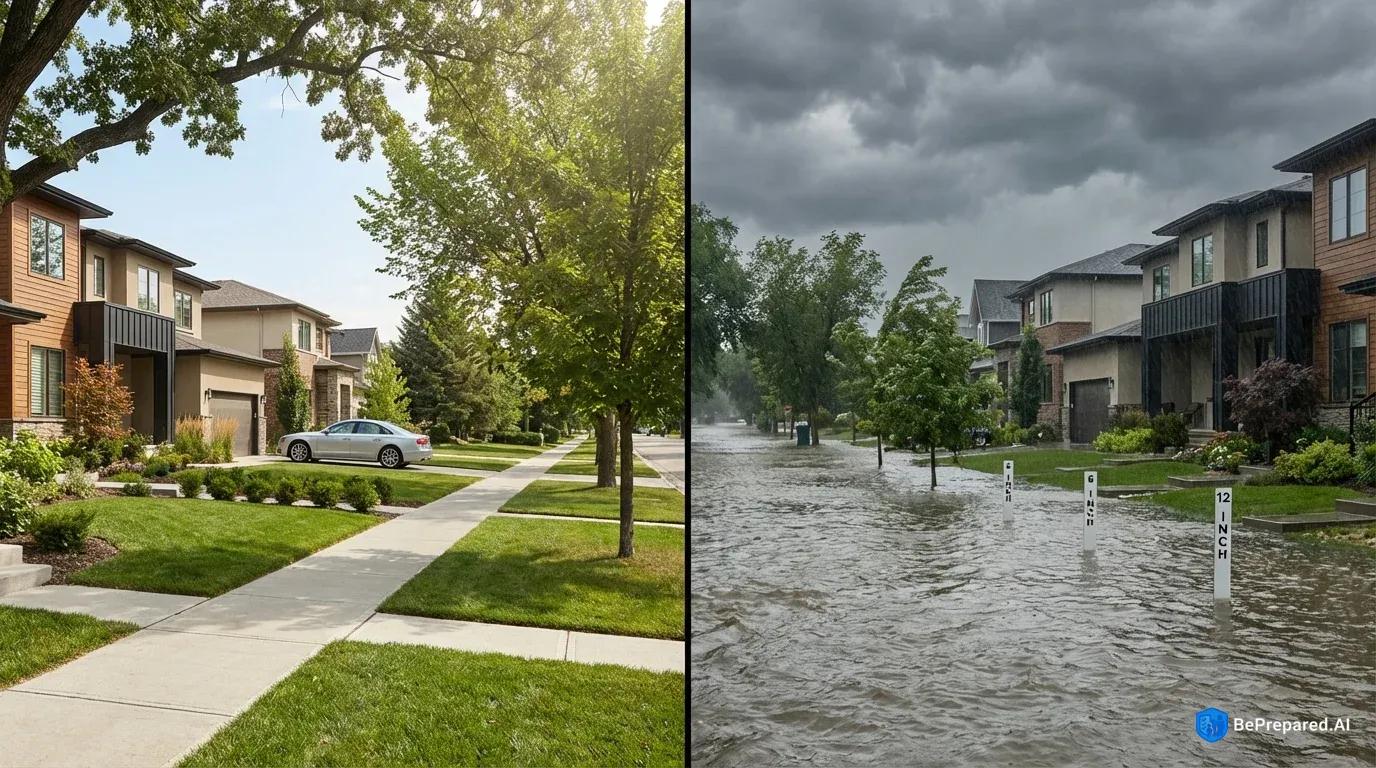
Complete Flood Preparedness and Recovery Guide
The long-form companion to this checklist: how floods develop, what protects a household, and the recovery steps in order.
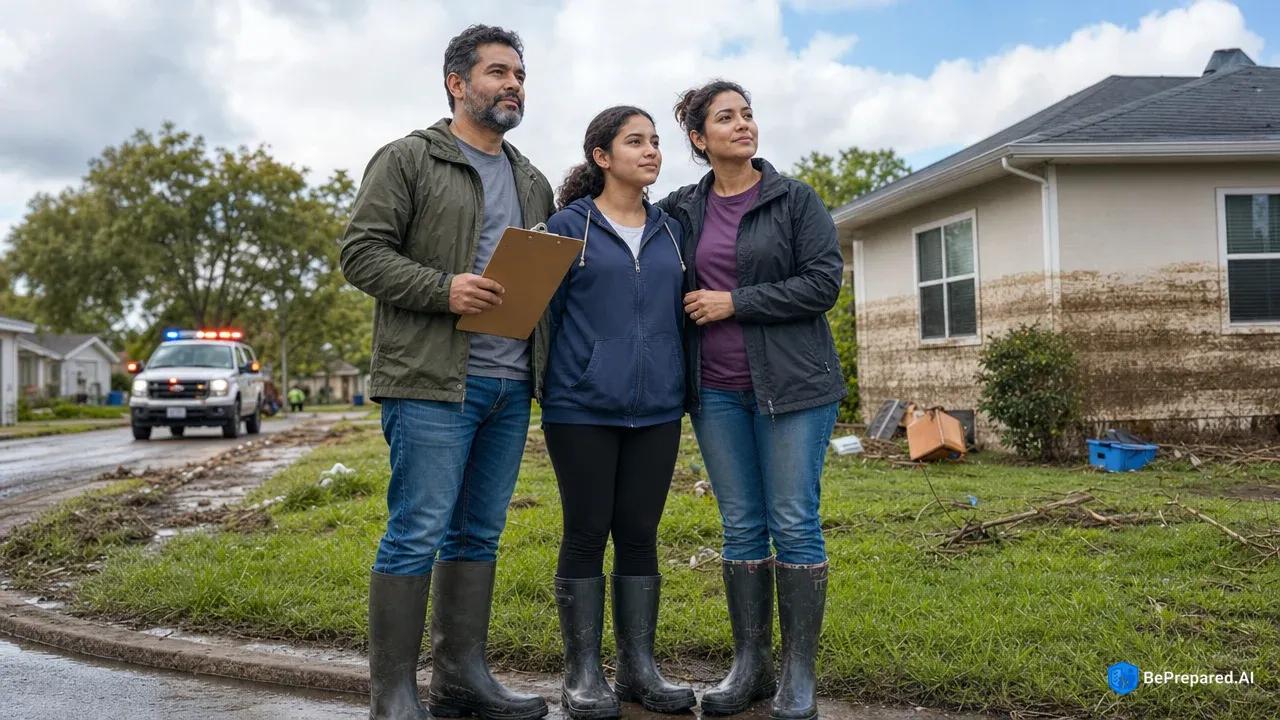
Flood Recovery Checklist: First 48 Hours After Waters Recede
A step-by-step list for the first two days back: electrical and structural checks, water safety, and what to document first.
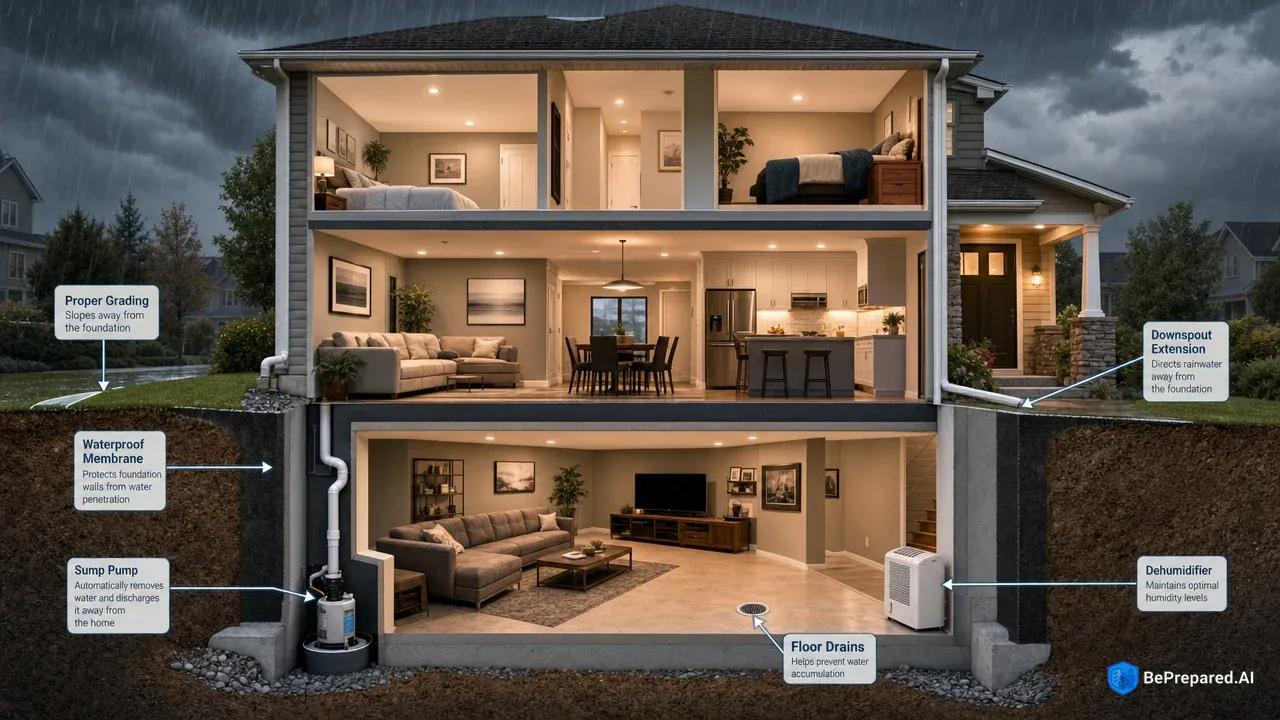
How to Waterproof Your Basement Before Flood Season
What to fix below grade before the rainy season, and how to weigh the cost of prevention against a repair.
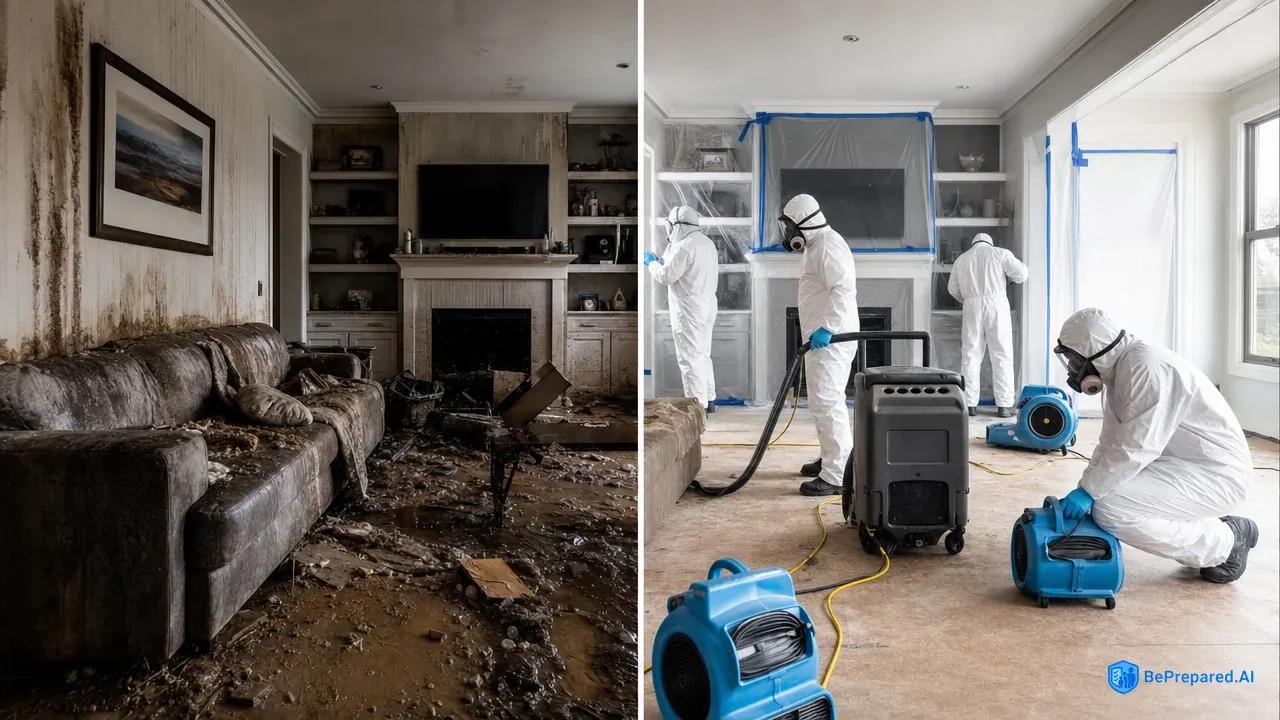
Flood Damage Cleanup: DIY vs Professional Restoration
Which cleanup jobs a household can handle safely, and when contamination or hidden moisture calls for a professional.
Preparedness for every season, every risk
Flooding is one of many risks your address might face. BeAware monitors all of them, BeReady builds the plan, BeEquipped ships the kit, and BeAdvised puts you in a room with an expert when you want one.
See all BePrepared solutionsOr try it first: BeAware and BeReady free for 7 days, no credit card.Start my free 7-day trial