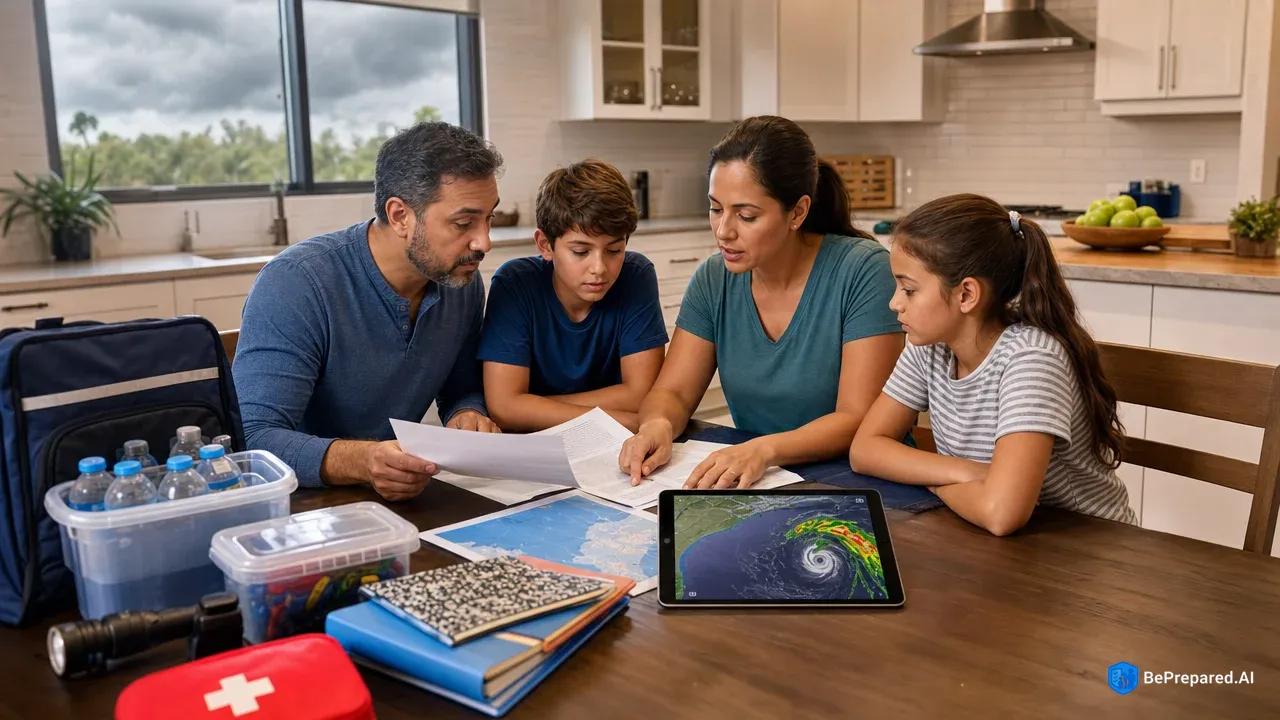
Building Your Homeschool Hurricane Emergency Plan
The National Weather Service issues its first hurricane watch of the season, and you glance at your homeschool room—shelves lined with carefully curated books, portfolios documenting months of student work, science equipment for next week's experiments, and your laptop containing years of lesson plans. While your neighbors worry about patio furniture and outdoor decorations, you face a different challenge: protecting not just your home, but your children's entire educational infrastructure.
Homeschool families operate in a distinctive space when hurricanes threaten. Unlike traditional school families who can rely on district-level emergency protocols and institutional continuity, homeschooling parents must simultaneously act as disaster coordinators, educators, and facility managers. Your home serves triple duty as living space, learning environment, and educational archive. This complexity demands a more nuanced emergency plan than standard family preparedness guides typically address.
Creating Your Foundation Emergency Plan
FEMA recommends creating a family emergency plan that includes evacuation routes and meeting places . Homeschoolers need to layer additional considerations onto this foundation. Your emergency plan must account for educational continuity alongside physical safety.
Start by designating a "command center" where all family members know to find critical information. This might be a specific drawer, binder, or digital folder. Within this system, document your primary and secondary evacuation routes. Consider not just speed but also proximity to potential temporary learning spaces. Libraries, community centers, and fellow homeschool families along your route could become crucial resources if you're displaced for weeks rather than days.
Hurricane-specific preparation requires different planning than other natural disasters . Unlike tornadoes that strike with little warning or earthquakes that happen without prediction, hurricanes give you precious days to prepare. Use this window strategically.
Your emergency contacts list should extend beyond immediate family. Include your homeschool co-op coordinator, curriculum suppliers with whom you have ongoing relationships, and other homeschool families who might serve as mutual aid partners. Document these contacts in multiple formats—printed copies in waterproof sleeves, saved in your phone, and backed up to cloud storage.
Assemble an emergency supply kit with at least 3 days of food and water for each family member . For homeschool families, this kit needs educational supplements. Pack basic learning materials that can function without power or internet access. Include books, notebooks, pencils, and simple manipulatives that keep children engaged during extended shelter periods.
The sheltering-versus-evacuation decision carries educational implications that most families don't face. If you shelter in place, can you maintain some semblance of learning routine in your designated safe room? If you evacuate, which educational materials make the cut for your limited vehicle space?
Think through both scenarios now, while you have time to make thoughtful decisions rather than panicked choices as winds begin to howl. Consider creating two separate "educational go-bags"—one optimized for sheltering at home with power outages, another streamlined for evacuation with minimal space. This dual-track planning acknowledges that you won't know which scenario you're facing until the storm's path becomes clear, often just 48-72 hours before landfall.
Protecting Educational Materials and Resources
Walk into your homeschool space and conduct a triage exercise. Not everything can be saved if you must evacuate quickly. Not everything deserves equal protection if you're preparing to shelter in place. This brutal prioritization feels uncomfortable—you've invested money, time, and careful selection into building your educational resources—but it's essential for effective disaster preparedness.
Start with your most irreplaceable items: student work portfolios, assessment records, attendance logs, and any documentation required for your state's homeschool compliance. The CDC recommends keeping important family documents in waterproof containers . Educational records are considered essential family documents for FEMA assistance .
These records prove your children's educational progress. They may be required when re-establishing your homeschool program after displacement. Purchase a portable, waterproof document safe—the kind designed to survive both water and fire. These safes are available at office supply stores and online retailers in various sizes to fit different document volumes.
Store originals of birth certificates, immunization records, previous year's portfolios, and your homeschool registration or notification documents in this safe. Keep it in an easily accessible location, not buried in a closet where you'll waste precious evacuation time searching.
Create a digital backup system for everything else. Photograph or scan current year portfolios, lesson plans, reading lists, and curriculum guides. Save these to at least two cloud storage services—redundancy matters when you're protecting years of educational investment. Google Drive, Dropbox, and iCloud all offer free storage tiers sufficient for document backup.
Take this digital preservation a step further by photographing your physical homeschool space from multiple angles. These images serve dual purposes: they document your educational setup for insurance claims if disaster strikes, and they provide a visual reference for rebuilding your learning environment in a new location if you face extended displacement.
For physical curriculum materials, implement a three-tier prioritization system. Tier One items are irreplaceable or prohibitively expensive to replace: heirloom books, out-of-print resources, specialized equipment, or materials with sentimental value. These should be stored on higher shelves (protecting against flooding) and away from windows (protecting against wind-driven rain). Consider purchasing large, clear plastic bins with tight-sealing lids for these priority materials.
Tier Two items are valuable but replaceable with effort: current textbooks, library books you've checked out, consumable workbooks with completed pages. These need basic protection but don't warrant the same level of security.
Tier Three items are easily replaceable: blank workbooks, art supplies, general craft materials. These receive standard storage and won't be prioritized during emergency preparation.
Develop your grab-and-go strategy for evacuation scenarios. Pack a "72-hour learning kit" that lives in a designated spot and can be thrown in your vehicle within minutes. This kit isn't about maintaining your full curriculum—it's about providing educational structure during acute crisis.
Include a few beloved read-aloud books, basic supplies (paper, pencils, crayons), a deck of math flashcards, and perhaps a travel-sized game that reinforces academic skills. Add a printed copy of your current lesson plans for the next two weeks, even if you don't have all the materials to execute them. These plans provide a roadmap for adapting your curriculum to whatever resources you find available in evacuation shelters or temporary housing.
Pros and Cons of Different Storage Approaches
Waterproof Document Safes
- Pros: Protects against water and fire damage; portable for evacuation; keeps documents organized in one location
- Cons: Limited capacity requires prioritization; represents additional expense; can be heavy when fully loaded
Cloud Storage Backup
- Pros: Accessible from anywhere with internet; automatic backup options available; typically free for basic storage needs; survives physical home destruction
- Cons: Requires internet access to retrieve; dependent on third-party service reliability; initial scanning time investment
Physical Off-Site Storage
- Pros: Completely independent of digital infrastructure; provides physical backup if primary location destroyed; no ongoing subscription costs
- Cons: Requires coordination with another household; may not be quickly accessible during evacuation; needs regular updating to remain current
- Critical Decision Points & Milestones
- Key assessment checkpoints for transitioning between phases, including safety clearances, resource availability thresholds, and learning continuity benchmarks
- Resource Requirements & Support Networks
- Essential materials, technology needs, community partnerships, and emergency funding sources required for each recovery phase
Hurricane-Specific Shelter and Evacuation Decisions
Storm surge represents the most lethal aspect of hurricane hazards. Understanding your property's relationship to this threat fundamentally shapes your emergency response. Storm surge can reach heights well over 20 feet according to NOAA . This transforms familiar coastal neighborhoods into deadly inland seas within hours. Unlike rising floodwaters that give some warning, storm surge arrives with the speed and force of a wall of water, pushing ahead of the hurricane's eyewall and trapping anyone who delayed evacuation.
Know your evacuation zone and evacuation routes - when a hurricane watch is issued, you may be asked to leave . Determine your evacuation zone immediately—not when a hurricane threatens, but today. Visit your local emergency management website and input your address into their evacuation zone mapping tool.
Most coastal counties use color-coded or letter-designated zones (Zone A, Zone B, etc.) that correspond to different storm surge risk levels. Category 1 hurricanes might trigger evacuation orders for Zone A only, while Category 3 storms could require evacuation from Zones A through C. Print this information and include it in your emergency command center. Understanding your zone transforms evacuation from a panicked last-minute decision into a planned response triggered by specific, objective criteria.
For homeschool families in evacuation zones, your decision-making timeline compresses significantly. Traditional school families might leave immediately after schools close, typically 24-48 hours before anticipated landfall. You lack this institutional trigger, which means you need to establish your own departure criteria.
Consider implementing a "when-then" protocol: "When our zone receives a mandatory evacuation order, then we depart within 6 hours." This predetermined decision removes the dangerous temptation to "wait and see" or "ride it out." Your children's education can resume anywhere; their lives cannot.
If you're located outside evacuation zones, the National Weather Service recommends identifying sturdy buildings close to home for non-evacuation zone residents . Evaluate your home's construction honestly. Newer homes built to modern hurricane codes offer significantly better protection than older structures. Mobile homes, regardless of age, provide inadequate hurricane shelter and should be evacuated even outside official evacuation zones.
If your homeschool operates in a structure that's not suitable for sheltering, identify alternatives now. Could you shelter with nearby family in a more robust home? Does your homeschool co-op meet in a building that might serve as a group shelter? Is there a designated community hurricane shelter within reasonable distance?
The sheltering decision carries educational implications that extend beyond immediate safety. If you shelter in place, you'll likely spend 12-24 hours in an interior room or closet as the storm passes. This creates a challenging environment for maintaining any learning routine, but having activities available can help manage fear and boredom.
If you evacuate to a public shelter, you might spend several days in a crowded gymnasium or community center, surrounded by stressed families and limited privacy. Neither scenario resembles your normal homeschool environment, yet both offer opportunities for modified learning if you've prepared appropriately.
Coordinate with your local homeschool network before hurricane season begins, not after a storm threatens. Identify families along potential evacuation routes who might host you temporarily, and offer reciprocal hosting for families evacuating from more vulnerable areas. This mutual aid network provides alternatives to crowded public shelters and helps preserve some educational continuity.
One homeschool family evacuating to another homeschool family's home means sharing curriculum resources, maintaining familiar routines, and providing social interaction between children facing the same disruption. These connections transform evacuation from an isolating experience into a community response.
Establish a communication protocol within your homeschool network that accounts for likely power and cell service disruptions. Designate an out-of-state contact person who can serve as an information hub—someone beyond the hurricane's impact zone who can relay messages between families when local communication infrastructure fails.
Share this contact's information with all families in your network, and ensure they're willing to serve this role. Test this system before hurricane season by having all families check in with your designated contact during a specific week, identifying any gaps in the communication chain before you need it during an actual emergency.
Educational Continuity During and After the Storm
The hours during a hurricane test every family's resilience. Homeschool families face the additional challenge of maintaining their role as educators while navigating their own fear and stress. Your children look to you not just for physical safety but for the psychological security that familiar routines provide. Research in child psychology suggests that maintaining elements of routine during disasters can help children process stress and maintain emotional stability.
During the acute phase—those intense hours when the hurricane makes landfall and passes over your location—don't attempt to maintain normal academic work. Instead, pivot to storm-appropriate activities that blend education with distraction. Reading aloud by flashlight transforms into an adventure rather than a frightening wait in the dark.
Simple math games played with dice or cards keep minds occupied without requiring the focus that formal lessons demand. Older students might document the experience through journaling, creating a primary source historical record while processing their emotions. These aren't compromises to your educational standards; they're age-appropriate responses to extraordinary circumstances.
In evacuation shelters or temporary housing, the challenge shifts from acute crisis management to sustained adaptation. You're no longer dealing with hours of intense storm activity but potentially weeks of displacement from your normal learning environment. This is where advance planning pays dividends.
If you've packed your 72-hour learning kit, you have immediate resources for establishing routine. Designate specific times for educational activities, even if these sessions are shorter or less formal than your usual schedule. A two-hour morning learning block in a shelter provides structure that benefits both children and parents, creating predictable patterns in an unpredictable situation.
Adapt your curriculum to available resources rather than lamenting what you can't access. Hands-on learning opportunities emerge naturally during disaster recovery. Younger children can practice counting and sorting while organizing relief supplies. Older students can study meteorology by tracking the storm's actual path versus predictions. Teenagers can engage in service learning by volunteering with recovery efforts.
These aren't inferior substitutes for "real" education; they're authentic learning experiences that most homeschoolers would deliberately seek under normal circumstances. The disaster context provides intrinsic motivation and real-world relevance that transforms abstract concepts into concrete understanding.
Maintain flexibility about what constitutes educational progress during extended disruptions. If you're displaced for two weeks, you won't maintain your normal pace through your curriculum, and that's acceptable. Most homeschool families operate with flexibility that allows catching up later or extending the school year if needed.
This advantage over traditional schools—your ability to adjust timelines and modify expectations based on family circumstances—becomes especially valuable during disaster recovery. Grant yourself and your children grace for reduced productivity while maintaining some structure to prevent complete educational shutdown.
Connect with other displaced homeschool families if you're in shelters or temporary housing. Children benefit enormously from peer interaction during stressful times. Coordinating with other homeschool families allows sharing resources and teaching responsibilities. Perhaps one parent leads a morning read-aloud session for multiple families while another organizes afternoon nature observation activities.
This cooperative approach reduces individual burden while enriching the educational experience for all children involved. It also models community resilience and mutual aid—lessons far more valuable than any single curriculum unit.
Post-Hurricane Recovery and Learning Space Restoration
The storm has passed, evacuation orders lift, and you return home to assess the damage. What you find in the first hours after a hurricane determines your recovery trajectory for the coming weeks or months. Approach this assessment methodically, balancing the emotional weight of seeing your home damaged with the practical necessity of documentation and rapid response.
Before entering your home, photograph exterior damage from multiple angles. Capture roof damage, broken windows, fallen trees, and flooding evidence. These images form the foundation of insurance claims and FEMA disaster assistance applications. Proper documentation is essential for FEMA disaster assistance claims . The quality of your initial documentation directly impacts your recovery funding.
Once inside, photograph each room before touching anything. Yes, you want to immediately start cleaning up, but those minutes spent documenting the damage state will save you months of disputes with insurance adjusters.
Focus first on your homeschool space, both for documentation and for time-sensitive preservation. Water damage represents your most urgent threat. The EPA states mold growth can be prevented by cleaning up and drying out buildings within 24-48 hours . This narrow window demands quick decision-making about what can be saved versus what must be discarded.
Books that have been soaked through typically cannot be salvaged—the paper warps, bindings fail, and mold begins growing within the pages even if surface drying appears successful. This loss hurts, especially for beloved read-alouds or expensive curriculum materials, but attempting to save unsalvageable books wastes precious time and creates ongoing mold exposure risks.
For materials that are damp but not soaked, implement aggressive drying protocols immediately. Remove books from shelves and stand them upright with pages fanned open. Point fans directly at affected materials, and use dehumidifiers if power is restored or if you have generator capacity. Replace desiccant packets every few hours if you're using them in storage containers.
Speed matters more than perfection—a book dried quickly with some warping is better than a book that develops mold while you wait for ideal drying conditions.
Create three sorting zones in your homeschool space: Keep, Uncertain, and Discard. Items that are clearly undamaged or successfully dried go in the Keep zone. Items that are obviously destroyed—soaked textbooks, mold-covered materials, broken equipment—go directly to Discard. Everything in between goes to Uncertain for later evaluation when you have more time and mental energy.
This triage system prevents paralysis and keeps recovery moving forward. Photograph items in the Discard zone before removing them from your property—insurance claims require proof of loss.
Remove and discard drywall and insulation that has been contaminated with sewage or flood waters . This applies to your homeschool space just as it does to the rest of your home. Materials that have been exposed to contaminated water pose health risks that cannot be adequately cleaned. Don't attempt to salvage items from areas with sewage contamination.
Document everything for FEMA assistance applications. The Individual and Households Program provides grants for disaster-related expenses, including replacement of essential educational materials . Educational records and homeschool supplies qualify as essential household items, but you must prove their loss.
Create a detailed inventory listing curriculum materials, books, educational equipment, and supplies that were damaged or destroyed. Include purchase prices when possible, or reasonable replacement cost estimates when you don't have receipts. This inventory process feels tedious when you're exhausted and overwhelmed, but it directly translates to recovery funding that helps rebuild your homeschool program.
You must register for FEMA assistance within 60 days of the disaster declaration . Don't delay this registration waiting for complete documentation. Register as soon as possible, then submit additional documentation as you compile it. Missing the 60-day window means forfeiting assistance regardless of your losses.
Begin restoration by addressing structural issues first—roof repairs, window replacement, electrical and plumbing restoration. Your homeschool cannot function in a home that isn't safe and habitable. Once basic systems are restored, turn attention to rebuilding your educational space.
This is an opportunity to implement lessons learned: perhaps installing higher shelving to protect materials from future flooding, choosing more water-resistant storage containers, or creating a more easily-evacuated organizational system. Don't simply recreate what existed before; build back with greater resilience.
Reach out to your homeschool network and broader community for curriculum replacement assistance. Many homeschool families have outgrown materials they're willing to donate. National homeschool organizations often coordinate disaster relief specifically for affected homeschool families. Local libraries may offer temporary extended borrowing privileges for families recovering from disasters.
Curriculum publishers sometimes provide replacement copies at reduced cost or free for disaster victims—contact them directly to ask about available assistance programs. These resources won't fully replace your losses, but they can bridge the gap while you work through insurance claims and FEMA assistance processes.
Building Long-Term Resilience in Your Homeschool Program
Hurricane recovery reveals vulnerabilities in systems you thought were robust. The months following a storm offer the best opportunity to build genuine resilience into your homeschool program. Resilience isn't about preventing all disruption—that's impossible when facing forces as powerful as hurricanes. Instead, resilience means creating systems flexible enough to bend without breaking, redundant enough to withstand partial failure, and adaptable enough to function under imperfect conditions.
Develop Curriculum Flexibility
Multi-modal learning approaches: Build your curriculum around concepts that can be taught through multiple methods. If you lose physical materials, you can pivot to discussion-based or hands-on learning without losing educational momentum.
Digital and physical redundancy: Maintain both digital copies and physical materials for core curriculum. This ensures you can continue teaching if either format becomes unavailable.
Unit-based rather than date-based planning: Structure your year around completing units rather than adhering to rigid weekly schedules. This allows compression or expansion as circumstances demand.
Emergency curriculum kit: Maintain a separate set of basic educational materials stored away from your main homeschool space. Perhaps keep these at a relative's house or in a storage unit. These materials could restart your program if you lost everything in your home.
Create Redundant Resource Systems
Cloud storage for all digital materials: Use multiple cloud services, not just one. Update backups monthly at minimum. This protects against both physical disaster and potential service disruptions from any single provider.
Physical backup location: Store copies of essential documents and previous year portfolios at a separate physical location outside your home. A relative's house, a safety deposit box, or a trusted friend's home all work for this purpose.
Diversified curriculum sources: Avoid depending entirely on any single curriculum provider or resource type. If your primary materials are destroyed, you should be able to continue with alternative resources without complete educational disruption.
Financial reserves: Maintain an emergency fund specifically for educational expenses, separate from general household emergency funds. This allows rapid curriculum replacement without waiting for insurance or FEMA reimbursement.
Strengthen Community Networks
Formalize mutual aid agreements: Move beyond casual friendships to explicit agreements with other homeschool families about disaster support. Clarify who can host whom, what resources can be shared, and how communication will be maintained.
Geographic distribution: Build relationships with homeschool families in different locations, not just your immediate area. This creates evacuation hosting options at various distances.
Resource sharing protocols: Establish systems for borrowing curriculum materials during recovery, sharing teaching responsibilities during displacement, and pooling knowledge about available disaster assistance.
Regular network communication: Don't wait for disasters to activate these networks. Maintain regular contact through co-ops, park days, or online groups so the relationships are strong when you need them. Studies of disaster response consistently show that pre-existing social networks provide more effective support than ad-hoc connections formed during crisis.
Implement Regular Practice and Updates
Regular emergency plan practice improves family response effectiveness . This transforms theoretical plans into practiced responses that function under stress. Schedule quarterly emergency drills that specifically address your homeschool setup.
Practice your evacuation procedure including loading your educational go-bag and priority materials. Time how long this process takes—you'll likely discover it takes longer than expected, informing more realistic planning. Review and update your emergency contacts list each season, confirming that phone numbers remain current and that designated out-of-state contacts still agree to serve that role.
Seasonal plan reviews: Update your emergency plan at the beginning of each hurricane season (June 1). Incorporate lessons learned and account for changes in your homeschool program.
Inventory updates: Photograph your homeschool space quarterly. This creates current documentation for insurance purposes and helps you remember what materials you actually have.
Drill variations: Practice different scenarios—sheltering in place, rapid evacuation, extended displacement. This helps your family develop flexible response capabilities rather than single-scenario muscle memory.
Post-drill debriefs: After each practice run, discuss what worked well and what created confusion or difficulty. Then revise your plan to address identified weaknesses.
Integrate Preparedness into Curriculum
Transform disaster preparedness from an additional burden into an educational opportunity by making it part of your regular curriculum. Older students can study meteorology by tracking hurricane formation and prediction, learning why forecasts include "cones of uncertainty" and how storm surge modeling works.
Younger children can practice map skills by plotting evacuation routes and identifying evacuation zones. Math lessons can incorporate disaster statistics, supply calculations, and budget planning for emergency kits. This integration serves double duty—it advances academic learning while simultaneously building family preparedness knowledge.
Evaluating Your Preparedness Progress
Strong Preparedness Indicators:
- All family members can locate and explain the emergency command center
- Educational go-bags are packed and accessible within 5 minutes
- Digital backups are current within the last 30 days
- At least three homeschool families in your network have confirmed mutual aid agreements
- Quarterly drills reveal decreasing preparation time and smoother execution
Preparedness Gaps to Address:
- Family members uncertain about evacuation triggers or routes
- Educational materials lack prioritization or protection systems
- Digital backups are outdated or stored in only one location
- No established relationships with homeschool families outside immediate area
- Emergency plans haven't been reviewed or practiced in over six months
Preparedness is not a destination you reach but an ongoing process of learning, adapting, and improving. Each hurricane season teaches new lessons. Each near-miss reveals overlooked vulnerabilities. Each year your homeschool evolves in ways that require updated planning.
Embrace this continuous improvement mindset rather than seeking perfect preparation. Your goal isn't to create an invulnerable homeschool program—that's impossible. Your goal is to build a resilient system that can withstand disruption, adapt to changed circumstances, and ultimately continue providing your children with the education you've chosen for them, regardless of what storms may come.
Connect with local homeschool networks in your area to build mutual support systems for emergency situations. These relationships provide practical assistance during disasters while enriching your homeschool experience year-round through shared resources, cooperative learning opportunities, and the collective wisdom of experienced homeschool families who understand your unique educational approach.