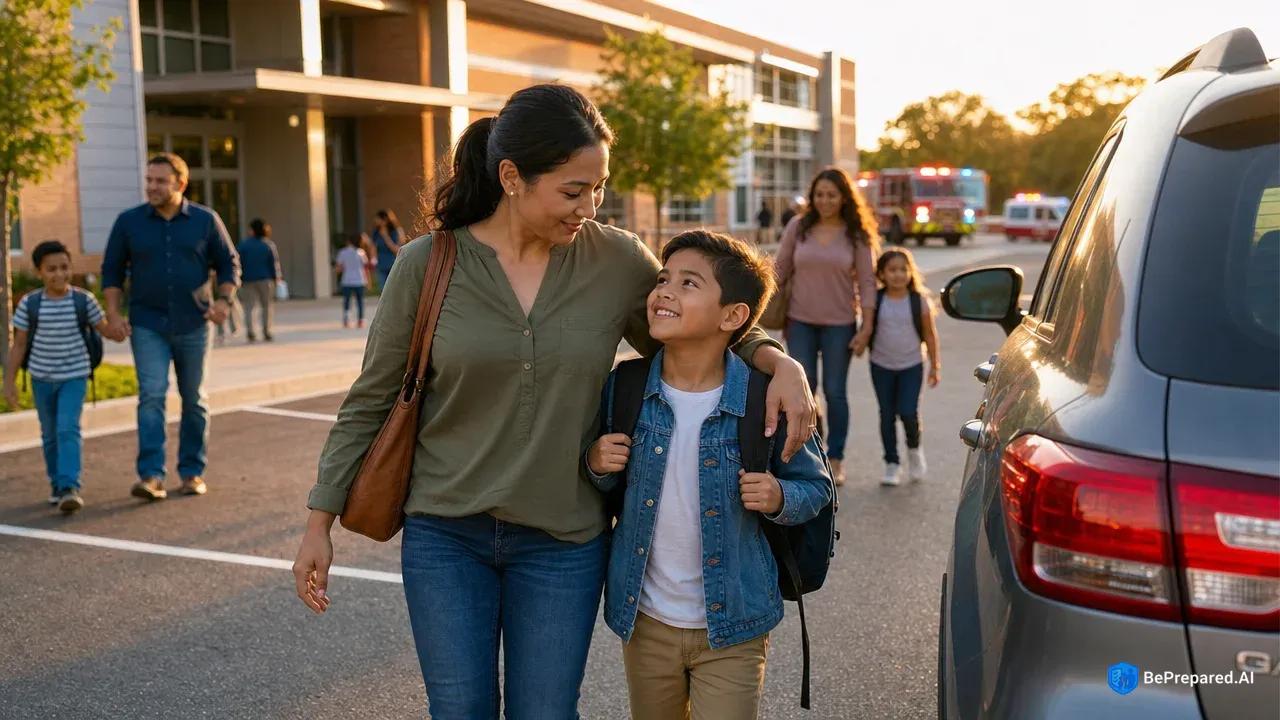
When Disaster Strikes: Your Child's Safety Comes First
Picture this: You're at work when your phone buzzes with an emergency alert. There's a wildfire burning five miles from your child's school, and the winds are picking up. Your heart races as you grab your keys, but then you pause—what exactly is your plan? Where do you go? Who can pick up your child if you can't get there in time?
Every parent's worst nightmare involves their child being in danger while they're not there to protect them. When wildfires threaten communities, these fears become real, and they happen fast. Wildfire evacuations can happen with as little as 15 minutes notice . That's barely enough time to grab your keys and get in the car, let alone figure out a plan on the fly.
Schools are required by law to have emergency plans for reuniting children with families, and they drill these procedures regularly . But here's the thing: having your own family plan is just as important. During wildfire 'SET' conditions—that middle phase between being ready and needing to evacuate immediately—parents should consider early pickup as situations can deteriorate rapidly . The difference between a calm, organized pickup and a panicked scramble often comes down to preparation you do right now, on an ordinary day when the sky is clear and the threat feels distant.
This isn't about living in fear. It's about building confidence through preparation, so when your phone does buzz with that alert, you know exactly what to do. You've thought through the scenarios, set up the systems, and practiced the plan. That preparation transforms panic into purposeful action.
The good news? You don't need to do everything at once. Start with one small step this week. Each action you take makes your family safer and helps you feel more in control.
- School Emergency Alert
- When an emergency occurs, your school will activate its communication system with alert notifications
- Multiple Communication Channels
- Schools use phone calls, text messages, and website updates to reach all families quickly
- Check All Your Devices
- Monitor your phone, email, and the school's official website for emergency updates and instructions
- DO NOT Go to School
- Never drive to the school building during an emergency - this blocks emergency vehicles and creates chaos
- Go to Designated Pickup Site
- Follow official instructions to the specified safe location where you can reunite with your child
- Stay Calm and Follow Directions
- Trust the emergency plan - school staff are trained to keep children safe until parents arrive at the correct location
Know Your School's Emergency Procedures
Before we dive into creating your personal plan, you need to understand what your school already has in place. Schools are required by law to have emergency plans for reuniting children with families, and they drill these procedures regularly . However, many parents don't actually know what these procedures are until an emergency happens—and that's exactly when you don't want to be learning them for the first time.
Here's what you need to find out from your child's school:
Communication Methods
- How will the school notify you during an emergency? (Text alerts, phone calls, email, social media)
- What's the backup method if primary systems fail?
- Where can you find official updates? (School website, district hotline, local emergency services)
Cell towers may be damaged during wildfires , which means your usual way of getting information might not work. Knowing all the ways the school can reach you gives you backup options when technology fails.
Evacuation and Relocation Plans
- Where will students be taken if the school building must be evacuated?
- Does the school have multiple alternate locations depending on the type of emergency?
- How will you be notified of the relocation site?
Pickup Procedures
- Where is the designated family reunification location?
- What identification will you need to show?
- What happens if roads to the school are blocked?
Critical Rule: Never Go Directly to the School Building
During wildfire emergencies, schools may evacuate to alternate locations, and parents should never go directly to the school building . This is counterintuitive—every instinct tells you to rush to where your child normally is—but showing up at an evacuated school wastes precious time and can actually interfere with emergency operations. Emergency vehicles need clear access, and staff members may have already left with students.
Instead, wait for official communication about where students have been taken. If you can't reach the school, contact your local emergency services or check the district's emergency information line. Many districts now use mass notification systems that will text or call you with relocation information automatically.
Take action this week: Call your school's main office and ask for their emergency procedures document. Many schools have this information on their websites, but it's often buried in the parent handbook. Print it out, read it with your partner or co-parent, and keep a copy in your car and at home. That's it—one phone call or one website visit. You've already made your family safer.
Set Up Your Authorized Pickup List
Here's a scenario that plays out more often than you'd think: A wildfire is approaching, and a parent is stuck on the other side of a road closure, unable to reach their child's school. They call their sister who lives closer, asking her to pick up their child. She rushes to the school, but there's a problem—she's not on the authorized pickup list. Schools must verify the identity of adults picking up children during emergencies , and without proper authorization, even close family members may be turned away.
This isn't red tape for its own sake. These verification procedures protect your child from being released to the wrong person during the chaos of an emergency. But they only work if you've set them up in advance.
Step 1: Review Your Current Authorized Pickup List
Start by pulling out the paperwork you filled out at the beginning of the school year. Who did you list as authorized to pick up your child? Is that list still accurate? People move, relationships change, and someone who made sense in September might not be your best option now. Parents should bring photo ID and know who else is authorized for pickup .
Step 2: Think Strategically About Backup People
Have a backup person authorized to pick up your children in case you cannot reach the school . Choose authorized pickup people who live or work in different areas around the school. If you and your partner both commute in the same direction, consider adding a neighbor, grandparent, or close friend who approaches from a different route.
Primary roads may be blocked during wildfire emergencies . Having pickup options from multiple directions dramatically increases the chances that someone can reach your child quickly. Think about it like this: if the main highway gets closed, who could still get to your child's school using back roads or side streets?
Step 3: Have the Conversation
This is the step many parents skip, and it's arguably the most important. Actually talk to each person you've listed. Don't just add their name to a form—have a real conversation. Explain that you've authorized them to pick up your child in an emergency. Make sure they're comfortable with this responsibility and understand what it might entail.
Give them key information: your child's teacher's name, classroom location, and any special medical needs or fears your child might have. If your child has asthma, for example, your backup person needs to know where the inhaler is and how to use it. If your child gets scared easily, they need to know how to comfort them.
Step 4: Provide Documentation
Give each authorized person a copy of your child's emergency information, including medical conditions, medications, allergies, and your contact information. Some parents create a small laminated card that authorized adults can keep in their wallets. Include a recent photo of your child—in a chaotic emergency situation, this helps, especially if the authorized person doesn't see your child regularly.
Step 5: Update Annually (Minimum)
Set a reminder on your phone for the start of each school year to review and update your authorized pickup list. But also update it whenever something significant changes: someone moves, changes jobs, or is no longer available. Call the school office to make changes—don't wait for the annual paperwork cycle.
Keep a copy of your current authorized pickup list in your phone (take a photo of it), in your car, and at home. In an emergency, you might need to quickly remind yourself who's on the list so you can coordinate pickup efforts.
Create Your Family Communication Plan
Sarah learned about the importance of backup communication the hard way. When a wildfire threatened her community last October, she relied on receiving text alerts from her daughter's school. But the fire moved so quickly that cell towers were overwhelmed, and her texts weren't going through. For forty-five agonizing minutes, she had no idea whether the school had evacuated or where her daughter was. She eventually learned that the school had posted updates on their Facebook page and sent emails—neither of which she'd been checking because she was focused on her phone.
Communication during disasters is notoriously unreliable. Networks get overwhelmed, power goes out, and systems fail exactly when you need them most. That's why your family communication plan needs layers—multiple ways to send and receive information, with clear fallback options when your primary method doesn't work.
Start by signing up for every notification system your school offers. Yes, even the ones that seem repetitive. Text alerts, email notifications, phone calls, social media updates—register for all of them. Air quality during wildfires can be hazardous to children, and schools may close or relocate with little notice . You want every possible way to receive that information quickly.
Next, establish a communication hierarchy for your family. Who calls whom, and in what order? Many emergency preparedness experts recommend designating an out-of-area contact—someone who lives far enough away that they won't be affected by the same disaster. During local emergencies, it's often easier to call long-distance than to reach someone in the same area. This person becomes your family's information hub. If you can't reach your partner directly, you both call your out-of-area contact, who can relay messages between you.
Write down all critical phone numbers and keep them somewhere accessible when technology fails. Yes, everyone's numbers are in your phone, but what happens if your phone dies or gets lost? Keep a printed list in your car's glove compartment and in your wallet. Include your child's school main line, the district emergency line, your authorized pickup people, your out-of-area contact, and local emergency services.
Practice your communication plan during calm times. Set up a family drill where you simulate an emergency and go through your communication procedures. Can you actually remember your out-of-area contact's number without looking at your phone? Do your kids know what to do if they can't reach you directly? These practice runs reveal gaps in your plan before they become dangerous problems.
Make sure your children know the plan too. Age-appropriate conversations about what happens during emergencies help kids feel more secure, not more scared. They should know that if there's an emergency at school, trusted adults will take care of them, and you have a plan to reunite quickly. Older children should know how to reach your out-of-area contact and understand that if they can't reach you, that's okay—they should stay with school staff and trust that you're following the plan to get to them.
- READY (Green)
- Create and practice your family evacuation plan - know your escape routes and meeting points
- Know Your Zone
- Sign up for local emergency alerts and learn your evacuation zone before fire season starts
- Practice Makes Perfect
- Run through your evacuation plan with your family at least twice a year
Wildfire-Specific Pickup Strategies
Wildfires demand a different mindset than other emergencies. Unlike hurricanes that give days of warning or even earthquakes that happen and then stop, wildfires are dynamic threats that can change minute by minute. The fire that's five miles away and "contained" at breakfast can jump containment lines and race toward your community by lunch, especially when wind conditions shift.
Understanding the Ready, Set, Go system used by fire officials helps you make better decisions about when to pick up your child . During the 'SET' phase, evacuation hasn't been ordered yet, but conditions are deteriorating and you should be prepared to leave at any moment. During wildfire 'SET' conditions—that middle phase between being ready and needing to evacuate immediately—parents should consider early pickup as situations can deteriorate rapidly . This is when many parents face a difficult decision: Do I pick up my child now, potentially overreacting, or do I wait for official word and risk being caught in an evacuation rush?
Consider Early Pickup When:
The answer often depends on several factors you should monitor actively during fire season. Air quality is one of the most important. Air quality during wildfires can be hazardous to children, and schools may close or relocate with little notice . Check your local Air Quality Index (AQI) throughout the day using apps or websites like AirNow.gov. When the AQI reaches unhealthy levels, children may be exposed to harmful particulate matter even if they're indoors.
Fire proximity and behavior matter enormously. A fire five miles away moving away from you is very different from a fire five miles away moving toward you at three miles per hour. Local news and fire authority social media accounts provide updates on fire behavior, containment status, and wind forecasts. If you see reports of rapid fire spread, spot fires, or changing wind conditions, that's information to act on.
Visibility is another critical factor. Visibility can drop to near zero during wildfire events, making travel to schools extremely dangerous . If you're having trouble seeing clearly while driving, imagine how much harder it will be in an hour when more smoke rolls in. When visibility starts dropping, that's your signal to pick up your child before conditions worsen.
What to Have Ready:
Keep N95 or P100 masks in your car specifically for wildfire situations . Regular cloth masks or surgical masks may not filter the tiny particulate matter that makes wildfire smoke so dangerous. You need masks rated N95 or higher. Have child-sized masks if possible—adult masks don't seal properly on small faces, reducing their effectiveness. When you pick up your child during smoky conditions, put masks on both of you before you leave your car.
Your vehicle should be well-fueled during fire season. Wildfires can force road closures that require long detours, and gas stations may close or run out of fuel during evacuations. Keep emergency supplies in your car year-round: water bottles, snacks, a first aid kit, phone chargers, flashlights, and a battery-powered radio. If you're picking up your child during an emergency, you might not be going straight home.
Plan Multiple Routes:
Drive different routes to your child's school during non-emergency times, noting landmarks and alternative paths. When a wildfire threatens, main roads may be closed or gridlocked with evacuation traffic. Primary roads may be blocked during wildfire emergencies . Knowing back roads and alternate routes gives you options. Take photos of your route maps and keep them in your car—if your phone dies or loses signal, you'll still have navigation information.
Stay connected to local emergency services through multiple channels. Follow your local fire department, sheriff's office, and emergency services on social media. Sign up for emergency alert systems like Nixle or your county's emergency notification system. Many fire departments now offer apps that show real-time fire perimeters and evacuation zones. The more information sources you have, the better you can assess whether early pickup makes sense.
Trust your instincts. Emergency officials do their best to provide timely evacuation orders, but fires can move faster than communication systems. If conditions look dangerous, if ash is falling, if the sky is dark orange at midday, or if you simply feel that something is very wrong—pick up your child. You can never be wrong for erring on the side of safety.
Practice and Prepare: Making It Second Nature
Knowledge without practice is just theory. You can read every emergency preparedness article ever written, but if you haven't actually walked through your procedures, you'll still fumble when stress hits. Regular practice helps families respond quickly and calmly during actual emergencies , transforming abstract plans into muscle memory and confident action.
Start each school year with a family meeting dedicated to emergency procedures. Sit down together—parents, kids, and even older siblings who might be responsible for younger ones—and review the plan. Where will you reunite if the school evacuates? Who are the authorized pickup people? What's the out-of-area contact's phone number? Make this conversation age-appropriate but honest. Children handle emergencies better when they understand what to expect and what their role is.
Update your contact information with the school every fall, even if nothing has changed. This simple act forces you to review your authorized pickup list, verify that phone numbers are current, and confirm that emergency contacts are still appropriate. Schools often send home emergency information forms in the first weeks of school—don't just sign and return them without reading. Actually look at what's on file and make sure it's accurate.
Your car should function as a mobile emergency kit during fire season. Beyond the supplies mentioned earlier, keep a paper copy of your school's emergency procedures and your family communication plan in the glove compartment. Include a list of authorized pickup people with their phone numbers. If you're in a panic, having this information literally in your hands can help you think more clearly.
Know the alternate pickup locations your school might use. Drive by these locations during normal times so you know exactly where they are and how to get there. Some schools evacuate to community centers, parks, or other schools. If you've never been to these places, finding them during an emergency while roads are closing and smoke is reducing visibility becomes much harder.
Stay informed about changes to local emergency procedures. Attend school emergency preparedness nights if your district offers them. Follow your local fire department's social media for updates about fire season conditions and preparedness tips specific to your area. Join neighborhood social media groups where residents share real-time information during emergencies—these hyperlocal sources often provide faster updates than official channels.
Consider doing an annual family drill. Pick a weekend afternoon and run through your emergency pickup scenario. Call your out-of-area contact. Have your partner practice driving an alternate route to school. Review where you'd meet if you can't get to the school. This might feel silly when you're doing it, but that hour of practice could save crucial minutes when every second counts.
Building preparedness into your routine makes it sustainable. Rather than treating emergency planning as a once-and-done task, weave it into your regular life. When you're updating your calendar each fall, add emergency contact updates. When you're cleaning out your car seasonally, restock emergency supplies. When you're having family dinners, occasionally talk about "what if" scenarios in a matter-of-fact way. This normalization of preparedness thinking helps everyone in the family develop better emergency instincts.
You've Got This
The goal isn't to live in a state of constant anxiety about disasters. It's the opposite, actually. When you've prepared thoroughly, practiced regularly, and built systems you trust, you can relax. You know that if something happens, you're ready. That confidence—the knowledge that you've done everything reasonable to prepare—is itself a form of protection. It shields your family from the paralysis that unpreparedness creates and replaces it with the calm certainty that you can handle whatever comes.
Remember, you don't need to tackle everything at once. Pick one action from this article and do it this week. Maybe you call the school to ask about their emergency procedures. Maybe you update your authorized pickup list. Maybe you just have a conversation with your backup person about what they'd need to know to pick up your child.
Each small step builds on the last. Before you know it, you'll have a complete plan in place. You'll have practiced it with your family. You'll have the supplies you need in your car. And most importantly, you'll have peace of mind knowing that if disaster strikes, you're ready to protect what matters most.
Take a few minutes this week to review your school's emergency procedures and update your authorized pickup list—your future self will thank you.