Hurricane Preparedness Checklist + Kit List
Hurricanes are predictable if you start early. This is the calm, complete hurricane preparedness checklist we built for the families we work with: check your hurricane zone at your exact address, build a 72-hour hurricane survival pack that actually matches your household, and wire up local alerts so you never hear about the storm from the neighbor's TV. No doom language, no prepper theater. Just the steps that matter, in the order that matters.
Updated

Before you buy a single can of beans, find out what you are actually planning for. Your address determines your hurricane evacuation zone, your storm surge exposure, and your FEMA flood zone. A home three blocks from the coast has a very different plan than a home thirty miles inland, even in the same county.
BeAware pulls FEMA flood-zone overlays, NWS alert zones, and local evacuation zone maps for your exact address so you can see your real hurricane risk in one place, without reading five different government sites.
Check my address for hurricane riskBuild your hurricane survival pack
A hurricane survival pack is a 72-hour kit that keeps your household self-sufficient while utilities are out and help is on the way. Tap each item once it is in the storm kit; this device keeps your place in the list.
Hurricane Preparedness Checklist
BePrepared Solutions · bepreparedsolutions.co/hurricane-preparedness
Check off each item as you go.
0 of 21 checked
Water
Non-perishable food for your hurricane kit
Power and light
Medical, sanitation, and prescriptions
Communication and wireless emergency alerts
Documents and cash
Want the kit picked out for you, sized for your household, and matched to your hurricane zone? BeEquipped curates hurricane kits where every item is chosen for the storm you are actually facing, not a generic checklist.
Your 7-day hurricane timeline
Ready.gov notes that storm surge has historically been the leading cause of hurricane-related deaths in the United States, and that you may not have access to supplies for days or even weeks after a hurricane. This timeline puts the preparation in order, so it is done before the storm arrives.
72 hours before landfall
Fuel every vehicle, fully charge all devices, request early prescription refills, confirm your evacuation routes and your out-of-state contact, and review your family emergency plan with everyone in the household.
48 hours before landfall
Board windows if you are in a surge zone, secure outdoor furniture and loose objects, make a final grocery run for perishables, and fill ice chests so refrigerator food lasts longer into the outage.
24 hours before landfall
Fill bathtubs and sinks with water for flushing and cleaning, move valuables to upper floors, park your car on high ground, position the survival pack by your exit, and charge every backup battery one more time.
During the storm
Stay inside an interior room on the lowest non-flooded floor, keep WEA alerts and a NOAA weather radio on, never use candles for light, do not open the refrigerator unless you have to, and stay away from windows until the all-clear.
24 to 72 hours after the storm
Photograph all damage before you move anything for insurance. Avoid downed power lines and standing water which can be energized. Do not return to evacuated areas until local authorities reopen them, and boil tap water until the utility confirms it is safe.
Your family emergency plan for hurricanes
A family emergency plan turns a stressful hour of decisions into a list of things you already agreed on. For hurricanes specifically, four elements matter more than anything else.
Two evacuation routes
Hurricanes close interstates, flood surface streets, and turn single-route neighborhoods into traps. Map a primary and a backup route inland, not along the coast. Share both with everyone in the household, including any caregivers.
An out-of-state contact
Pick one relative or friend who lives out of state. Every household member calls or texts that same person to check in, so no single local number has to connect everyone.
Two meeting points
One meeting point near your home for small emergencies, one well outside your neighborhood for evacuations. Both should be places every household member can reach on foot or with a stranger's help.
Pets, prescriptions, and accessibility needs
Many public shelters and hotels do not allow pets inside. Know which shelters in your evacuation zone are pet-friendly before you need one. Flag any family member with medical equipment, mobility needs, or cognitive conditions that require special planning.
Wireless emergency alerts (WEA) for hurricanes
Wireless Emergency Alerts are short, text-like messages pushed to compatible phones in the affected area. FEMA says they are free, do not count toward your texting limits, are not affected by network congestion, and arrive with a unique tone and vibration. The National Weather Service uses WEA for its most critical warnings, including hurricane, storm surge, tornado, and the most dangerous flash flood warnings, and state and local officials use it when people need to evacuate.
You do not need to sign up for WEA, but alerts can be switched off in phone settings, so it is worth verifying:
- iPhone: Settings → Notifications → scroll to Government Alerts and enable every category.
- Android: Settings → Notifications → Wireless Emergency Alerts and enable every category.
WEA tells you a hurricane warning exists for your area. BeAware tells you what it means for your address, which utilities are out near you in real time, and what historical risks apply to your specific property. Both working together is the pattern we recommend.
Evacuate or shelter in place?
Start with your evacuation zone and follow local officials. If you live in a mandatory evacuation zone and they tell you to leave, leave immediately. Do not judge the danger by category alone: the National Hurricane Center warns that hurricanes of all categories can produce deadly storm surge, which requires evacuating from areas vulnerable to it. If you are outside the evacuation zone and officials have not told you to leave, sheltering at home with a stocked survival pack may be your plan: take refuge in an interior room for high winds, and never climb into a closed attic to escape rising water.
Category, for reference, rates only maximum sustained wind speed and its expected wind damage; it does not account for storm surge, rainfall flooding, or tornadoes (our flood guide covers the rain and the rising water):
| Category | Sustained winds | Typical impact |
|---|---|---|
| Category 1 | 74-95 mph | Damage to roofs, shingles, siding, and gutters. Large branches snap. Power outages that could last a few to several days. |
| Category 2 | 96-110 mph | Major roof and siding damage. Many trees snapped or uprooted, blocking roads. Near-total power loss, with outages that could last several days to weeks. |
| Category 3 | 111-129 mph | Major damage even to well-built framed homes. Electricity and water unavailable for several days to weeks after the storm. |
| Category 4 | 130-156 mph | Severe damage to well-built framed homes. Power outages lasting weeks to possibly months. Most of the area uninhabitable for weeks or months. |
| Category 5 | 157+ mph | Catastrophic damage. A high percentage of framed homes destroyed. Most of the area uninhabitable for weeks or months. |
From the Alert Pulse archive
Hurricane and tropical storm alerts by the numbers
From July 2026 through September 2026, 357 distinct hurricane and tropical storm alerts went out across the United States: 134 Tropical Cyclone Local Statements, 116 Tropical Storm Warnings and 5 other kinds. They reached 121 counties in 8 states and territories.
Figures v2 · frozen · covering July 2026 – September 2026. Summed from our monthly Alert Pulse reports on the public emergency alerts sent in the United States.
- distinct hurricane and tropical storm alerts
- 357
- messages carrying them
- 2,160
- counties reached
- 121
- states and territories
- 8
Month by month
| Month | Alerts | Counties |
|---|---|---|
| July 2026 | 178 | 117 |
| August 2026 | 77 | 40 |
| September 2026 | 102 | 40 |
Each month links to the Alert Pulse edition it comes from.
By alert type
| Alert type | Distinct alerts | Messages |
|---|---|---|
| Tropical Cyclone Local Statement | 134 | 137 |
| Tropical Storm Warning | 116 | 1,062 |
| Tropical Storm Watch | 84 | 593 |
| Hurricane Watch | 10 | 141 |
| 3 other alert types | 13 | 227 |
The 3 other alert types
- Hurricane Warning: 9
- Storm Surge Watch: 3
- Storm Surge Warning: 1
A message is each issue, update or re-issue of an alert. Distinct alerts count each one once.
By state
A county-alert is one alert counted once in each county it covered, so a warning over five counties adds five. That is why the state rows add up to more than the alert total.
| Rank | State | Counties reached | County-alerts | |
|---|---|---|---|---|
| 1 | Louisiana | 38 | 569 | |
| 2 | Texas | 29 | 501 | |
| 3 | Florida | 20 | 281 | |
| 4 | Hawaii | 4 | 211 | |
| 5 | Mississippi | 13 | 205 | |
| 6 | Alabama | 12 | 201 | |
| 7 | Northern Mariana Islands | 4 | 28 | |
| 8 | Guam | 1 | 1 |
Also reached: 67 coastal and offshore marine zones (423 county-alerts), which belong to no U.S. state and are not counted as counties.
Counties with the most hurricane and tropical storm alerts
| County | State | Alerts |
|---|---|---|
| Hawaii | HI | 63 |
| Maui | HI | 57 |
| Kauai | HI | 46 |
| Honolulu | HI | 45 |
| Cameron | LA | 25 |
| Vermilion | LA | 24 |
| Galveston | TX | 24 |
| Baldwin | AL | 23 |
| Jefferson | TX | 23 |
| Santa Rosa | FL | 20 |
These are counts, not rates: a county is not adjusted for its size or population. Every county is in the CSV.
How these figures were counted
- Summed from the national monthly Alert Pulse editions listed here, each published after human review. Nothing here is a fresh query of the archive: every figure can be re-derived from those editions' own CSV downloads, except the busiest days, which come from each edition's page.
- An alert counts as a hurricane and tropical storm alert when its event type names the hazard (Tropical Cyclone Local Statement, Tropical Storm Warning, Tropical Storm Watch, Hurricane Watch, Hurricane Warning, Storm Surge Watch, Storm Surge Warning).
- A distinct alert is the first message of a CAP identifier chain. Updates and re-issues are counted as messages, never as extra alerts.
- Real alerts only: tests, exercises and demos are excluded, as they are in every edition.
- County and state figures use the classification that colors each edition's reach map: an alert whose event type or SAME code is a hurricane and tropical storm product, counted once in every county it covered. Statewide codes are not counted as counties.
What they cannot tell you
- These figures count tropical alerts, not storms or landfalls. Storm counts come from the National Hurricane Center.
- Alert feeds code 67 coastal and offshore marine zones the same way as counties. They belong to no U.S. state, so they are counted separately here and never as counties; each edition's own "counties reached" includes them.
- An alert is not the same as a county-alert. One warning covering five counties is one alert and five county-alerts, and an alert covering several states counts in each of them, so the state rows do not add up to the alert total.
- Months are summed as each edition published them. A warning chain that continues past midnight at the end of a month is counted in both months, as each edition counted it.
- National Weather Service alerts began arriving in this archive in volume on June 12, 2026. Every month here starts after that change, so the months can be compared with one another.
- These are counts, not rates. Population figures are not available for most of these counties, so nothing here is reported per resident.
- Times are UTC calendar days and months.
For newsrooms and researchers
Use these figures
You are welcome to reuse these figures with attribution. Version 2 is frozen: when a new month is added or an edition is corrected, a new version appears below with a dated note, and every earlier version stays downloadable.
BePreparedSolutions.co. "Hurricane and tropical storm alerts in the United States, July 2026 – September 2026." Alert Pulse statistics, figures v2, frozen October 1, 2026. https://bepreparedsolutions.co/hurricane-preparedness#hurricane-statistics
Source: BePrepared Solutions, Alert Pulse statistics (figures v2). Alert counts from FEMA IPAWS and National Weather Service feeds.
<iframe src="https://bepreparedsolutions.co/hazard-statistics/hurricane/embed" width="100%" height="560" style="border:0" loading="lazy" title="Hurricane and tropical storm alerts in the United States, July 2026 – September 2026"></iframe>
Versions
- v2 · · Added the September 2026 edition. Now covers July 2026 – September 2026. CSV for version 2
- v1 · · First release, covering July 2026 – August 2026. CSV for version 1
Hurricane preparedness FAQ
Sources
The safety guidance on this page follows these sources. When the National Hurricane Center or your county emergency managers say something different, do what they say.
- Hurricane and Tropical Storm Watches, Warnings, Advisories and Outlooks — National Weather Service
Supports: the watch versus warning definitions. NWS: a hurricane watch means hurricane conditions "are possible within your area" and NHC issues it "48 hours before it anticipates tropical storm-force winds"; a hurricane warning means they "are expected" and is issued "36 hours in advance of tropical storm-force winds".
- Hurricanes — Ready.gov
Supports: the timeline intro ("Historically, storm surge is the leading cause of hurricane-related deaths in the United States"), the supply advice ("You may not have access to these supplies for days or even weeks after a hurricane"), the evacuation guidance ("Follow the instructions from local emergency managers"; "If you live in a mandatory evacuation zone and local officials tell you to evacuate, do so immediately"), keeping document copies "in a secure password-protected digital space", and WEA requiring "no sign up".
- Saffir-Simpson Hurricane Wind Scale — National Hurricane Center
Supports: the category table (wind ranges and the damage and outage wording for each category), that the scale "does not take into account other potentially deadly hazards such as storm surge, rainfall flooding, and tornadoes", and that "Hurricanes of all categories can produce deadly storm surge".
- Wireless Emergency Alerts — FEMA
Supports: the WEA explainer: "WEAs are not affected by network congestion"; "WEA messages are free and will not count towards texting limits on your wireless plan"; "WEAs have a unique tone and vibration, both repeated twice."
- Wireless Emergency Alerts (WEA) — Federal Communications Commission
Supports: who sends WEA and what it covers: "Authorized national, state or local government authorities send alerts regarding public safety emergencies – such as severe weather, missing children, or the need to evacuate"; and "Consumers do not need to sign up for this service."
- Weather warnings on the go! (Wireless Emergency Alerts) — National Weather Service
Supports: which NWS warnings go out as WEA: "Warnings for Tsunamis, Tornado, Severe Thunderstorm (only when the damage threat is destructive), Flash Flood (only when the damage threat is considerable or catastrophic), Hurricane, Typhoon, Storm Surge, Extreme Wind, Dust Storm and Snow Squall."
- NOAA Weather Radio All Hazards — National Weather Service
Supports: the weather-radio item: NWR is "a nationwide network of radio stations broadcasting continuous weather information directly from the nearest National Weather Service office" and "broadcasts official Weather Service warnings, watches, forecasts and other hazard information 24 hours a day, 7 days a week."
- Prepare Your Pets for Disasters — Ready.gov
Supports: the pet-shelter warning: "Many public shelters and hotels do not allow pets inside."
Deep dives from our article library
These pair well with hurricane preparation. Each goes deeper on a single part of the plan than space allows above.
Next: browse our hurricane and other severe weather guides, or turn on alerts for your address before the season starts.

How to Create a Family Emergency Communication Plan
How to build a family communication plan for when your household is scattered and cell service is spotty.

Essential Documents Checklist for Family Emergencies
A checklist of the documents to copy, protect, and pack in your evacuation go bag.

Medicine Storage Guide for Emergencies
How to store medications for an emergency, through a long outage and an evacuation.
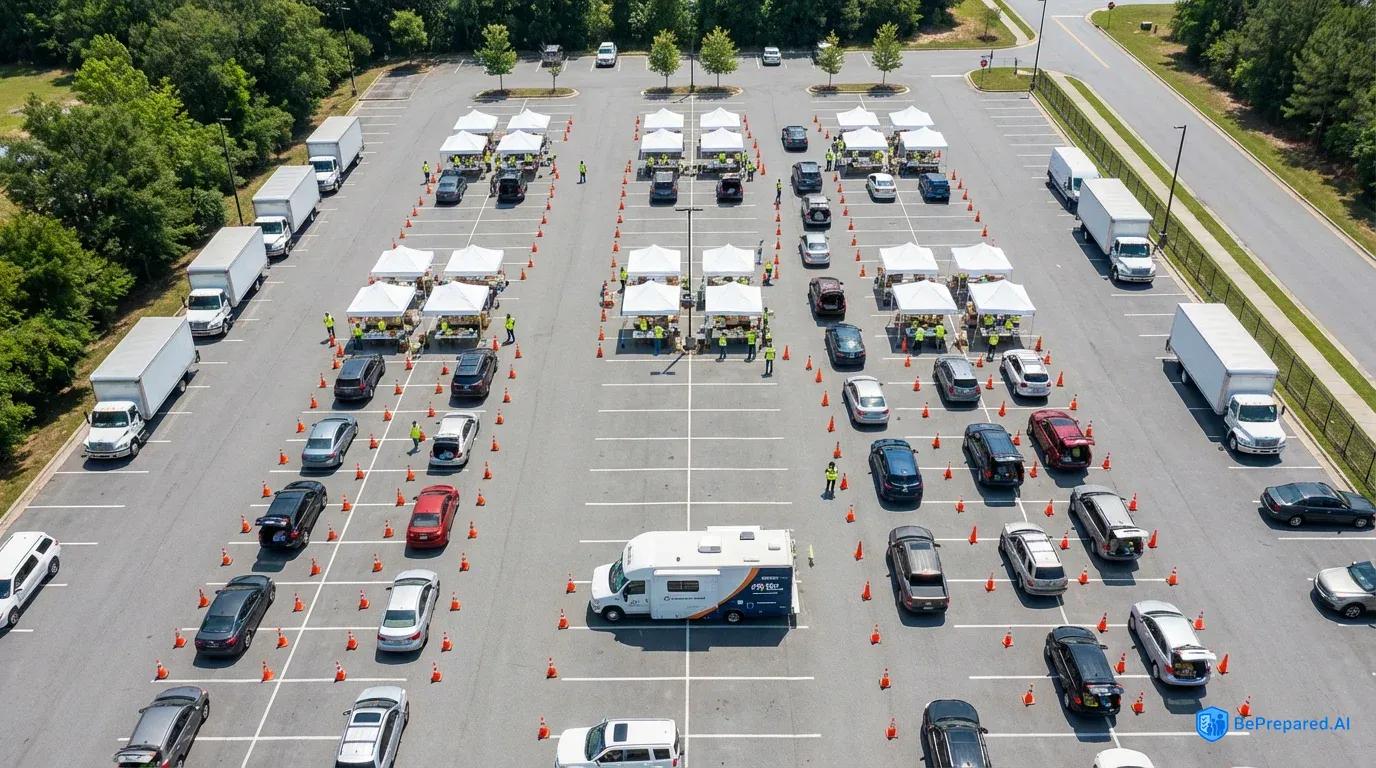
Emergency Food Distribution Systems for Communities
How communities organize food distribution during and after a major disaster.

Complete Hurricane Home Protection Guide
The pillar guide for hardening a house before landfall: windows, roof, doors, and the order to do the work in.
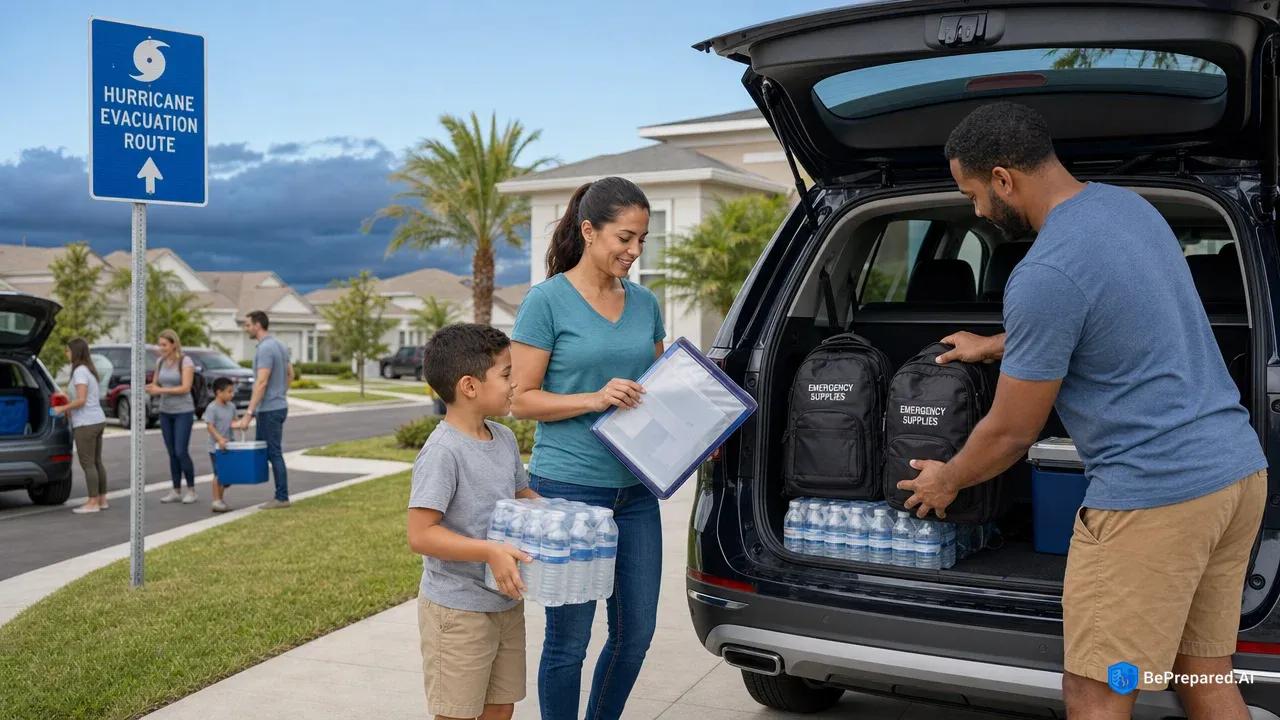
Hurricane Evacuation Checklist: What to Pack in 30 Minutes
When the order comes you will not have time to think. What to grab, in what order, and what to leave behind.
Preparedness that goes beyond hurricane season
Hurricanes are only one of the risks at your address. BeAware sends hurricane and storm surge alerts for your area, BeReady writes your household plan around them, BeEquipped ships a hurricane kit, and BeAdvised gives you time with a preparedness expert when you want one.
See all BePrepared solutionsOr try it first: BeAware and BeReady free for 7 days, no credit card.Start my free 7-day trial