Wildfire Evacuation Checklist + Defensible Space Guide
Wildfire is one of the few disasters where the work that saves your home happens before fire season starts. This is the calm, complete wildfire preparedness guide we built for real families: know your wildland-urban interface risk by address, complete the defensible space and home hardening that keeps embers out, build an evacuation go bag you can grab in a minute, and know what to do the moment a Warning or Order is issued. No doom language, no prepper theater.
Updated

Wildfire risk is hyper-local. A home in a wildland-urban interface (WUI) has fundamentally different exposure than a home three miles away in a fully developed neighborhood, even in the same county. California’s Fire Hazard Severity Zones, Oregon’s Wildfire Risk Map, and the USFS Wildfire Hazard Potential all publish this information, but reading the raw GIS layers is not a user-friendly experience.
BeAware pulls your address-specific wildfire risk, historical burn perimeters within 10 miles of your home, and current red-flag or fire-weather watch status into one view so you know whether your home needs a basic plan or a serious home-hardening investment.
Check wildfire risk at my addressDefensible space: the work that actually saves homes
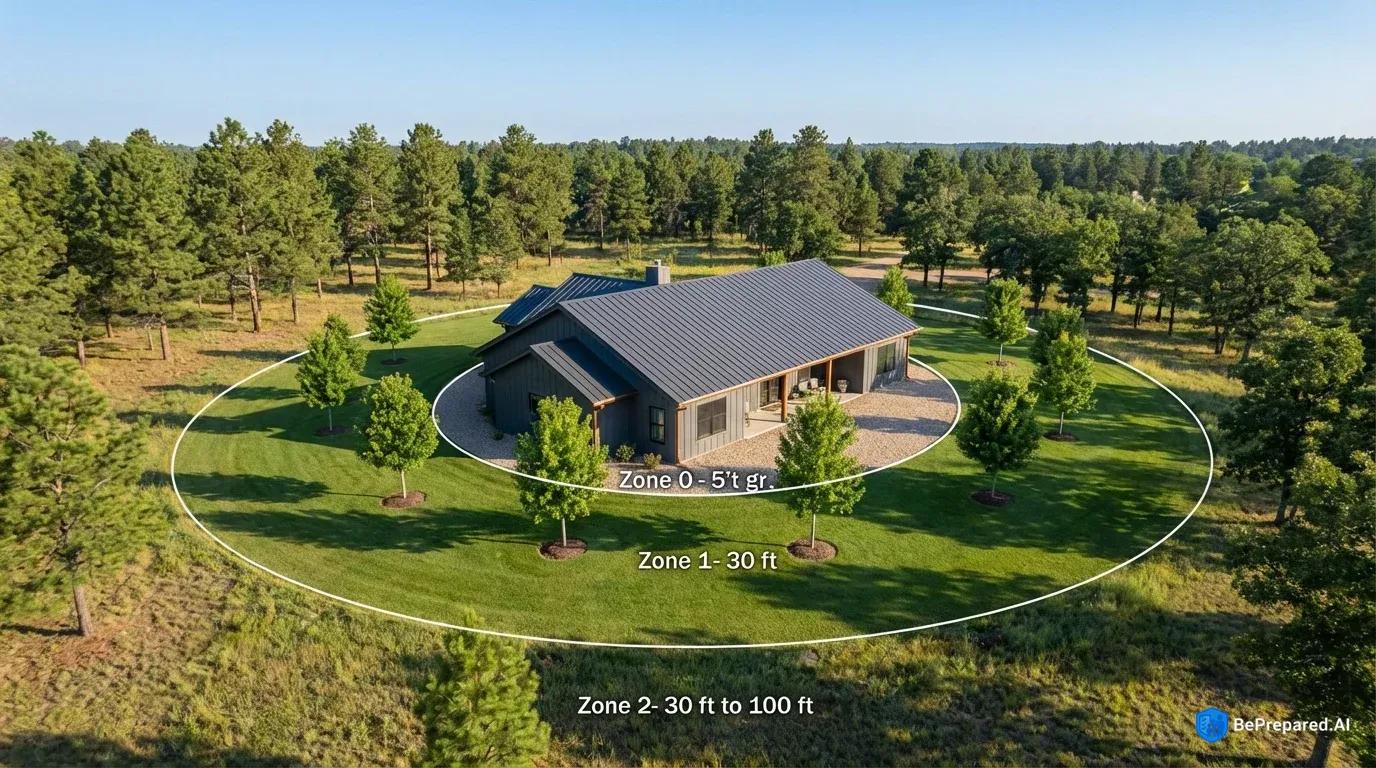
FEMA notes that most single-family homes are not required to be fire resistant, which leaves them vulnerable to embers, flames, and hot gases, and that unprotected vents give embers a way in. Defensible space and ember-resistant upgrades cut that exposure. The work is not glamorous (mostly yard work), and CAL FIRE's zones below are the standard way to organize it.
Zone 0 (0-5 feet from home)
Ember-resistant zone
- Remove all vegetation within 5 feet of the structure
- Use non-combustible mulch (gravel, stone, decomposed granite) — no wood chips, no bark
- Clear gutters, roof valleys, and under decks of leaves and pine needles year-round
- No woodpiles, propane tanks, trash bins, or combustible storage within 5 feet
Zone 1 (5-30 feet)
Lean, clean, and green
- Remove dead vegetation, pine needles, and dry leaves year-round
- Trim tree branches up to at least 6 feet from the ground, and keep branches 10 feet from your chimney
- Maintain space between trees, shrubs, and flammable items like patio furniture and wood piles
- Clear flammable vegetation and items from under decks, balconies, and stairs
Zone 2 (30-100 feet)
Reduced fuel zone
- Trim annual grass to a maximum height of 4 inches
- Remove fallen leaves, needles, and small branches
- Space out shrubs and trees horizontally and vertically; larger plants on steeper slopes need more space
For a complete seasonal maintenance calendar and zone-by-zone tool list, see our step-by-step defensible space guide. For home hardening (ember-resistant vents, roofing, siding, window film), see the complete home wildfire defense guide.
Build your wildfire go bag and evacuation kits
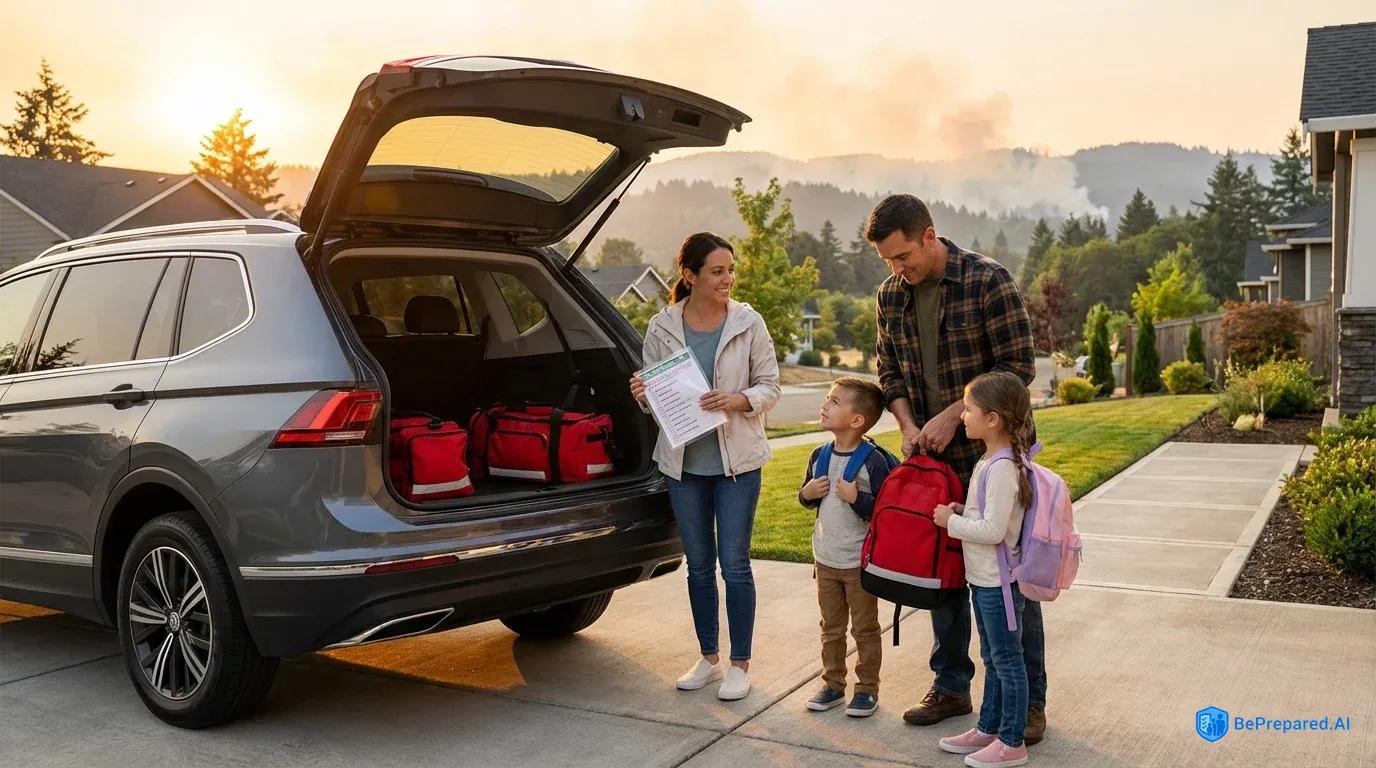
Unlike hurricane or earthquake kits (which are stationary), wildfire kits are structured for a fast departure. Three layers: a go bag you can grab in a minute, a household kit that lives in the vehicle during fire season, and pre-staged valuables you load in five minutes when the Warning escalates. Tap each item as it is staged; this browser keeps your checks.
Wildfire Preparedness Checklist
BePrepared Solutions · bepreparedsolutions.co/wildfire-preparedness
Check off each item as you go.
0 of 27 checked
Go bag (grab and leave in 60 seconds)
Household kit (in the vehicle during fire season)
Pre-staged valuables (5-minute load list)
Vehicle readiness (habit during fire season)
Home hardening (one-time work, done before the season)
Air quality (for smoke events even 100+ miles from the fire)
Want the kit picked out for you, sized for your household, with the right N95s, the right go bag, and the right HEPA purifier already chosen? BeEquipped curates wildfire kits where every item is matched to the evacuation and smoke-event scenarios real families actually face.
Evacuation timeline: Warning, Order, and the drive out
For a dress-rehearsal version of this timeline, run the drill once in normal weather, calmly, with the family. Our 15-minute wildfire evacuation checklist is the shorter walkthrough to practice against.
Before fire season (the work that actually matters)
Complete the defensible space work and home hardening below. Build the go bag, household kit, and vehicle kit. Identify two evacuation destinations in different directions and your out-of-state contact. Register for your county emergency alert service (Nixle, CodeRED, or county-specific apps).
Evacuation Warning issued
In California’s statewide terms (other states vary), an Evacuation Warning means a potential threat to life and/or property, and those who need extra time to evacuate, or have pets or livestock, should leave now. Everyone else: start loading the vehicle with pre-staged valuables and the household kit. Put gas in the car if needed, though prefer to skip lines by leaving earlier. Dress every household member in long pants, long-sleeve cotton, and sturdy shoes. Move pets into carriers. Monitor the NOAA radio and local emergency alerts continuously.
Evacuation Order issued, or you see fire or thick smoke
An Evacuation Order means an immediate threat to life: leave now. Do not wait for an Order if you feel at risk; Cal OES advises leaving as soon as evacuation is recommended to avoid being caught in dangerous conditions or road congestion. Take the go bag, the pet carriers, the pre-staged valuables list, and the keys. Close all windows and doors, but leave them unlocked. Leave lights on so firefighters can see your house in smoke.
During the drive out
Drive with headlights on. Windows up. Recirculate the air. If ash is falling thickly, wear N95 masks inside the vehicle too. Follow the evacuation routes officials give you, even if they feel longer: CAL FIRE notes that fire officials decide when and where to evacuate based on the fire, wind, and terrain.
After the all-clear
Do not return until the area is explicitly reopened. Even cleared areas may have hotspots, flare-ups, toxic debris, and unsafe utilities. Check in with the out-of-state contact to confirm you are out. Photograph your property before moving anything for insurance. Expect power, water, and internet to be out for days to weeks.
Wildfire smoke, even when you are not evacuating
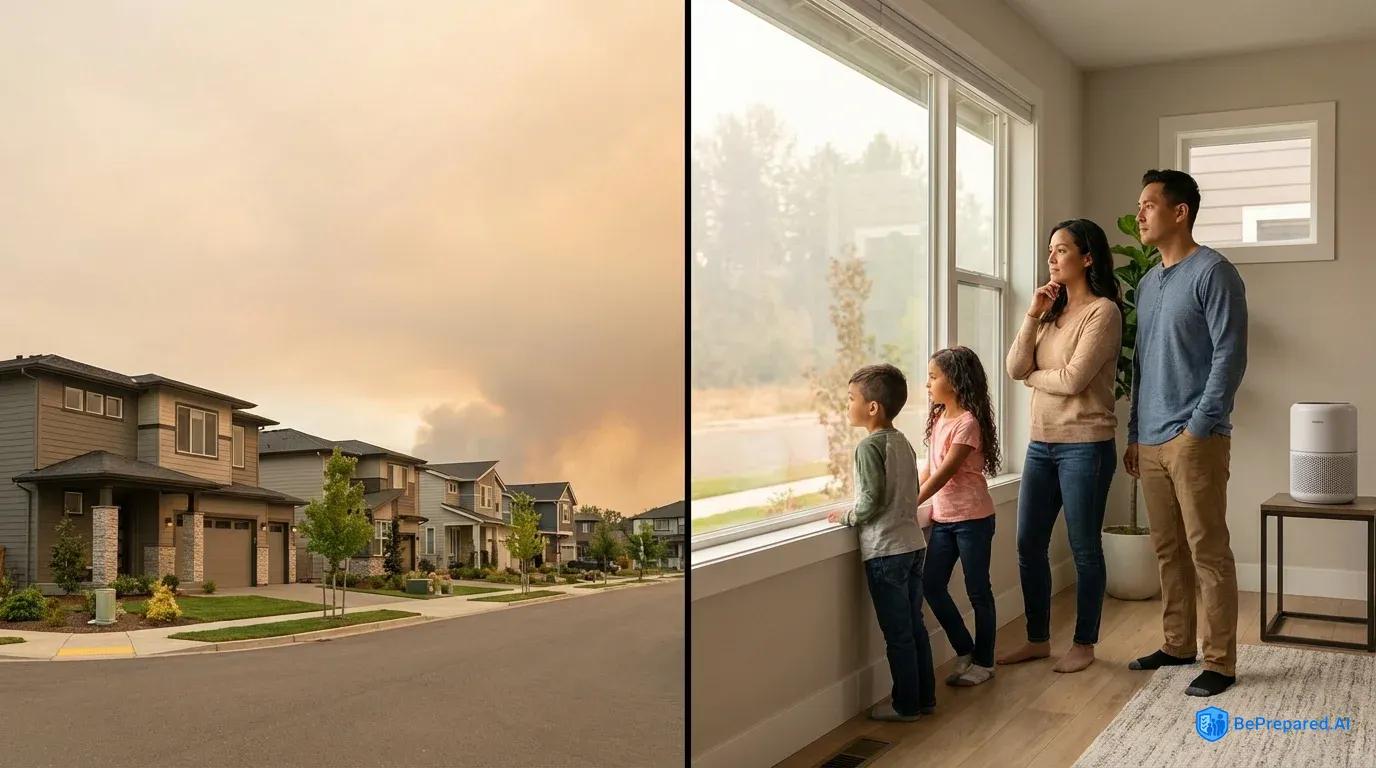
Wildfire smoke can reach well beyond the evacuation zones, so homes nowhere near the fire still need a smoke plan. Ready.gov advises that if you are not ordered to evacuate but smoky conditions exist, you stay inside in a safe location or go to a community building where smoke levels are lower. If you have children, older adults, or anyone with asthma or heart disease in the household, the smoke plan is as important as the evacuation plan.
AQI thresholds and what they mean for your behavior:
- 0-50 (Good): normal activity.
- 51-100 (Moderate): sensitive groups should limit prolonged outdoor exertion.
- 101-150 (Unhealthy for Sensitive Groups): children, older adults, and people with respiratory or heart conditions should limit outdoor activity.
- 151-200 (Unhealthy): everyone should limit outdoor exertion. Close windows, run HEPA, consider N95 if outside.
- 201-300 (Very Unhealthy): stay indoors, windows closed, HEPA running. N95 mandatory outdoors.
- 301+ (Hazardous): stay in a clean room: close its windows and doors and run a portable air cleaner sized for the room, continuously if you can (EPA).
For HEPA purifier selection (CADR matched to room square footage), see our air purifier sizing calculator. For the full indoor air strategy, our ultimate guide to wildfire air quality protection goes deeper than space allows here.
Special situations: PSPS, pets, and late-notice evacuations
Public Safety Power Shutoffs (PSPS)
Some utilities in wildfire-prone areas impose preemptive outages during high fire-weather conditions to reduce the chance of their equipment starting a fire. PSPS events overlap fire-weather days by design. If you live in a PSPS zone, your wildfire kit and your power-outage kit should be functionally the same kit, because the outage can come before any fire is visible.
Pets and livestock
Have pet carriers out and accessible, not in the attic. Keep leashes and harnesses staged next to the go bag. If you have livestock, identify the closest designated large-animal evacuation center before fire season begins. California's standard terms say those with pets and livestock should leave at the Evacuation Warning, not wait for an Order.
Late-notice evacuation (you missed the Warning)
If you see fire close by, leave immediately with the go bag and follow the directions of law enforcement and fire officials. Do not return for items. If you are trapped, Ready.gov says to call 9-1-1 and give your location, knowing that emergency response could be delayed or impossible, and to turn on lights to help rescuers find you. If you are trapped in a vehicle, CAL FIRE says to park in an area clear of vegetation, close all windows and vents, cover up with a wool blanket or jacket, lie on the vehicle floor, and call 911.
Wildfire alerts: WEA and your county system
Wireless Emergency Alerts (WEA) carry the National Weather Service's most critical warnings, such as Extreme Wind Warnings, and local emergencies requiring evacuation. Red Flag Warnings are not on the NWS list of WEA messages, so watch for them in your weather app or on a NOAA Weather Radio. Sign up for your county's own alert system too (Nixle, CodeRED, or county-specific apps); Ready.gov advises having several ways to receive alerts.
You do not need to sign up for WEA, but alerts can be switched off in phone settings, so verify:
- iPhone: Settings → Notifications → scroll to Government Alerts and enable every category.
- Android: Settings → Notifications → Wireless Emergency Alerts and enable every category.
- County-specific: search “[your county name] emergency alerts” to find the opt-in SMS or app that distributes evacuation-zone-level orders.
BeAware layers red-flag warnings, fire-weather advisories, and active wildfire perimeters within 10 miles of your address so you see a single coherent view of how close the threat is.
From the Alert Pulse archive
Wildfire alerts by the numbers
From July 2026 through September 2026, 1,432 distinct wildfire alerts went out across the United States: 809 Red Flag Warnings, 277 Fire Warnings and 25 other kinds. They reached 520 counties in 24 states and territories.
Figures v2 · frozen · covering July 2026 – September 2026. Summed from our monthly Alert Pulse reports on the public emergency alerts sent in the United States.
- distinct wildfire alerts
- 1,432
- messages carrying them
- 2,562
- counties reached
- 520
- states and territories
- 24
Month by month
| Month | Alerts | Counties |
|---|---|---|
| July 2026 | 703 | 361 |
| August 2026 | 532 | 425 |
| September 2026 | 197 | 201 |
Each month links to the Alert Pulse edition it comes from.
By alert type
| Alert type | Distinct alerts | Messages |
|---|---|---|
| Red Flag Warning | 809 | 1,585 |
| Fire Warning | 277 | 277 |
| Fire Weather Watch | 194 | 377 |
| Dense Smoke Advisory | 124 | 295 |
| 23 other alert types | 28 | 28 |
The 23 other alert types
- Fire Ban in effect until further notice: 2
- Frijoles Fire: 2
- Pocket Fire Set: 2
- Wild Fire: 2
- Wildfire Evacuation - Level 1 GET READY: 2
- 01_EVACUATION_Wildfire: 1
- 02_PRE-EVACUATION_Wildfire: 1
- A2 - FIRE - Go Message: 1
- Fire scoopers will be dipping out of GTL: 1
- Floriston Fire Evacuation Order: 1
- Frijoles Fire READY status: 1
- Hartman Hill Fire All Clear: 1
- Hartman Hill Fire Update: 1
- Lake Wildfire: 1
- Mine fire Rollback: 1
- Referencing Rolling Ridge Fire roll back: 1
- Rolling fire rollback to SET: 1
- ROLLING RIDGE FIRE - Set Message: 1
- Wildfire: 1
- Wildfire Alert: 1
- WILDFIRE in Santa Fe National Forest: 1
- Yarnell Fire All Clear: 1
- Yuba Ridge Drive Wildfire: 1
A message is each issue, update or re-issue of an alert. Distinct alerts count each one once.
The busiest days
The days with the most fire warnings and fire-weather alerts, counted as UTC calendar days.
45
on
43
on
34
on
By state
A county-alert is one alert counted once in each county it covered, so a warning over five counties adds five. That is why the state rows add up to more than the alert total.
| Rank | State | Counties reached | County-alerts | |
|---|---|---|---|---|
| 1 | Washington | 35 | 1,454 | |
| 2 | Montana | 51 | 1,301 | |
| 3 | Idaho | 44 | 1,213 | |
| 4 | Oregon | 30 | 1,055 | |
| 5 | Wyoming | 23 | 813 | |
| 6 | California | 43 | 464 | |
| 7 | South Dakota | 28 | 422 | |
| 8 | Colorado | 47 | 333 | |
| 9 | Nebraska | 29 | 255 | |
| 10 | North Dakota | 16 | 253 |
Show all 24 states and territories
| Rank | State | Counties reached | County-alerts | |
|---|---|---|---|---|
| 11 | Nevada | 17 | 250 | |
| 12 | Utah | 27 | 242 | |
| 13 | Puerto Rico | 33 | 86 | |
| 14 | Minnesota | 13 | 81 | |
| 15 | Oklahoma | 34 | 70 | |
| 16 | Texas | 23 | 46 | |
| 17 | New Mexico | 13 | 37 | |
| 18 | Alaska | 4 | 21 | |
| 19 | Arizona | 4 | 15 | |
| 20 | South Carolina | 1 | 13 | |
| 21 | Georgia | 2 | 2 | |
| 22 | Mississippi | 1 | 2 | |
| 23 | Arkansas | 1 | 1 | |
| 24 | Louisiana | 1 | 1 |
Also reached: 120 coastal and offshore marine zones (740 county-alerts), which belong to no U.S. state and are not counted as counties.
Counties with the most wildfire alerts
| County | State | Alerts |
|---|---|---|
| Chelan | WA | 132 |
| Lake | OR | 100 |
| Harney | OR | 90 |
| Grant | WA | 82 |
| Okanogan | WA | 82 |
| Douglas | WA | 81 |
| Jefferson | OR | 77 |
| Wheeler | OR | 76 |
| Blaine | ID | 69 |
| Klamath | OR | 66 |
These are counts, not rates: a county is not adjusted for its size or population. Every county is in the CSV.
How these figures were counted
- Summed from the national monthly Alert Pulse editions listed here, each published after human review. Nothing here is a fresh query of the archive: every figure can be re-derived from those editions' own CSV downloads, except the busiest days, which come from each edition's page.
- An alert counts as a wildfire alert when its event type names the hazard (Red Flag Warning, Fire Warning, Fire Weather Watch, Dense Smoke Advisory, Fire Ban in effect until further notice, Frijoles Fire, Pocket Fire Set, Wild Fire, Wildfire Evacuation - Level 1 GET READY, 01_EVACUATION_Wildfire, 02_PRE-EVACUATION_Wildfire, A2 - FIRE - Go Message, Fire scoopers will be dipping out of GTL, Floriston Fire Evacuation Order, Frijoles Fire READY status, Hartman Hill Fire All Clear, Hartman Hill Fire Update, Lake Wildfire, Mine fire Rollback, Referencing Rolling Ridge Fire roll back, Rolling fire rollback to SET, ROLLING RIDGE FIRE - Set Message, Wildfire, Wildfire Alert, WILDFIRE in Santa Fe National Forest, Yarnell Fire All Clear, Yuba Ridge Drive Wildfire).
- A distinct alert is the first message of a CAP identifier chain. Updates and re-issues are counted as messages, never as extra alerts.
- Real alerts only: tests, exercises and demos are excluded, as they are in every edition.
- County and state figures use the classification that colors each edition's reach map: an alert whose event type or SAME code is a wildfire product, counted once in every county it covered. Statewide codes are not counted as counties.
What they cannot tell you
- These figures count fire warnings, fire-weather alerts (Red Flag Warnings and Fire Weather Watches, which describe conditions rather than fires) and Dense Smoke Advisories, whose smoke is often but not always from wildfires. They are not a count of fires or acres burned; those come from the National Interagency Fire Center.
- Left out of the alert counts because their names show they are not wildfire alerts: "Fire Department Incident. Avoid the area." (1). The counties they covered remain in the county figures, which follow each edition's map classification.
- Alert feeds code 120 coastal and offshore marine zones the same way as counties. They belong to no U.S. state, so they are counted separately here and never as counties; each edition's own "counties reached" includes them.
- An alert is not the same as a county-alert. One warning covering five counties is one alert and five county-alerts, and an alert covering several states counts in each of them, so the state rows do not add up to the alert total.
- Months are summed as each edition published them. A warning chain that continues past midnight at the end of a month is counted in both months, as each edition counted it.
- National Weather Service alerts began arriving in this archive in volume on June 12, 2026. Every month here starts after that change, so the months can be compared with one another.
- These are counts, not rates. Population figures are not available for most of these counties, so nothing here is reported per resident.
- Times are UTC calendar days and months.
For newsrooms and researchers
Use these figures
You are welcome to reuse these figures with attribution. Version 2 is frozen: when a new month is added or an edition is corrected, a new version appears below with a dated note, and every earlier version stays downloadable.
BePreparedSolutions.co. "Wildfire alerts in the United States, July 2026 – September 2026." Alert Pulse statistics, figures v2, frozen October 1, 2026. https://bepreparedsolutions.co/wildfire-preparedness#wildfire-statistics
Source: BePrepared Solutions, Alert Pulse statistics (figures v2). Alert counts from FEMA IPAWS and National Weather Service feeds.
<iframe src="https://bepreparedsolutions.co/hazard-statistics/wildfire/embed" width="100%" height="560" style="border:0" loading="lazy" title="Wildfire alerts in the United States, July 2026 – September 2026"></iframe>
Versions
- v2 · · Added the September 2026 edition. Now covers July 2026 – September 2026. CSV for version 2
- v1 · · First release, covering July 2026 – August 2026. CSV for version 1
Wildfire preparedness FAQ
Sources
The safety guidance on this page follows these sources. An evacuation order or other instruction from your fire officials or sheriff overrides anything on this page.
- Air Quality Index (AQI) Basics — AirNow (U.S. EPA)
Supports: the AQI category bands this page uses, and the AQI 151 to 200 health wording: "Some members of the general public may experience health effects; members of sensitive groups may experience more serious health effects."
- Understanding Wildfire Warnings, Watches and Behavior — National Weather Service
Supports: the Red Flag Warning and Fire Weather Watch terms only: "NWS issues a Red Flag Warning when fire conditions are ongoing or expected to occur shortly" and "A watch means critical fire weather conditions are possible but not imminent or occurring."
- Wildfires — Ready.gov
Supports: the defensible-space and go-bag guidance, "Have several ways to receive alerts", the WEA no-sign-up note, keeping document copies "in a secure password-protected digital space", the smoke advice ("If you are not ordered to evacuate but smoky conditions exist, stay inside in a safe location or go to a community building where smoke levels are lower"), and the trapped advice ("If trapped, call 9-1-1 and give your location, but be aware that emergency response could be delayed or impossible. Turn on lights to help rescuers find you.").
- Evacuation Warning vs. Evacuation Order — California Governor’s Office of Emergency Services
Supports: the California evacuation terms ("An evacuation warning means there’s impending danger to your life or property. If a warning is given assume an evacuation order will follow." / "An evacuation order means there’s an immediate threat to your life and you need to leave right now!") and when to go: "Leave as soon as evacuation is recommended to avoid being caught in dangerous conditions or road congestion."
- California Standard Statewide Evacuation Terminology — California OES (CalAlerts)
Supports: the exact California definitions: "Evacuation Order: Immediate threat to life. This is a lawful order to leave now." / "Evacuation Warning: Potential threat to life and/or property. Those who require additional time to evacuate, and those with pets and livestock should leave now." / "Shelter in Place: Go indoors. Shut and lock doors and windows."
- Create a Clean Room to Protect Indoor Air Quality During a Wildfire — U.S. Environmental Protection Agency
Supports: the clean-room advice: "Close all windows and doors in the room" and "Use a portable air cleaner that is the right size for the room."
- Protecting structures from wildfire embers and fire exposures — U.S. Fire Administration (FEMA)
Supports: the ember claims: embers "contribute to a significant percentage of home ignitions"; "According to National Institute of Standards and Technology (NIST) research, embers can be carried by winds and deposited several miles downwind from the wildfire"; and "embers can reach a building’s interior through a point of entry, such as a window or vent."
- Reducing Wildfire Risk to Your Home — FEMA
Supports: the home-hardening items: "most homes are vulnerable to ignition to embers, flames and hot gases"; "Replace existing vent covers with corrosion-resistant 1/8-inch or 1/16-inch (preferred) wire mesh"; "replace roof with Class A covering materials"; "replace the bottom 6-12 inches of siding"; noncombustible gutter covers; and "Ensure that there are no combustible fuels (e.g., mulch, trees, shrubs, wood piles, trash bins) within 0-5 feet of the home."
- Defensible Space — CAL FIRE (Ready for Wildfire)
Supports: the zone checklist: Zone 0 "extends 0- 5 feet from your home"; Zone 1 ("Trim overhanging branches and keep them 10 feet from your chimney"; "Maintain space between trees, shrubs, and flammable items like patio furniture and wood piles"; "Clear flammable vegetation and items from under decks, balconies, and stairs"); Zone 2 ("Trim annual grass to a maximum height of 4 inches"; "Remove fallen leaves, needles, and small branches"; "Space out shrubs and trees horizontally"); and "Trim tree branches up to at least 6 feet from the ground."
- Go! Evacuation Guide — CAL FIRE (Ready for Wildfire)
Supports: the clothing item ("Wear clothes that cover your skin (100% cotton is best), like long pants and tops, and tough shoes"), "Maintain at least half a tank of gas in your vehicle", "Close all windows and doors but leave them unlocked", "Leave lights on for firefighters to see your house in smoke", "don’t wait for an evacuation order if you feel at risk", and the trapped-in-a-vehicle steps ("Park in an area clear of vegetation / Close all vehicle windows and vents / Cover up with a wool blanket or jacket / Lie on the vehicle floor / Use your cell phone to call 911").
- Weather warnings on the go! (Wireless Emergency Alerts) — National Weather Service
Supports: which NWS warnings go out as WEA ("Warnings for Tsunamis, Tornado, Severe Thunderstorm (only when the damage threat is destructive), Flash Flood (only when the damage threat is considerable or catastrophic), Hurricane, Typhoon, Storm Surge, Extreme Wind, Dust Storm and Snow Squall"), which does not include Red Flag Warnings, and that WEA covers "Local emergencies requiring evacuation or immediate action".
Deep dives from our article library
Each of these articles goes deeper on a single part of wildfire preparedness than a single page can.
See the wildfire and severe weather guides together, or get fire and smoke alerts for your address before fire season peaks.
Creating a Wildfire Defensible Space: Step-by-Step Guide
Zone-by-zone walkthrough with tools, quantities, and a seasonal maintenance calendar for the three defensible-space zones.

Complete Home Wildfire Defense Guide
Home hardening deep dive: ember-resistant vents, roofing, siding, window film, and the budget-ranked priority order for a whole-house upgrade.
15-Minute Wildfire Evacuation Checklist
What to grab, in what order, when a warning becomes an order. Run the drill once calmly before you need it under pressure.

Fire-Resistant Plants: What to Grow in Wildfire Zones
Long-term landscaping choices for wildfire zones: what to plant and what to remove.
Ultimate Guide to Wildfire Air Quality Protection
Indoor air strategies for smoke events, including when to run HEPA, when to seal a clean room, and AQI thresholds that should change your behavior.

Air Purifier Sizing Calculator for Wildfire Smoke
Match CADR to room square footage so you are not buying a bedroom-sized purifier for a great-room-sized problem.
Preparedness for every season, every risk
Fire season is one part of the picture at your address. BeAware alerts you to fire perimeters and air quality near your area, BeReady writes the evacuation steps into your plan, BeEquipped ships the supplies, and BeAdvised gives you an expert to plan with.
See all BePrepared solutionsOr try it first: BeAware and BeReady free for 7 days, no credit card.Start my free 7-day trial