Tornado Emergency Kit + Preparedness Checklist
Tornadoes give you minutes, not days. That changes what preparedness actually means: the kit matters less than the shelter you already chose, and the shelter matters less than whether every person in the house knows the route to it. This is the calm, complete tornado preparedness checklist we built for real families: know your tornado risk by address, build a kit sized to a short event, pick your safe room now, and respond right in the minutes you will actually have.
Updated
Not every home in a tornado state faces the same tornado risk. Two houses twenty miles apart can have very different historical EF-rated tornado activity within a 20-mile radius, very different county risk ratings in FEMA's National Risk Index, and very different proximity to hardened public shelters.
BeAware pulls tornado history and FEMA National Risk Index data for your exact address, then layers the current NWS watch and warning zones on top. You see whether your location calls for a basic plan or a serious shelter investment, without cross-referencing four government sites.
Check tornado risk at my addressBuild your tornado preparedness kit
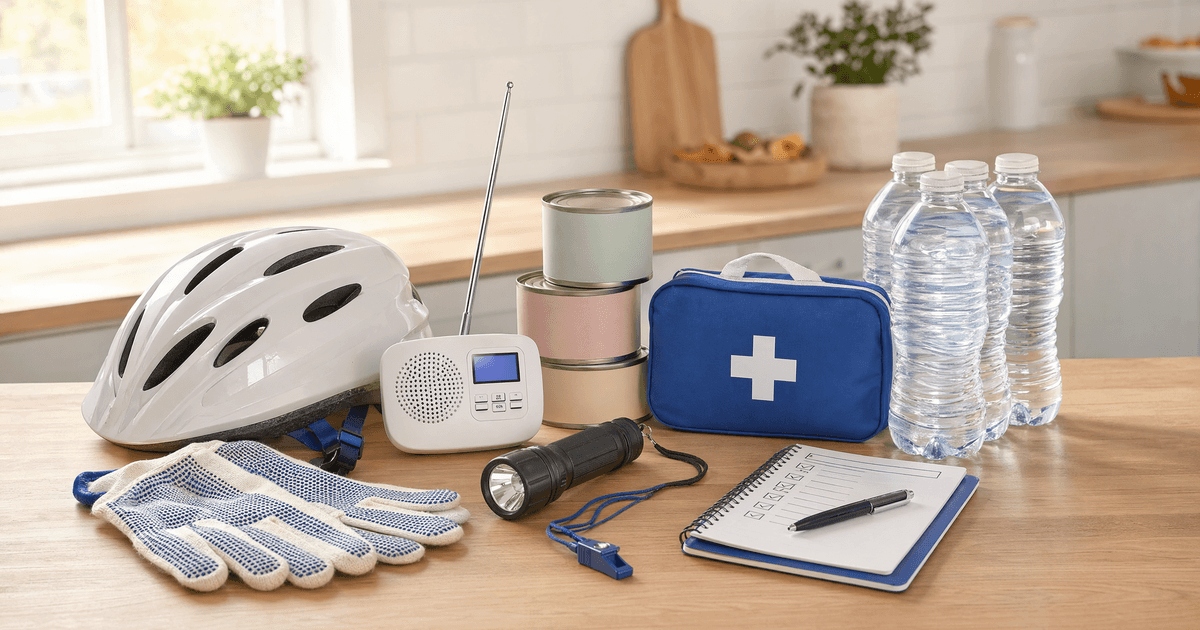
Tornado kits are shorter than hurricane kits because the event itself is shorter; what matters more is that everything lives inside the shelter area already. If you have to run across the house to find a flashlight during a warning, the kit failed before the storm hit. Tap each item once it is in the shelter area; your checks stay on this device.
Tornado Preparedness Checklist
BePrepared Solutions · bepreparedsolutions.co/tornado-preparedness
Check off each item as you go.
0 of 22 checked
Shelter gear (head and debris protection)
First response and debris cleanup
Light and power
Water and food (24-48 hours)
Communication and alerts
Documents and cash
Want the kit picked out for you, sized for your household, with shelter-rated helmets and a SAME-capable NOAA radio already chosen? BeEquipped curates tornado kits where every item is selected for a short-duration, high-debris event - and every kit hands off to your own Amazon cart at our cost, with no markup added.
Tornado response: before the season through after the all-clear
A tornado response plays out on five clocks: the season clock (months), the watch clock (hours), the warning clock (minutes), the storm clock (seconds), and the recovery clock (days). Knowing what to do on each is the whole game. If the watch-versus-warning distinction is new to you, start with our plain-language guide to what each alert means.
Before the season
Identify your shelter: a basement, storm cellar, or safe room if you have one; otherwise a small interior room, closet, or hallway on the lowest floor with no windows. Stock the shelter with the kit above. Brief every household member on the route to the shelter and practice it once.
When a tornado watch is issued
A watch means tornadoes are possible in and near the watch area. Move the kit to the shelter if it is not already there. Charge phones and battery packs. Bring pets inside. Stay aware of the sky and the NOAA radio. Do not leave the house for errands until the watch expires.
When a tornado warning is issued
A warning means a tornado is indicated or spotted in your area. Take shelter NOW. Put on helmets and sturdy shoes. Cover yourselves with the mattress or blankets. Stay away from windows. Keep the NOAA radio on. Do not open windows; it is a myth that pressure equalization helps.
During the storm
Stay low, cover your head, and stay put until the all-clear is announced on the radio. A loud, continuous roar or rumble that does not fade like thunder can be a tornado close by; the Storm Prediction Center says the most common tornado sound is a continuous rumble, like a nearby train. Stay down; it is not the time to look.
After the all-clear
Wait for explicit NOAA or local emergency all-clear before leaving shelter. Check everyone for injuries. Put on sturdy shoes and gloves. Avoid downed power lines and gas lines. Photograph damage before moving anything for insurance. Do not use lighters or candles until you have confirmed there is no gas leak.
Make this plan household-specific
The timeline above only works once it has names on it: which room each person shelters in, who carries the toddler and who grabs the documents container, where you meet if the house is unlivable, and who your out-of-state check-in contact is. Write those decisions down and walk the route to the shelter once - a plan nobody has practiced is a suggestion.
BeReady builds exactly that document for your household: a per-person plan built from your address, your home layout, and the people who actually live with you, with a printable sheet for every family member.
Build my household tornado planWhere to shelter: the hierarchy that actually works
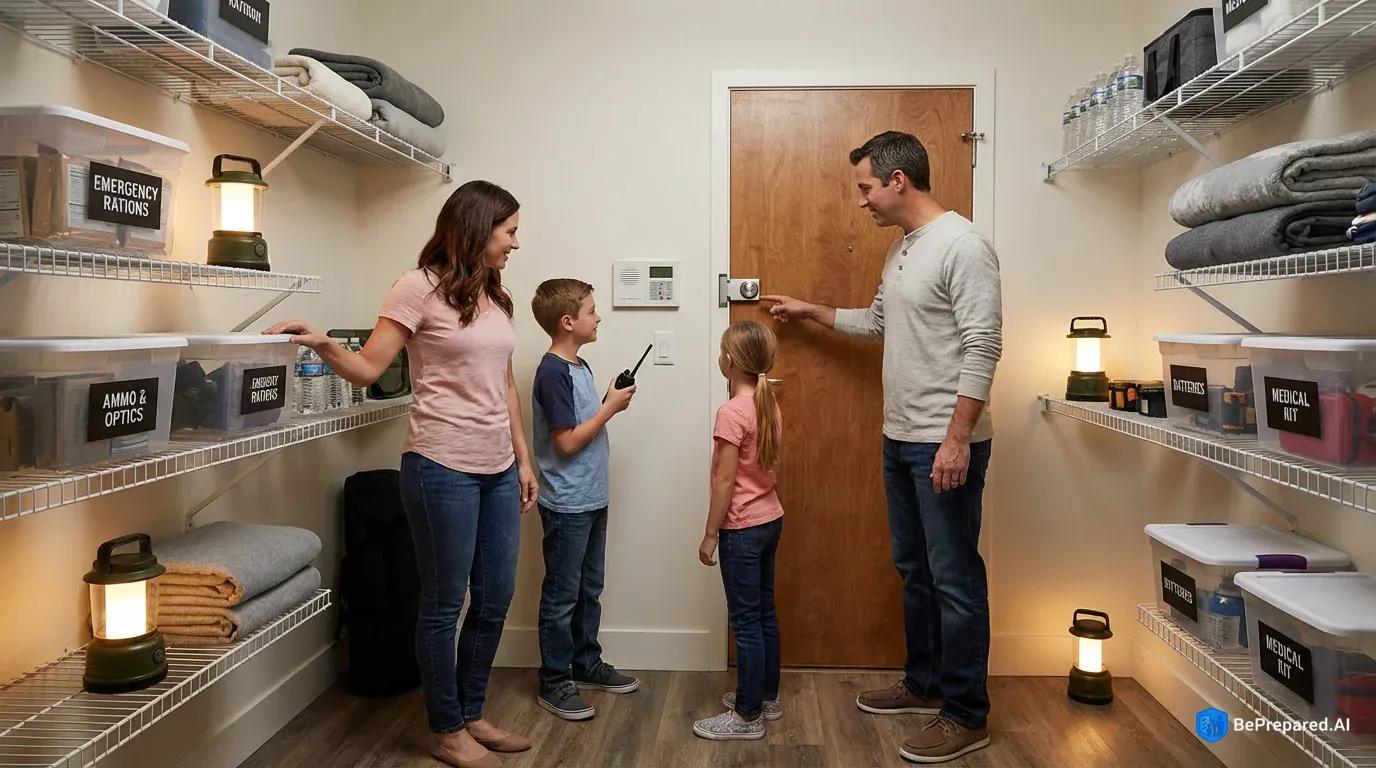
The best shelter is the lowest, most interior, most structurally protected space you can reach quickly. Rank your options now so you are not making the decision during a warning - our room-by-room shelter guide walks the house you already live in, and if you want to go further, a budget safe-room conversion hardens the room you pick.
| Shelter option | Rating | Notes |
|---|---|---|
| Basement or underground storm shelter | Best | Get under sturdy protection such as a heavy table or workbench, or cover yourself with a mattress or sleeping bag. Do not shelter under heavy objects on the floor above (pianos, refrigerators), which may fall through a weakened floor. |
| Interior bathroom, closet, or small hallway | Good | Lowest floor, no windows, as many walls as possible between you and the outside. A metal bathtub may offer partial protection; a plastic or fiberglass one does not. |
| Community storm shelter or hardened public building | Good (if time) | Identify the closest one now, not during a warning. Do not drive to it during an active warning unless you have clear time and a short route. |
| Mobile home, manufactured home, or RV | Never | Get out to a sturdy permanent building or shelter. Most tornadoes can destroy even tied-down mobile homes. |
| Vehicle on an open road | Last resort | Drive to the closest shelter if you can. If you cannot, either get down in the car and cover your head, or leave it for a low-lying area such as a ditch, covering your head. Never under an overpass. |
Special cases: mobile homes, cars, and being outside
Mobile and manufactured homes
The Storm Prediction Center's advice is to get out: most tornadoes can destroy even tied-down mobile homes. Find out now whether your community has a public storm shelter, or plan to stay with someone in a sturdy permanent building when a tornado threat is forecast. If you are caught outside with no shelter, lie flat and face-down on low ground and protect the back of your head with your arms.
In a car on an open road
The best course is to drive to the closest sturdy shelter. If the tornado is visible, far away, and traffic is light, you may be able to drive out of its path at right angles. If you are caught by extreme winds or flying debris, the National Weather Service gives two options: get down in the car and cover your head, or abandon it for a low-lying area such as a ditch or ravine. Never shelter under an overpass; the Storm Prediction Center documents people killed doing exactly that.
Outdoors with no shelter
Lie flat and face-down in the lowest spot you can find, as far from trees and cars as possible. Protect the back of your head with your arms. Do not try to outrun a tornado on foot.
In a high-rise apartment
Move to the lowest floor interior hallway, stairwell, or designated shelter space. Do not use the elevator. Stay away from windows and glass lobbies.
Wireless emergency alerts (WEA) for tornadoes
Outdoor tornado sirens are designed only to alert people who are outside, and siren policy is set locally, so indoors you need your own warning. The National Weather Service sends tornado warnings as Wireless Emergency Alerts, which arrive with a unique tone and vibration, both repeated twice.
You do not need to sign up for WEA, but alerts can be switched off in phone settings, so verify:
- iPhone: Settings → Notifications → scroll to Government Alerts and enable every category, especially tornado.
- Android: Settings → Notifications → Wireless Emergency Alerts and enable every category.
For true belt-and-suspenders redundancy, pair WEA with a NOAA Weather Radio configured for SAME (Specific Area Message Encoding) so it only sounds for your area. The National Weather Service recommends a NOAA Weather Radio for alerts indoors, and it does not depend on your phone.
From the Alert Pulse archive
Tornado alerts by the numbers
From July 2026 through September 2026, 1,881 distinct tornado alerts went out across the United States: 1,808 Tornado Warnings and 73 Tornado Watches. They reached 864 counties in 40 states.
Figures v2 · frozen · covering July 2026 – September 2026. Summed from our monthly Alert Pulse reports on the public emergency alerts sent in the United States.
- distinct tornado alerts
- 1,881
- messages carrying them
- 1,947
- counties reached
- 864
- states
- 40
Month by month
| Month | Alerts | Counties |
|---|---|---|
| July 2026 | 932 | 534 |
| August 2026 | 619 | 309 |
| September 2026 | 330 | 214 |
Each month links to the Alert Pulse edition it comes from.
By alert type
| Alert type | Distinct alerts | Messages |
|---|---|---|
| Tornado Warning | 1,808 | 1,809 |
| Tornado Watch | 73 | 138 |
A message is each issue, update or re-issue of an alert. Distinct alerts count each one once.
The busiest days
The days with the most tornado warnings, counted as UTC calendar days.
230
on
137
on
93
on
By state
A county-alert is one alert counted once in each county it covered, so a warning over five counties adds five. That is why the state rows add up to more than the alert total.
| Rank | State | Counties reached | County-alerts | |
|---|---|---|---|---|
| 1 | Iowa | 86 | 403 | |
| 2 | Kentucky | 73 | 346 | |
| 3 | Ohio | 51 | 269 | |
| 4 | Illinois | 37 | 247 | |
| 5 | Pennsylvania | 58 | 242 | |
| 6 | Wisconsin | 50 | 202 | |
| 7 | Texas | 25 | 189 | |
| 8 | New York | 45 | 168 | |
| 9 | Missouri | 49 | 165 | |
| 10 | Minnesota | 31 | 156 |
Show all 40 states
| Rank | State | Counties reached | County-alerts | |
|---|---|---|---|---|
| 11 | Nebraska | 44 | 142 | |
| 12 | Maryland | 23 | 133 | |
| 13 | West Virginia | 28 | 133 | |
| 14 | Virginia | 39 | 123 | |
| 15 | Indiana | 30 | 118 | |
| 16 | North Carolina | 34 | 104 | |
| 17 | Kansas | 31 | 97 | |
| 18 | New Jersey | 19 | 95 | |
| 19 | Michigan | 21 | 85 | |
| 20 | South Dakota | 17 | 79 | |
| 21 | North Dakota | 16 | 68 | |
| 22 | Delaware | 3 | 33 | |
| 23 | Tennessee | 10 | 27 | |
| 24 | Colorado | 8 | 25 | |
| 25 | Arizona | 2 | 16 | |
| 26 | Utah | 4 | 16 | |
| 27 | Georgia | 6 | 11 | |
| 28 | Wyoming | 3 | 11 | |
| 29 | Florida | 3 | 9 | |
| 30 | Louisiana | 4 | 7 | |
| 31 | New Mexico | 1 | 7 | |
| 32 | Nevada | 3 | 6 | |
| 33 | Alabama | 1 | 4 | |
| 34 | Oregon | 1 | 3 | |
| 35 | Vermont | 3 | 3 | |
| 36 | Connecticut | 1 | 2 | |
| 37 | Maine | 1 | 2 | |
| 38 | Oklahoma | 1 | 2 | |
| 39 | South Carolina | 1 | 2 | |
| 40 | Hawaii | 1 | 1 |
Also reached: 32 coastal and offshore marine zones (62 county-alerts), which belong to no U.S. state and are not counted as counties.
Counties with the most tornado alerts
| County | State | Alerts |
|---|---|---|
| Uvalde | TX | 27 |
| Bureau | IL | 25 |
| Will | IL | 24 |
| Cook | IL | 23 |
| Delaware | IA | 19 |
| Bexar | TX | 19 |
| Randall | TX | 19 |
| Kenton | KY | 17 |
| Cape May | NJ | 17 |
| DuPage | IL | 16 |
These are counts, not rates: a county is not adjusted for its size or population. Every county is in the CSV.
How these figures were counted
- Summed from the national monthly Alert Pulse editions listed here, each published after human review. Nothing here is a fresh query of the archive: every figure can be re-derived from those editions' own CSV downloads, except the busiest days, which come from each edition's page.
- An alert counts as a tornado alert when its event type names the hazard (Tornado Warning, Tornado Watch).
- A distinct alert is the first message of a CAP identifier chain. Updates and re-issues are counted as messages, never as extra alerts.
- Real alerts only: tests, exercises and demos are excluded, as they are in every edition.
- County and state figures use the classification that colors each edition's reach map: an alert whose event type or SAME code is a tornado product, counted once in every county it covered. Statewide codes are not counted as counties.
What they cannot tell you
- These figures count warnings and watches, not tornadoes. One tornado can prompt several warnings, and a warning can pass with no tornado. Confirmed tornado counts come from the NOAA Storm Prediction Center.
- Alert feeds code 32 coastal and offshore marine zones the same way as counties. They belong to no U.S. state, so they are counted separately here and never as counties; each edition's own "counties reached" includes them.
- An alert is not the same as a county-alert. One warning covering five counties is one alert and five county-alerts, and an alert covering several states counts in each of them, so the state rows do not add up to the alert total.
- Months are summed as each edition published them. A warning chain that continues past midnight at the end of a month is counted in both months, as each edition counted it.
- National Weather Service alerts began arriving in this archive in volume on June 12, 2026. Every month here starts after that change, so the months can be compared with one another.
- These are counts, not rates. Population figures are not available for most of these counties, so nothing here is reported per resident.
- Times are UTC calendar days and months.
For newsrooms and researchers
Use these figures
You are welcome to reuse these figures with attribution. Version 2 is frozen: when a new month is added or an edition is corrected, a new version appears below with a dated note, and every earlier version stays downloadable.
BePreparedSolutions.co. "Tornado alerts in the United States, July 2026 – September 2026." Alert Pulse statistics, figures v2, frozen October 1, 2026. https://bepreparedsolutions.co/tornado-preparedness#tornado-statistics
Source: BePrepared Solutions, Alert Pulse statistics (figures v2). Alert counts from FEMA IPAWS and National Weather Service feeds.
<iframe src="https://bepreparedsolutions.co/hazard-statistics/tornado/embed" width="100%" height="560" style="border:0" loading="lazy" title="Tornado alerts in the United States, July 2026 – September 2026"></iframe>
Versions
- v2 · · Added the September 2026 edition. Now covers July 2026 – September 2026. CSV for version 2
- v1 · · First release, covering July 2026 – August 2026. CSV for version 1
Tornado preparedness FAQ
Sources
The safety guidance on this page follows the National Weather Service and the NOAA Storm Prediction Center. If a National Weather Service warning for your county disagrees with anything here, the warning comes first.
- The Online Tornado FAQ — NOAA Storm Prediction Center
Supports: that opening windows does not help — the SPC calls it "absolutely useless, a waste of precious time, and can be very dangerous"; the watch versus warning definitions; the helmet and debris advice ("Flying debris is the greatest danger in tornadoes", "A helmet can offer some protection against head injury"); the after-storm hazards ("broken glass, nails, and other sharp objects"); the bathtub note ("If you have a metal bath tub, that may offer a shell of partial protection, but not plastic or fiberglass ones"); the basement advice (do not go under heavy objects on the floor above, which "may fall down through a weakened floor"); the mobile-home advice ("Get out! Even if your home is tied down, it is not as safe as an underground shelter or permanent, sturdy building"; "Most tornadoes can destroy even tied-down mobile homes"); the vehicle advice ("There is no safe option when caught in a tornado in a car, just slightly less-dangerous ones"; "If the tornado is visible, far away, and the traffic is light, you may be able to drive out of its path by moving at right angles"); the overpass deaths of 3 May 1999; the outdoors advice ("lie flat and face-down on low ground, protecting the back of your head with your arms"); the tornado sound ("The most common tornado sound is a continuous rumble, like a nearby train"; "Loud, continuous roar or rumble, which doesn’t fade in a few seconds like thunder"); that lead time "can be a negative number in reality"; and that "Siren policy is local and varies from place to place."
- Prepare! Don't let Tornadoes Take You by Surprise — National Weather Service
Supports: the advice to plan a safe room before a warning is issued: "Pick a safe room in your home, such as a basement, storm cellar, or an interior room on the lowest floor with no windows."
- What to do During a Tornado — National Weather Service
Supports: the during-the-event actions (basement, safe room, or an interior room away from windows) and the vehicle options: "Being in a vehicle during a tornado is not safe. The best course of action is to drive to the closest shelter. If you are unable to make it to a safe shelter, either get down in your car and cover your head, or abandon your car and seek shelter in a low lying area such as a ditch or ravine."
- Outdoor Warning Sirens: Frequently Asked Questions — National Weather Service, Quad Cities office
Supports: the siren claim: "Sirens are an outdoor warning system designed only to alert those who are outside that something dangerous is approaching"; and "For alerts indoors, every home and business should have a NOAA Weather Radio All-Hazards."
- Weather warnings on the go! (Wireless Emergency Alerts) — National Weather Service
Supports: that NWS sends tornado warnings as WEA, and "WEA messages include a special tone and vibration, both repeated twice."
- Tornado Safety — National Weather Service
Supports: that "Tornadoes can occur at any time of day or night and at any time of the year."
- Tornadoes — Ready.gov
Supports: the preparedness checklist framing and the guidance to identify a community shelter in advance.
Deep dives from our article library
These articles go deeper on the parts of tornado preparedness that need their own treatment.
For the rest of storm season, our tornado and other storm guides are in one place, and you can set up tornado-season alerts for your home.
How to Create a Safe Room on a Budget
How to turn an interior room into a safer shelter space on a budget: what to reinforce and what to skip.

How to Create a Family Emergency Communication Plan
How to build a family communication plan for when you are separated and phone service is unreliable.

Essential Documents Checklist for Family Emergencies
A checklist of the documents to keep copied and protected, and which ones belong in the shelter container.

Complete Tornado Safety and Preparedness Guide
The pillar guide: how tornadoes form, what the risk is where you live, and every step from watch to all-clear.

Tornado Watch vs Warning: What Each Means and How to Respond
A watch means conditions are possible; a warning means take shelter now. What to do in each case, and where to go.

Where to Take Shelter During a Tornado: Room-by-Room Guide
No basement is not the same as no options. The safest spot in each room, ranked, for the house you already live in.
Preparedness for every season, every risk
A tornado is rarely the only risk an address faces. BeAware alerts you when a tornado warning covers your area, BeReady puts the shelter plan in writing for everyone at home, BeEquipped ships the supplies, and BeAdvised connects you with a preparedness expert if you have questions.
See all BePrepared solutionsOr try it first: BeAware and BeReady free for 7 days, no credit card.Start my free 7-day trial