Understanding Food Storage Requirements During Civil Unrest
The protests started on a Tuesday morning, and by Wednesday afternoon, Maria realized the grocery store shelves weren't going to restock anytime soon. The main distribution center sat in the middle of the affected zone, and delivery trucks had stopped running. She had her usual week's worth of groceries, maybe ten days if she stretched it. Her neighbor, who'd quietly built up a three-month supply over the previous year, barely noticed the disruption. The difference between them wasn't paranoia or luck—it was calculation and planning.
Civil unrest creates a unique pattern of supply chain disruption that differs significantly from natural disasters. While hurricanes and earthquakes typically damage infrastructure in predictable ways, civil disturbances can render entire districts inaccessible for extended periods without warning. Historical data from urban unrest events across the United States shows food supply chains can experience disruptions lasting anywhere from two to twelve weeks, depending on the severity and geographic scope of the situation . The challenge isn't just the duration—it's the unpredictability. You might have three days of relative calm followed by another week where leaving your neighborhood feels inadvisable.
FEMA's standard recommendation calls for a minimum three-day emergency food supply , which serves adequately for short-term weather events or brief power outages. However, this baseline falls dramatically short during civil unrest scenarios. The three-day supply assumes you'll either weather the storm or evacuate to safer areas with functioning infrastructure. During widespread civil disturbances, evacuation may not be possible, and the "storm" doesn't pass on a meteorological schedule. A more realistic target ranges from two weeks at the absolute minimum to 90 days for comprehensive preparedness.
The calculation process begins with honest assessment. How many people live in your household? What are their ages, activity levels, and dietary restrictions? Do you have infants requiring formula, elderly family members with specific nutritional needs, or anyone with medical conditions affecting their diet? During civil unrest, you can't simply run to the pharmacy for specialized foods. Every variable must factor into your baseline calculations before you purchase a single can of beans. The difference between adequate preparation and dangerous shortfall often comes down to these initial calculations—done carefully, with realistic numbers rather than optimistic guesses.
- Adjustment Factors
- Additional modifiers for weight goals (gain/loss), pregnancy, and athletic training
Basic Caloric Needs Calculator
Understanding caloric requirements forms the foundation of any food storage plan, yet most people dramatically underestimate how much energy the human body actually needs to function. The average adult male requires between 2,000 and 2,600 calories per day under normal conditions, while adult females need approximately 1,800 to 2,200 calories . These numbers shift based on age, body composition, and baseline activity levels, but they represent your starting point for calculations. A sedentary 65-year-old woman needs fewer calories than a 30-year-old construction worker, and your storage plan must account for these differences.
For emergency planning purposes, calculate 2,000 calories per person per day for emergency planning . This standardized baseline simplifies calculations while providing adequate nutrition for most adults under stress conditions. You can adjust upward for highly active individuals or those with greater caloric needs.
Children present a more complex calculation because their needs change rapidly with age and growth stages. Toddlers aged 2-3 years require roughly 1,000-1,400 calories daily, while children aged 4-8 need 1,200-1,800 calories . Teenagers, particularly active adolescent males, can require 2,400-3,000 calories per day—sometimes matching or exceeding adult male requirements. Parents often underestimate these needs, particularly for teenagers, which can create dangerous shortfalls in extended emergency situations.
The stress multiplier adds another layer to these calculations. During civil unrest, your body operates under heightened psychological and sometimes physical stress. Anxiety, disrupted sleep patterns, and the physical demands of securing your home or moving supplies all increase caloric needs. Some experts suggest increasing baseline calculations by 10-20% during emergency scenarios, though individual needs vary. If your normal requirement sits at 2,000 calories, planning for 2,200-2,400 calories during periods of civil unrest creates a buffer. This prevents the gradual energy depletion that can impair decision-making and physical capability when you need them most.
Special dietary considerations cannot be overlooked in your calculations. Diabetics require careful carbohydrate management and consistent meal timing. People with celiac disease need gluten-free options, which often come at premium prices and require specific storage considerations. Vegetarians and vegans must ensure adequate protein sources in shelf-stable forms. These aren't optional adjustments—they're medical necessities that become critical when you can't access regular food sources.
The practical calculation works like this: multiply each household member's daily caloric need by the number of days you're planning for, then add your stress buffer. A family of four—two adults and two school-age children—might calculate: (2,200 + 1,900 + 1,600 + 1,400) × 30 days × 1.15 (stress buffer) = 246,450 calories for a 30-day supply. This number becomes your target for food acquisition and storage planning. Without this calculation, you're guessing, and guessing in emergency preparedness creates gaps that emerge at the worst possible moments.
Water requirements deserve equal attention to food calculations. Plan for at least one gallon of water per person per day for at least three days . For extended civil unrest scenarios, expand this to one gallon per person per day for your entire storage duration. A 30-day supply for four people means 120 gallons of water—roughly 1,000 pounds of storage weight. This massive requirement often forces people to consider water filtration and purification systems rather than pure storage, but the baseline calculation remains essential for planning.
Use our Emergency Food Storage Calculator to estimate your household's food needs based on family composition and storage duration goals.
Storage Space Requirements
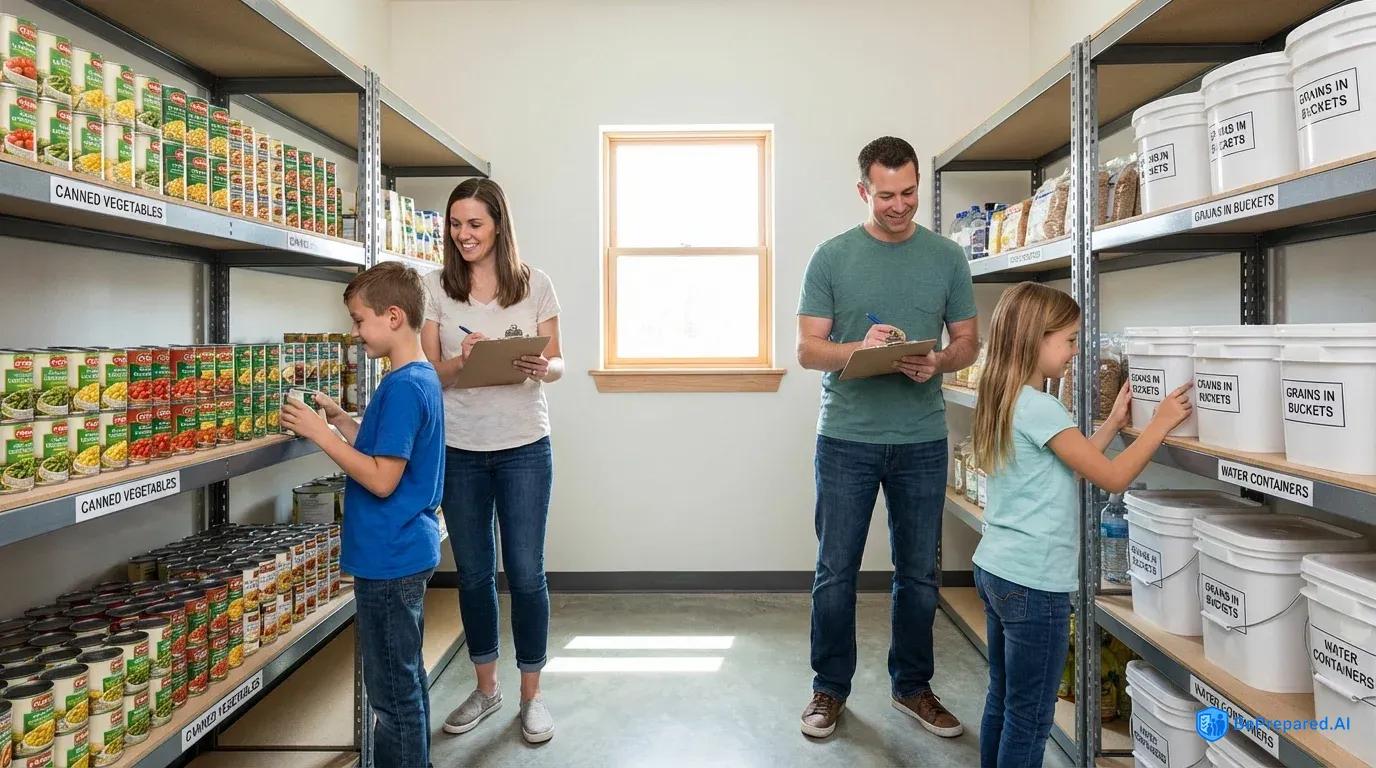
The physical reality of food storage surprises most first-time preparedness planners. Experienced preppers estimate a 30-day food supply for one person typically occupies approximately two to three cubic feet of space when efficiently organized—roughly the size of a small filing cabinet drawer or a large plastic storage bin. That sounds manageable until you multiply it by four family members and suddenly you're looking at eight to twelve cubic feet, which translates to a closet shelf, under-bed storage, and probably part of your garage or basement. The space requirements scale linearly with duration: a 90-day supply requires three times the space of a 30-day supply, and families quickly discover that food storage becomes a household infrastructure project rather than a simple pantry expansion.
Different food types occupy vastly different volumes per calorie, which dramatically affects your space calculations. Rice and dried beans pack tremendous caloric density into small volumes—a 25-pound bag of rice (approximately 0.5 cubic feet) contains roughly 40,000 calories. Canned goods, while convenient and nutritionally diverse, occupy significantly more space per calorie. A standard 15-ounce can of beans provides about 350 calories but takes up approximately 0.015 cubic feet. When you're storing 200,000+ calories for a 30-day supply, these differences compound quickly. A storage plan based entirely on canned goods might require three to four times the space of a plan emphasizing bulk grains and legumes.
Temperature and humidity control directly impact both food longevity and storage space efficiency. Food storage experts generally recommend keeping stored food between 50-70°F (10-21°C) in low-humidity environments, ideally below 15% relative humidity. Higher temperatures accelerate food degradation—every 10°F increase above 70°F can cut storage life in half for many products. This means your garage in Phoenix or attic in Houston probably won't work for long-term storage. Basements in humid climates present different challenges, where moisture can compromise packaging and promote mold growth. These environmental factors often dictate storage location more than available space, forcing creative solutions like climate-controlled closets or insulated storage areas.
Rotation and accessibility planning transforms static storage into a functional system. The oldest items must remain accessible for regular use and replacement—otherwise, you'll discover expired food when you actually need it. To maintain freshness, rotate stored food every 6 months to ensure freshness . This requires organizing storage with a first-in, first-out (FIFO) system, which typically means shallow storage (items no more than two or three deep) rather than stacking everything in a single tall pile. The accessibility requirement effectively increases your space needs by 20-30% compared to simple bulk storage. You're not just storing food; you're creating a personal grocery store with inventory management requirements.
Smart storage solutions maximize efficiency within these constraints. Shelving units designed for garage or basement use provide adjustable heights to accommodate different container sizes. Under-bed storage containers utilize otherwise wasted space, though you'll need to account for temperature variations near floors. Vacuum-sealed bags reduce volume for certain items like dried fruits or pasta. The key calculation combines your caloric targets with realistic space availability, then works backward to determine the optimal food type distribution that meets nutritional needs within your spatial constraints.
- Dry Goods (35%)
- Grains, legumes, pasta with 1-2 year shelf life; store in airtight containers at room temperature
- Fresh Produce (20%)
- Fruits and vegetables with 1-2 week shelf life; refrigerate at 40°F (4°C)
Food Type Distribution Calculator
Building a balanced food storage system requires moving beyond simple calorie counting to nutritional distribution across food categories. Calculate 25-35 pounds of food per person per month for long-term storage . This weight-based guideline provides a practical starting point, but understanding the composition of those pounds matters equally.
The most effective approach allocates approximately 50% of total calories to shelf-stable grains—rice, wheat, oats, pasta, and similar carbohydrate sources. These foods provide the caloric foundation of your storage plan because they offer exceptional shelf life (20-30 years for properly stored whole grains), high caloric density, and low cost per calorie. For a 30-day supply targeting 60,000 calories per person, this means 30,000 calories from grain sources, which translates to roughly 20-25 pounds of rice, pasta, and oats combined.
Protein sources should comprise approximately 20% of your total caloric storage, though they'll represent a higher percentage of your budget and planning attention. Shelf-stable proteins include dried beans and legumes (the most cost-effective option), canned meats (tuna, chicken, salmon), peanut butter, protein powder, and freeze-dried meats. A 30-day supply requires about 12,000 calories from protein sources per person. Since protein contains 4 calories per gram, you're looking at 3,000 grams or roughly 6.6 pounds of pure protein—but since protein sources aren't pure protein, the actual food weight increases to 15-20 pounds depending on your specific selections. Dried beans offer the best value and shelf life, while canned meats provide convenience and familiar meal options.
The remaining 30% of calories should distribute across fats, fruits, vegetables, and supplementary items. Fats deserve special attention because they provide 9 calories per gram—more than twice the density of carbohydrates or proteins. Cooking oils, canned coconut milk, nuts, and seeds deliver these essential calories and help make stored grains more palatable. Plan for roughly 18,000 calories from this category, which includes about 6,000-8,000 calories from pure fats (approximately 1.5 pounds of oil or equivalent) and the remainder from canned or dried fruits and vegetables.
Working through this distribution step by step prevents both nutritional gaps and storage inefficiencies. Start by calculating your total caloric target for the full storage period. Multiply by 0.50 to determine grain calories, then convert to actual food quantities using package information. Next, multiply total calories by 0.20 for protein targets and select your protein sources based on budget, preference, and shelf life. Finally, allocate the remaining 30% across fats, fruits, and vegetables, prioritizing items that add nutritional value and meal variety.
The practical implementation means creating a shopping list organized by category. For a single person planning a 30-day supply (approximately 60,000 calories with stress buffer): 25 pounds of mixed grains (rice, pasta, oats), 15 pounds of protein sources (dried beans, canned tuna, peanut butter), 2 pounds of cooking oil, 10-15 cans of vegetables, 10-15 cans of fruit, and supplementary items like salt, sugar, and spices. This distribution ensures you're not just surviving but maintaining reasonable nutrition and meal satisfaction.
Pros and Cons of Different Food Storage Approaches
Bulk Grains and Legumes Approach
Pros:
- Lowest cost per calorie
- Longest shelf life (20-30 years when properly stored)
- Minimal storage space per calorie
- Highly versatile for different recipes
Cons:
- Requires cooking skills and fuel
- Less convenient during emergencies
- Can become monotonous without variety
- Needs additional equipment (oxygen absorbers, mylar bags)
Canned Goods Approach
Pros:
- Ready to eat with minimal preparation
- Familiar foods reduce stress during emergencies
- No special storage equipment needed
- Good nutritional variety available
Cons:
- Higher cost per calorie
- Shorter shelf life (2-5 years typically)
- Requires significantly more storage space
- Heavier weight complicates relocation if needed
Freeze-Dried Foods Approach
Pros:
- Excellent shelf life (25+ years)
- Lightweight and compact
- Simple preparation (just add water)
- Maintains nutritional value well
Cons:
- Highest cost per calorie
- Requires water for preparation
- Limited availability in regular stores
- Some products have artificial flavors or preservatives
Hybrid Approach (Recommended)
Pros:
- Balances cost, convenience, and shelf life
- Provides meal variety and flexibility
- Optimizes storage space efficiency
- Allows strategic purchasing during sales
Cons:
- Requires more planning and organization
- Multiple rotation schedules to manage
- More complex inventory tracking
- Initial setup takes more time
Shelf life considerations add another dimension to distribution planning. While grains can last decades, canned goods typically maintain peak quality for 2-5 years, and oils can go rancid within 1-2 years even under good storage conditions. This means your rotation schedule varies by category—you'll replace oils and certain canned goods more frequently than bulk grains. The distribution calculator must account for replacement cycles to prevent waste and ensure freshness. A 90-day supply with mixed shelf lives requires more active management than a simple 30-day supply you'll rotate through regular use.
Budget Planning and Implementation
The financial reality of food storage often determines whether people actually implement their plans or leave them as theoretical exercises. Building a basic 30-day supply typically costs between $150-250 per person when purchasing strategically, though costs vary significantly by region and food choices. This means a family of four faces a $600-1,000 investment for baseline preparedness. This number can shock people into inaction, but phased purchasing over 3-6 months reduces the financial impact to $100-200 per month for the same family—comparable to a modest increase in regular grocery spending. The key difference between successful and abandoned storage plans often comes down to this purchasing strategy.
Comparing purchasing approaches reveals significant cost variations. Buying everything at once from a specialty emergency food supplier might cost $250-350 per person for a 30-day supply, offering convenience and optimized packaging but at a premium price. The opposite approach—building your supply entirely from regular grocery store purchases during sales—can reduce costs to $120-180 per person but requires more time, planning, and storage organization. A middle path combines bulk purchases of staples (rice, beans, oats) from warehouse stores with strategic grocery store sales for canned goods and proteins. This hybrid approach typically lands around $160-220 per person while balancing convenience and cost.
The phased purchasing strategy works through systematic monthly additions. Month one might focus on grains—purchase 25 pounds of rice, 10 pounds of pasta, and 5 pounds of oats per person. Month two adds protein sources: dried beans, canned tuna, peanut butter, and protein powder. Month three covers fats and produce: cooking oil, canned vegetables, and canned fruits. Months four through six fill gaps, add variety, and build toward 60 or 90-day supplies. This approach distributes costs, allows you to take advantage of sales and seasonal pricing, and prevents the storage overwhelm that comes from suddenly having hundreds of pounds of food to organize.
Price comparison methods maximize your purchasing efficiency. Track per-ounce or per-pound costs rather than package prices—a $12 twenty-five-pound bag of rice costs $0.48 per pound, while a $2 one-pound bag costs $2.00 per pound. The larger package offers 75% savings, which compounds dramatically across your full storage plan. Warehouse stores like Costco or Sam's Club typically offer the best bulk pricing on staples. Regular grocery stores often run deep sales on canned goods (stock up when canned vegetables drop to $0.50-0.75 per can instead of regular $1.25). Online retailers sometimes offer competitive pricing on specialty items like freeze-dried foods or long-term storage containers.
The budget calculation spreadsheet should track several metrics: cost per calorie (revealing which foods deliver the most energy for your dollar), cost per pound (useful for comparing similar items), and total investment toward your storage goal. This data-driven approach prevents emotional purchasing and keeps you focused on efficient progress. A simple spreadsheet with columns for item name, quantity, price, calories per unit, and total cost provides the foundation for smart purchasing decisions.
Budget planning must also account for non-food storage costs. Storage containers, shelving units, oxygen absorbers for long-term grain storage, and organization systems can add 10-15% to your total investment. A family spending $700 on food should budget another $70-100 for proper storage infrastructure. These aren't optional expenses—improper storage can ruin hundreds of dollars of food through moisture damage, pest infestation, or simple disorganization that leads to waste. The infrastructure investment protects your food investment and ensures your storage system remains functional when you actually need it.
The final comparison worth making contrasts the cost of advance preparation against emergency purchasing. During the early days of the COVID-19 pandemic, basic staples like rice, beans, and flour saw price increases of 20-50% in many markets, when they were available at all. Civil unrest scenarios often see even more dramatic price spikes in affected areas. The money you spend over six months building a 30-day supply might cost 40-70% more if you tried to assemble it during an active emergency—assuming you could find the items at all. Advance planning isn't just about readiness; it's about financial efficiency and ensuring you're not competing for scarce resources when everyone else suddenly realizes they need the same items.
Actionable Implementation Steps
Transform your calculations into reality with this systematic approach:
Week 1-2: Assessment and Planning
- Calculate exact caloric needs for each household member
- Identify dietary restrictions and special requirements
- Measure available storage space in your home
- Set your target duration (30, 60, or 90 days)
- Establish your total budget and monthly spending limit
Week 3-4: Infrastructure Setup
- Purchase or repurpose shelving units for storage
- Identify optimal storage locations (temperature and humidity)
- Acquire basic storage containers and organization tools
- Set up your inventory tracking system (spreadsheet or app)
- Purchase oxygen absorbers and mylar bags for bulk grains
Month 2: Foundation Building
- Buy bulk grains (rice, oats, pasta) to meet 50% of caloric target
- Package grains in mylar bags with oxygen absorbers
- Label everything with purchase date and contents
- Begin your inventory spreadsheet
- Research sales and pricing at local stores
Month 3: Protein Addition
- Purchase dried beans and legumes in bulk
- Add canned proteins (tuna, chicken, salmon)
- Include peanut butter and other nut-based proteins
- Continue tracking prices and updating inventory
- Test recipes using stored foods
Month 4: Fats and Produce
- Buy cooking oils and store in cool, dark location
- Stock canned vegetables and fruits
- Add nuts, seeds, and other fat sources
- Verify you're meeting the 30% remaining caloric target
- Practice FIFO rotation with current pantry items
Month 5-6: Refinement and Expansion
- Fill nutritional gaps identified during testing
- Add comfort foods and morale items (coffee, chocolate, spices)
- Expand toward 60 or 90-day targets if budget allows
- Establish firm rotation schedule
- Document your system for other household members
Ongoing Maintenance
- Rotate stored food every 6 months to ensure freshness
- Replace consumed items immediately
- Update inventory after each rotation
- Adjust calculations as family composition changes
- Review and improve your system quarterly
The mathematics of food storage preparedness ultimately comes down to converting abstract anxiety into concrete numbers, then converting those numbers into actionable plans. You can't store "enough" food any more than you can save "enough" money—these terms lack meaning without specific calculations. But you can calculate that your household needs 246,450 calories for a 30-day supply, that this requires approximately eight to twelve cubic feet of storage space, that it should distribute across specific food categories, and that it costs roughly $600-800 purchased strategically over four to six months.
These numbers transform preparedness from an overwhelming concept into a series of manageable steps. The family that works through these calculations methodically, adjusting for their specific circumstances and constraints, builds genuine resilience. The family that skips the math and hopes for the best discovers their gaps when grocery stores close and distribution centers sit idle. The difference between these outcomes isn't luck or resources—it's calculation, planning, and systematic implementation of the numbers that matter when normal systems fail.
Start with one calculation today. Determine your household's daily caloric needs. That single number becomes the foundation for everything else. From there, each subsequent calculation builds on the last until you've transformed uncertainty into a concrete plan backed by actual food sitting in actual storage containers in your actual home. The work isn't glamorous, but neither is hunger during civil unrest. Choose calculation over hope, and build your food security one number at a time.