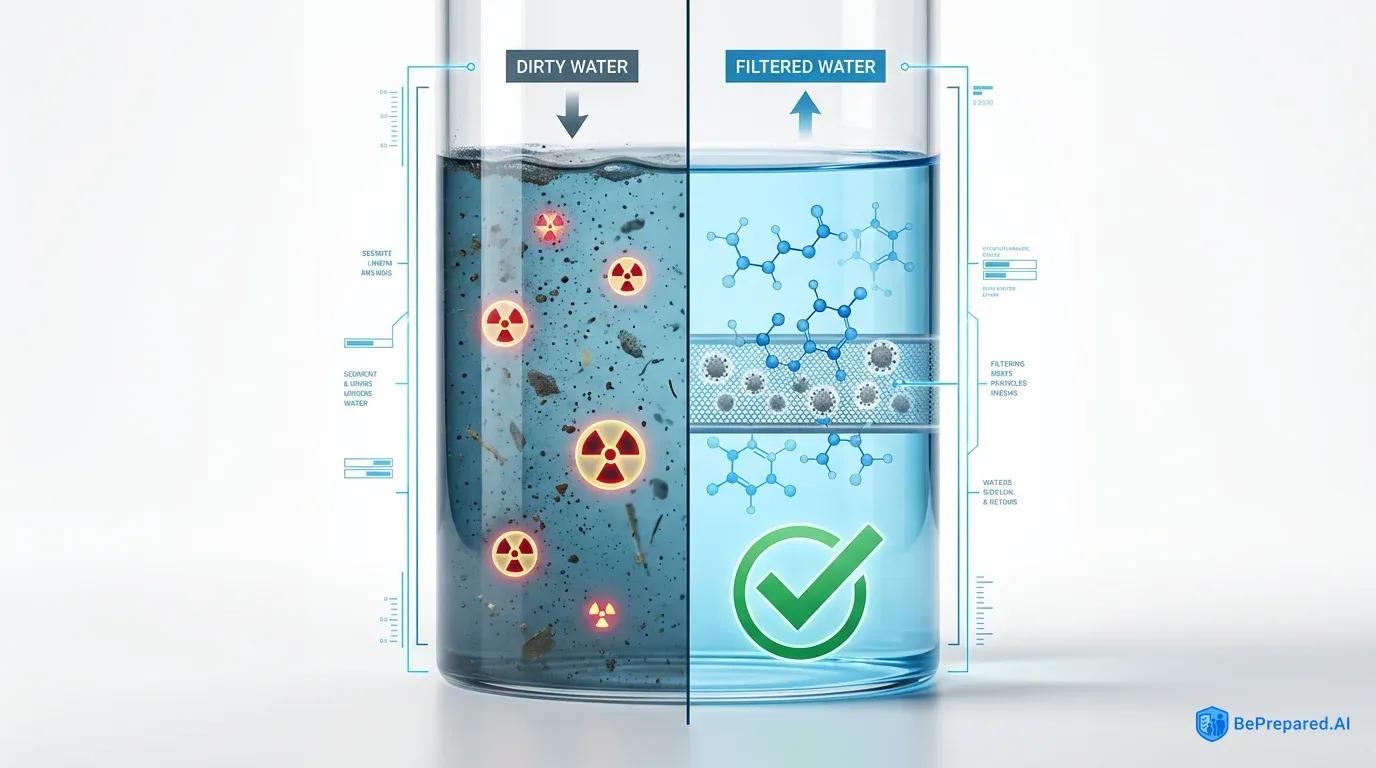
Understanding Nuclear Water Contamination Risks
When a nuclear event occurs, the invisible threat doesn't end with the initial blast or radiation exposure. Within hours, radioactive particles settle onto watersheds, reservoirs, and underground aquifers, creating a contamination challenge that can persist for months or even years. Understanding exactly what you're dealing with becomes the foundation for protecting your family's water supply.
Nuclear fallout introduces several distinct types of radioactive contaminants into water systems, each with unique characteristics and health implications. Iodine-131, one of the most immediate concerns, concentrates rapidly in the thyroid gland and can cause cancer, particularly in children. This radionuclide has a relatively short half-life, meaning its threat diminishes faster than other contaminants, but during those initial weeks, exposure can be devastating . Cesium-137 and Strontium-90 present longer-term challenges with multi-decade half-lives. Cesium distributes throughout soft tissues and can cause various cancers. Strontium behaves chemically similar to calcium, incorporating itself into bones and teeth where it delivers radiation doses for decades .
The health impacts of consuming contaminated water extend far beyond immediate radiation sickness. Low-level chronic exposure creates cumulative damage that manifests years later as increased cancer rates, genetic mutations affecting future generations, and compromised immune function. Children face exponentially higher risks because their rapidly dividing cells are more susceptible to radiation damage. Their smaller body mass means higher concentrations of radionuclides per kilogram of body weight. A seemingly safe glass of water containing just a few becquerels of radioactive material can deliver significant internal radiation doses when consumed daily over weeks or months.
The timeline of contamination risks follows a predictable but extended pattern that demands sustained vigilance. Fallout particles can contaminate water sources for weeks to months depending on environmental factors like rainfall, watershed characteristics, and the specific radionuclides involved . Surface water sources become contaminated first, within hours of fallout deposition, as particles wash directly into streams, lakes, and reservoirs. Groundwater contamination follows a delayed pattern, sometimes taking weeks or months as radioactive materials percolate through soil layers. This same soil can provide some natural filtration. Well water in areas with shallow water tables faces contamination faster than deep wells, but no source remains immune indefinitely.
Different radionuclides require different filtration approaches because they exist in water in various chemical forms and particle sizes . Some radioactive materials dissolve completely as ions, while others attach to suspended particles or form colloidal suspensions. This variation means no single purification method removes all contaminants equally effectively. Iodine can exist in multiple chemical forms, from elemental iodine to various iodide compounds, each responding differently to filtration technologies. Cesium and strontium typically dissolve as positively charged ions, making them susceptible to certain removal methods but resistant to others. Understanding these distinctions transforms water purification from guesswork into a strategic, science-based defense against invisible threats.
Primary Purification Methods
The landscape of water purification technology offers three primary methods proven effective against radioactive contamination. Each has distinct mechanisms, advantages, and limitations that determine suitability for different emergency scenarios. Choosing between them requires understanding not just their effectiveness percentages, but how they actually work and what resources they demand.
Reverse osmosis (RO) stands as perhaps the most comprehensive solution for removing radioactive contaminants from water supplies. This technology forces water through a semi-permeable membrane with pores so microscopically small that only water molecules can pass through. Radioactive particles, dissolved ions, and other contaminants remain trapped on the input side. The process removes up to 99% of radionuclides , including cesium, strontium, and iodine in their various chemical forms. The effectiveness stems from the membrane's ability to reject both particulate matter and dissolved ions, addressing contamination regardless of how the radioactive materials exist in the water.
RO systems demand specific conditions to function properly. They require consistent water pressure to operate effectively, which presents challenges in emergency scenarios where municipal water pressure may be compromised or nonexistent. This means you'll likely need a pressure pump and reliable electricity or alternative power source. The systems also waste significant water—typically producing multiple gallons of contaminated wastewater for every gallon of purified water. In a crisis where water scarcity compounds radiation concerns, this inefficiency becomes a serious consideration. The membranes themselves require protection from sediment and chlorine, necessitating pre-filtration stages that add complexity and maintenance requirements.
Despite these challenges, RO systems designed for point-of-use installation under kitchen sinks offer the most practical emergency option. They provide on-demand purified water without requiring extensive infrastructure. The compact design focuses treatment where you need it most—at the tap where you obtain drinking and cooking water.
Distillation represents humanity's oldest purification method, refined over centuries but fundamentally unchanged in its elegant simplicity. By boiling water and collecting the condensed steam, distillation physically separates water molecules from virtually everything else. Radioactive contaminants remain in the boiling chamber as concentrated residue. Distillation is effective but energy-intensive, requiring sustained heat sources to boil significant water quantities . A family of four consuming two gallons of purified water daily would need to boil and condense that volume continuously, demanding substantial fuel or electricity.
The energy requirements translate directly into practical limitations. Electric countertop distillers typically consume significant electricity per gallon produced, meaning daily requirements become substantial when operating on backup generators or solar systems with limited capacity. Manual distillation using stovetops or camping stoves provides independence from electrical infrastructure but demands constant attention and fuel supplies that may be difficult to maintain long-term. The process is also slow, with most household distillers producing only one gallon every four to six hours. You cannot simply turn on a tap for instant purified water. You must plan hours ahead and maintain continuous operation to meet daily needs.
Yet distillation offers unique advantages that make it indispensable in certain scenarios. The technology removes not just radioactive contaminants but also biological threats, chemical pollutants, and dissolved minerals. It produces exceptionally pure water regardless of source water quality. Unlike filtration systems with membranes or resins that eventually saturate and require replacement, distillation equipment consists of simple, durable components that can function indefinitely with basic maintenance. For those with reliable fuel sources or robust alternative energy systems, distillation provides long-term purification capability without dependence on supply chains for replacement filters or membranes.
Ion exchange systems employ specialized resins that selectively remove radioactive ions from water through a chemical swap process. The resins contain sites loaded with harmless ions like sodium or hydrogen. When contaminated water flows through, radioactive cesium and strontium ions attach to these sites while the harmless ions release into the water. Ion exchange resins remove 98% of radioactive cesium and strontium , making them highly effective against these specific long-lived contaminants. The technology operates without electricity, requiring only gravity flow or modest hand-pumping pressure. This provides crucial operational simplicity during infrastructure failures.
The selectivity of ion exchange represents both strength and limitation. While these systems excel at removing ionic radionuclides like cesium-137 and strontium-90, they prove less effective against radioactive iodine. Iodine can exist in multiple chemical forms, some of which don't readily exchange with resin sites. This means ion exchange works best as part of a multi-method approach rather than a standalone solution. The resins also have finite capacity, gradually saturating as they accumulate radioactive ions until they can no longer remove contaminants effectively.
Unlike simple filters you can clean and reuse, saturated ion exchange resins become radioactive waste requiring careful disposal. In extended emergencies, obtaining replacement resins becomes critical. The saturated resins you remove represent a radiation hazard that cannot simply be discarded in household trash.
The practical implementation of ion exchange systems ranges from sophisticated whole-house units to simple gravity-fed camping filters containing ion exchange media. The simpler systems offer accessibility and affordability but provide limited capacity before requiring resin replacement. Professional-grade systems include larger resin volumes and regeneration capabilities. You flush the resins with concentrated salt solutions to strip away accumulated contaminants and restore capacity. This regeneration process, however, produces highly contaminated brine that presents its own disposal challenges in nuclear emergency contexts.
Pros and Cons of Primary Methods
Reverse Osmosis
- Pros: Comprehensive removal of multiple radionuclide types, removes other contaminants simultaneously, proven technology with reliable performance
- Cons: Requires consistent water pressure and power, wastes significant water, membranes need regular replacement, complex multi-stage setup
Distillation
- Pros: Simple mechanical operation, removes virtually all contaminants, no replacement parts needed, works with any heat source
- Cons: Extremely energy-intensive, slow production rates, requires constant monitoring, produces very hot equipment during operation
Ion Exchange
- Pros: No power required, highly effective for cesium and strontium, simple gravity-fed operation possible, compact and portable options available
- Cons: Limited effectiveness against iodine, finite capacity before replacement, creates radioactive waste, silent failure mode without testing
- Reverse Osmosis (99% effective)
- Semi-permeable membrane removes dissolved solids, heavy metals, and microorganisms
- Post-mineralization (100% complete)
- Adds beneficial minerals and stabilizes pH for optimal drinking water
- Storage Tank
- Maintains purified water in sealed, sanitized container with continuous monitoring
Secondary Treatment Methods and Combinations
While primary purification methods form the foundation of radioactive water treatment, secondary methods and strategic combinations create defense-in-depth systems. They maximize safety while addressing practical limitations. Understanding how different technologies complement each other transforms adequate protection into comprehensive security.
Activated carbon pre-filtration serves as the essential first line of defense in any sophisticated purification system. These filters contain specially processed carbon with an extraordinarily porous structure. A single gram can exceed 3,000 square meters of surface area where contaminants adsorb and bind. Activated carbon excels at removing radioactive iodine, particularly when the carbon is treated with specific compounds that enhance iodine capture . The filters also protect downstream purification equipment by removing sediment, chlorine, and organic compounds that can damage reverse osmosis membranes or interfere with ion exchange processes.
The synergy between activated carbon and primary methods creates purification capability exceeding what either achieves alone. When positioned before an RO system, activated carbon removes the chlorine that would otherwise degrade RO membranes. This extends their operational life from months to years. It captures radioactive iodine that might partially pass through RO membranes in certain chemical forms. The carbon also removes organic compounds and improves taste, making purified water more palatable during extended emergencies when palatability affects consumption patterns and hydration levels. Point-of-use RO systems with activated carbon pre-filtration provide most comprehensive protection against the full spectrum of radioactive contaminants, biological threats, and chemical pollutants you might encounter.
Multi-stage systems represent the gold standard for nuclear emergency water purification, offering redundant safety through sequential treatment processes. A properly designed multi-stage system might include sediment pre-filtration to remove particles, activated carbon to capture iodine and protect downstream components, reverse osmosis for comprehensive radionuclide removal, and post-filtration carbon to polish the water and remove any residual tastes. Each stage addresses specific contaminants while compensating for the limitations of other stages. If one component fails or operates below optimal efficiency, the remaining stages continue providing protection.
This redundancy proves critical during extended emergencies when replacement parts become scarce and professional maintenance impossible. A single-method system that fails leaves you completely vulnerable. A multi-stage system degrades gracefully, maintaining partial protection even when individual components reach end-of-life. The redundancy also addresses the reality that different radionuclides respond differently to various purification methods. While RO might remove 99% of cesium, it may capture slightly less of certain iodine compounds. The activated carbon stages capture what the RO misses, pushing overall removal rates above 99.9%.
Complementary treatments extend beyond conventional filtration into approaches that reduce radiation exposure through dilution and decay management. Storing water for extended periods before consumption allows short-lived radionuclides to decay naturally, reducing contamination without any purification equipment. After sufficient time, short-lived isotopes diminish to less than one-thousandth of original levels. Strategic storage means you can treat and store water in rotation, always consuming the oldest stocks while freshly purified water ages in storage tanks. This approach works best when combined with active purification, using time as an additional protective factor rather than the sole defense.
Blending purified water with stored rainwater collected before contamination events dilutes radioactive concentrations while stretching purified water supplies further. If you purified water to 1% of original contamination levels and blended it equally with clean stored water, the result contains just 0.5% of original contamination. This represents a minimal additional improvement, but one that costs nothing and reduces the burden on purification systems. These complementary approaches require planning and infrastructure established before emergencies strike. Nuclear preparedness demands advance preparation rather than reactive scrambling.
System Selection and Implementation
Choosing the right purification system requires balancing effectiveness, cost, operational demands, and your specific circumstances. The balance transforms theoretical protection into practical, sustainable safety. The perfect system on paper becomes useless if you cannot maintain it or if it demands resources you lack during actual emergencies.
Cost comparison reveals dramatic differences not just in initial purchase prices but in long-term operational expenses that often exceed equipment costs. A quality point-of-use reverse osmosis system suitable for nuclear emergency use typically costs several hundred dollars. Replacement membranes and filters add ongoing annual expenses under normal use—potentially more during extended emergency operation when you're processing higher volumes and possibly more contaminated source water. Countertop distillation units range from budget models to premium systems with automatic operation and higher capacity. The real cost lies in energy consumption. Distilling significant daily volumes requires substantial ongoing energy expenses, far more when operating on generator fuel or propane.
Ion exchange systems span the widest price range, from affordable gravity-fed camping filters containing small amounts of exchange resin to expensive whole-house systems with large resin volumes and regeneration capability. The camping-style filters offer attractive entry-level pricing but provide limited capacity before requiring replacement cartridges. Professional systems with regenerable resins cost more initially but offer lower long-term costs if you can obtain regeneration chemicals and safely dispose of contaminated brine. Multi-stage systems combining multiple technologies start at moderate prices for quality units and can exceed several thousand dollars for comprehensive whole-house installations. This investment provides the redundant protection and operational flexibility that justifies the expense for serious preparedness.
Point-of-use systems are most practical for emergency scenarios because they concentrate protection where you need it most . They treat water at the kitchen tap where you obtain drinking and cooking water rather than treating water for toilets, laundry, and other non-consumption uses. This focused approach reduces equipment costs, maintenance burden, and consumable usage while still protecting health. A family can manage hygiene and sanitation with untreated or minimally treated water while reserving purified water strictly for consumption. This stretches both purification capacity and stored supplies significantly further.
Installation requirements vary from plug-and-play simplicity to projects requiring plumbing skills and permanent modifications to your home. Countertop distillers demand only an electrical outlet and counter space, making them ideal for renters or those wanting systems they can relocate quickly. Under-sink RO systems require drilling a hole for the dedicated faucet, connecting to cold water supply lines, and routing a drain line for wastewater. This is manageable for moderately handy homeowners but potentially requires professional installation. The installation becomes permanent infrastructure that adds value to your preparedness but cannot easily relocate if you move.
Whole-house systems typically demand professional installation, with costs varying depending on system complexity and your home's plumbing configuration. These systems integrate into your home's main water line, treating all incoming water and requiring space for equipment, often in basements or utility rooms. The permanence and complexity create dependency on your current location. Whole-house systems prove most appropriate for those committed to long-term residence in areas where nuclear threats justify the investment.
Maintenance needs determine whether systems provide reliable long-term protection or become expensive failures during extended emergencies. RO systems require pre-filter replacement every six to twelve months, carbon filter replacement annually, and membrane replacement every two to four years under normal conditions. During emergency use with potentially more contaminated source water, these intervals compress significantly. You must stock replacement filters and membranes in advance, as supply chains will likely fail during actual nuclear emergencies. Regular maintenance is crucial for system effectiveness . A clogged pre-filter reduces water pressure below operational thresholds. An exhausted membrane allows contaminants to pass through, providing false security that may be worse than no system at all.
Distillers require descaling to remove mineral deposits that accumulate in boiling chambers. This typically occurs every 20 to 40 gallons of production depending on source water hardness. This simple maintenance uses citric acid or vinegar and takes minutes. Neglecting it reduces efficiency and eventually damages heating elements. The simplicity of distiller maintenance makes it attractive for long-term emergency use. You can descale units indefinitely without depending on replacement parts.
Ion exchange systems need resin replacement or regeneration on schedules determined by source water contamination levels and total volume processed. Unlike filters with obvious flow reduction when clogged, ion exchange resins fail silently. They continue to pass water while no longer removing contaminants. This invisible failure mode makes regular testing essential, adding operational complexity and requiring test equipment or supplies that may be unavailable during emergencies. Some systems include built-in monitoring that tracks gallons processed and alerts when regeneration or replacement is needed. These electronic systems add cost and potential failure points.
Use our plan builder to create a personalized preparedness plan based on your location and family needs for CBRN water supplies and maintenance.
Emergency Implementation Protocol
When radiation alerts sound and contamination becomes imminent or confirmed, your response speed and systematic approach determine whether your purification system provides protection or fails when you need it most. The initial 48 hours are most critical for implementation. This window determines whether you capture clean water before contamination, establish purification capability before supplies run out, and protect your family before significant exposure occurs .
Your initial response steps begin the moment you receive credible warning of a nuclear event, whether through emergency alert systems, news reports, or other reliable sources. Before radioactive fallout arrives, immediately fill every available container with tap water while it remains uncontaminated. Bathtubs, clean trash cans lined with plastic bags, water storage barrels, cooking pots—every vessel becomes precious inventory. A standard bathtub can hold substantial gallons, providing days or weeks of drinking water for a family of four. This captured clean water reduces immediate pressure on your purification system and provides blending stock for diluting purified water later.
Simultaneously, verify your purification system's operational status. If you've maintained equipment properly, this should be a quick confirmation. Discovering failures now rather than after contamination arrives could save lives.
Seal your stored water immediately using plastic wrap, lids, or any covering that prevents fallout particles from settling into containers. Even a thin layer of plastic film provides substantial protection against particulate contamination. Move sealed containers away from exterior walls and preferably to basement locations where building mass provides radiation shielding. This stored water becomes your primary supply for the first days or weeks. It allows short-lived radionuclides in the environment to decay before you begin processing potentially contaminated sources.
System startup procedure follows a logical sequence that ensures proper operation and confirms effectiveness before you depend on purified water. For RO systems, flush the entire system thoroughly, running three to five gallons through before collecting water for consumption. This flushes manufacturing residues, stagnant water from storage, and verifies proper flow and pressure. Check for leaks at all connections, as even small leaks waste precious water and indicate potential system failures. Verify wastewater is draining properly. Backed-up waste water can contaminate purified output. If your system includes a storage tank, fill it completely and verify the automatic shutoff functions correctly. This prevents overflow and confirms pressure switches work properly.
Distillation units require verification that heating elements function, condensation coils aren't blocked, and collection containers are clean and properly positioned. Run a complete cycle with clean water before processing potentially contaminated sources. Confirm the unit produces expected output volumes in expected timeframes. This test cycle establishes baseline performance for comparison if you suspect later problems.
For ion exchange systems, ensure resins are properly positioned and wetted, verify flow rates match specifications, and confirm any monitoring systems function correctly. Some resins require initial flushing to remove fines and prepare for service.
Monitoring requirements extend throughout the emergency period, providing essential verification that your purification continues working effectively as conditions change and equipment ages. Regular testing is essential for safety assurance , yet poses challenges during actual emergencies when professional testing services are unavailable and supply chains for test kits fail. The solution lies in establishing testing capability before emergencies strike. Stockpile appropriate test equipment and supplies as part of your preparedness infrastructure.
Radiation detection equipment provides the most direct monitoring approach. Survey meters or Geiger counters can detect radiation in water samples. Interpreting results requires understanding that these devices measure different radiation types with varying sensitivity. Alpha and beta radiation from ingested radionuclides cause the most internal damage. Many affordable detectors primarily measure gamma radiation. More sophisticated equipment like scintillation detectors provides better sensitivity and specificity but costs thousands of dollars and requires training to operate effectively.
For most families, a quality Geiger counter offers reasonable capability to compare source water radiation levels against purified output. This verifies your system reduces contamination even if you cannot quantify exact radionuclide concentrations.
Establish regular testing schedules rather than random checks. Test source water and purified output daily during the first week of emergency operations, then weekly if results consistently show effective purification. Compare readings against baseline measurements from uncontaminated water captured before the event. This provides reference points for evaluating results. Document all measurements with dates, times, and conditions, creating records that reveal trends and potential degradation in system performance. If purified water readings begin rising relative to earlier measurements, this signals possible system failure requiring immediate investigation and corrective action.
Beyond radiation testing, monitor system performance indicators that signal problems before complete failure. For RO systems, track flow rates and wastewater ratios. Declining flow suggests clogged pre-filters or failing membranes. Changing wastewater ratios indicate membrane damage allowing contaminants through. Distillers should maintain consistent production rates and energy consumption. Changes suggest scaling buildup or heating element problems. Ion exchange systems should maintain steady flow rates without pressure increases that indicate resin bed compaction or fouling.
The protocol demands discipline and systematic execution when stress and fear naturally create chaos. Written checklists and procedures prepared during calm times provide essential structure when crisis undermines clear thinking. Practice your implementation protocol periodically, running through startup procedures and testing protocols until they become automatic. This preparation transforms emergency implementation from a stressful, error-prone scramble into a confident, systematic process that provides the protection you've invested in creating.
Actionable Recommendations
Based on the analysis of purification methods and emergency requirements, here are specific recommendations for different preparedness levels:
Minimum viable protection: Install a point-of-use reverse osmosis system with activated carbon pre-filtration under your kitchen sink. Stock one year's worth of replacement filters and membranes. Acquire a basic Geiger counter for testing. This combination provides comprehensive radionuclide removal while remaining affordable and practical for most households.
Enhanced protection: Add a countertop distiller as backup to your RO system. Store fuel or ensure alternative power capability to run the distiller if electrical infrastructure fails. Maintain sealed containers for capturing 100+ gallons of clean water on short notice. This redundancy ensures continued purification capability even if one system fails.
Comprehensive protection: Implement a multi-stage whole-house system with RO, activated carbon, and ion exchange components. Install point-of-use systems at multiple taps. Maintain distillation capability as tertiary backup. Stock two years of replacement parts for all systems. Acquire professional-grade radiation detection equipment and learn proper testing protocols. This approach provides maximum protection with multiple redundant systems.
Critical supplies to stockpile: Replacement filters and membranes for your specific systems, descaling agents for distillers, regeneration chemicals for ion exchange resins if applicable, radiation test equipment and calibration sources, sealed water storage containers, and detailed maintenance documentation for all equipment.
Testing and maintenance schedule: Test all systems quarterly during normal times to ensure operational readiness. Replace consumables on manufacturer schedules, not when they fail. Document all maintenance with dates and observations. Practice emergency startup procedures annually. Verify radiation detection equipment functions properly and batteries remain fresh.
Nuclear water contamination represents one of the most insidious threats in disaster scenarios—invisible and persistent, capable of delivering devastating health impacts through the simple act of drinking. Yet understanding the mechanisms of contamination, the technologies for purification, and the protocols for implementation transforms this threat into a manageable challenge. Multiple purification methods working in combination provide comprehensive protection, while thoughtful system selection balances effectiveness with practical sustainability. Regular maintenance and disciplined testing ensure your protection remains effective throughout extended emergencies.
The investment in equipment, knowledge, and preparation provides something precious beyond measure—the ability to provide safe water for your family when the invisible threat settles onto your watershed, turning a basic necessity into a potential hazard. That capability, established before crisis strikes, represents preparedness at its most fundamental and essential level.