Understanding Food Rotation Systems
Sarah opened her basement storage closet and pulled out what she thought would be a quick dinner solution during a particularly hectic week. The canned soup she grabbed had expired eighteen months ago. As she dug deeper into her emergency food supply, she discovered an uncomfortable truth: nearly a quarter of her carefully assembled stockpile had passed its prime. She'd spent hundreds of dollars and countless hours building what she believed was a reliable safety net, only to find that without a proper rotation system, much of it had become unusable waste.
This scenario plays out in households across the country more often than most people realize. Food rotation isn't just about keeping your emergency supplies fresh—it's about transforming your stockpile from a static collection gathering dust into a dynamic, living system that actually works when you need it. At its core, food rotation means systematically using and replacing stored food items to ensure nothing sits unused until it expires. The concept seems simple enough, yet the execution trips up even the most well-intentioned preparedness enthusiasts.
The benefits of implementing a systematic rotation approach extend far beyond simply avoiding waste. Proper rotation can significantly extend the effective storage life of your supplies. This happens because you're actively monitoring conditions, catching potential problems early, and ensuring items are stored optimally throughout their lifecycle. When you rotate regularly, you also become intimately familiar with what you actually have, eliminating the duplicate purchases that plague static storage systems. You'll know exactly which items you're running low on and which are overstocked, allowing for more strategic purchasing decisions.
Most shelf-stable foods are best when used within one year . Understanding this timeline helps you plan your rotation schedule and purchasing patterns. You're not building a bunker to survive decades underground—you're creating a practical system that keeps your household supplied with fresh, usable food whether you're facing a temporary emergency or just a busy week where grocery shopping doesn't happen.
Yet despite these clear advantages, many households waste substantial portions of their emergency food through poor rotation practices. The mistakes fall into predictable patterns. Some people organize their supplies once and never touch them again, creating what essentially becomes a time capsule rather than a usable resource. Others lack any organizational system at all, randomly placing new purchases wherever space exists, making it nearly impossible to track what needs using first. Perhaps the most common error is the "special occasion" mentality—treating emergency food as something separate from daily life, reserved only for disasters, which guarantees it will age out before ever being used.
The psychological barrier proves just as significant as the logistical one. Many people resist using their emergency supplies because doing so feels like depleting their safety margin. This mindset creates a paradox where the very supplies meant to provide security become a source of waste and inefficiency. Breaking this cycle requires a fundamental shift in thinking: your emergency food storage should function as an extension of your regular pantry, not a separate entity. When you embrace rotation as an ongoing practice rather than an occasional task, you create a system that's both practical for daily life and reliable during emergencies.
Setting Up Your Rotation System
Building an effective rotation system starts with understanding how you'll physically organize your space. The foundation of any successful rotation system is accessibility—you need to see what you have and reach what you need without moving mountains of supplies. This means rejecting the common approach of stacking boxes deep in closets or garages where items in the back become essentially invisible and inaccessible.
The gold standard for physical organization is the FIFO principle: First In, First Out. This method can substantially reduce waste compared to unorganized storage. To make FIFO work in practice, you need to create a flow system where new items enter from one side and older items are taken from the other. Picture a grocery store shelf—stockers add new products from behind while customers take from the front. You're creating the same principle in your home.
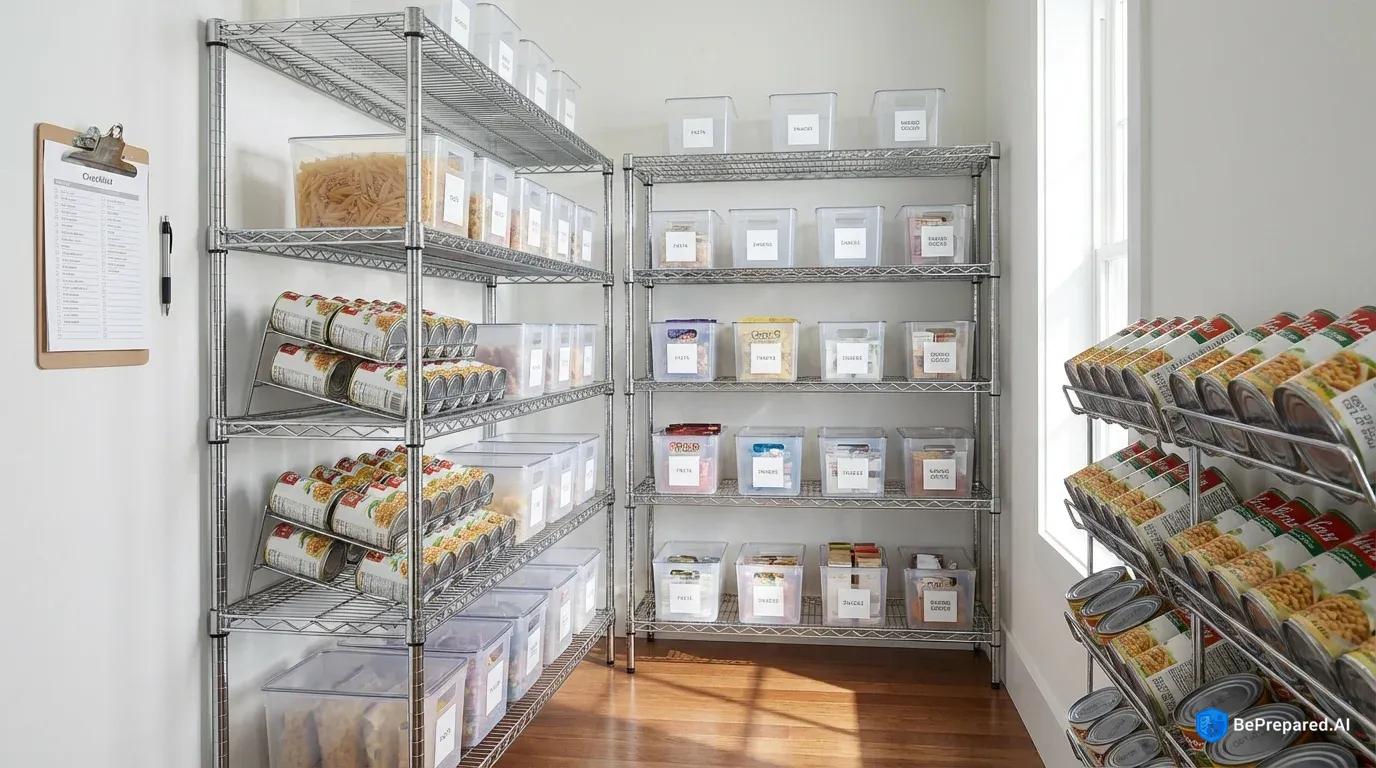
For pantry shelving, this might mean using can organizers that slope downward, allowing cans to roll forward as you remove the front one. When you add new purchases, they go in the elevated back, automatically positioning themselves behind older stock. For larger storage areas, consider installing shelving units that you can access from both sides. Load new supplies from the back, retrieve items for use from the front.
Place new items at the back of the storage area and older ones in front . If you're working with standard shelving against a wall, commit to the extra effort of pulling items forward and loading new purchases behind them. It takes an additional thirty seconds per shopping trip but saves hours of sorting later and prevents significant waste.
Your labeling system serves as the communication backbone of your rotation strategy. Every item should clearly display its purchase date or expiration date where you can see it at a glance. For commercially packaged foods, the printed date codes often hide in obscure locations or use confusing formats. Combat this by adding your own labels using a permanent marker or label maker. Write the month and year in large, clear numbers on the top or front of each item—whichever surface faces you when the item sits on your shelf.
Develop a color-coding system to provide instant visual feedback about age and priority. Use colored dots or tape to mark items by purchase quarter: green for the current quarter, yellow for last quarter, orange for two quarters ago, and red for anything older. This creates an immediate visual alert system. When you scan your shelves and see predominantly green with some yellow, you know you're in good shape. If you're seeing orange and red, you know you need to prioritize using those items immediately.
The physical organization extends to grouping like items together and arranging them by expiration timeline. Keep all your canned vegetables in one zone, all your grains in another, all your proteins in a third. Within each category, arrange items from shortest to longest shelf life. This clustering serves multiple purposes: it prevents you from buying duplicates of items you already have plenty of, it makes meal planning easier because you can see all your options at once, and it allows you to quickly identify categories that need replenishing.
Inventory tracking tools transform your rotation system from a manual guessing game into a data-driven operation. Digital tracking systems can significantly improve rotation compliance compared to relying on memory alone. The simplest approach uses a spreadsheet with columns for item name, quantity, purchase date, expiration date, and location. Update it every time you add or remove items from storage. This sounds tedious, but it typically takes less than five minutes per shopping trip once you establish the habit.
For those who prefer technology solutions, several smartphone apps specifically designed for food storage management can streamline the process. These apps often include barcode scanning capabilities, automated expiration alerts, and recipe suggestions based on items nearing their use-by dates. The key is choosing a system you'll actually maintain. A sophisticated app you never update is worthless compared to a simple notebook you reference consistently.
Create a master inventory list that lives in an accessible location—posted inside a cabinet door, kept in a kitchen drawer, or saved as a bookmark on your phone. This list should provide a snapshot of your entire storage system, organized by category and location. When you need to find something specific or check if you have an item before shopping, you can reference this list rather than physically digging through your supplies. Update it during your regular rotation maintenance checks to keep it accurate.
- Data Accessibility
- Paper: Limited to physical location vs. Digital: Access from anywhere with internet connection
- Search Capability
- Paper: Manual scanning through pages vs. Digital: Instant keyword search and filtering
- Data Security
- Paper: Vulnerable to physical damage vs. Digital: Automated backups and encryption options
Tracking and Maintenance
The debate between digital and paper tracking systems often comes down to personal preference and technological comfort, but each approach offers distinct advantages that make them suitable for different situations. Digital systems excel at providing automated reminders, generating reports, and allowing easy updates from anywhere. Paper systems never run out of battery, don't require internet connectivity, and often feel more tangible and immediate for people who think better with pen in hand.
Digital tracking through dedicated apps or spreadsheets brings powerful capabilities to your rotation system. Apps designed for food storage can send push notifications when items approach expiration, automatically calculate how long your supplies would last based on your household size, and even suggest recipes using ingredients you need to consume soon. Spreadsheet programs like Excel or Google Sheets offer flexibility to customize your tracking exactly to your needs while providing sorting and filtering capabilities. You can sort by expiration date to see what needs using first, filter by category to check your grain supplies, or search for specific items instantly. Digital tracking apps may increase compliance because they remove the friction of manual updates and provide convenient reminders.
Paper tracking systems offer reliability and simplicity that digital solutions sometimes lack. A clipboard hanging in your storage area with a simple grid showing item names, quantities, and dates requires no technical knowledge and works even during power outages. Many people find the physical act of writing helps them remember and engage with their inventory more actively than typing into a device. Paper systems also create a visible presence—that clipboard hanging on the wall serves as a constant reminder to maintain your rotation, whereas an app icon on your phone can be easily ignored.
The hybrid approach combines the strengths of both methods. Maintain your detailed inventory digitally for the searchability and backup capabilities, but keep a paper summary sheet in your storage area for quick reference and immediate updates. When you remove items, mark them on the paper sheet, then update your digital system during your monthly review. This gives you the convenience of digital tracking with the immediate accessibility of paper.
Check expiration dates and rotate stock every six months . Set a recurring calendar reminder for the same day each month or every other month—perhaps the first Saturday or the fifteenth—and block out thirty to forty-five minutes for your rotation review. Consistency matters more than the specific timing; what's important is establishing a rhythm that becomes automatic.
Regular rotation checks can substantially reduce expired food compared to less frequent reviews. During your check, start by scanning your entire storage area with your inventory list in hand. Look for any items that have shifted position, fallen behind others, or otherwise escaped the normal rotation flow. Check expiration dates on items in the front of each category—these should be your oldest items if your FIFO system is working correctly. If you find newer items in front of older ones, reorganize immediately to correct the flow.
Compare your physical inventory against your tracking system. Discrepancies between what your list says you have and what's actually on the shelf indicate either tracking errors or consumption you forgot to record. Investigate and correct these differences, because an inaccurate inventory undermines your entire system. Count quantities for each item and note any categories running low. This is your signal to watch for sales or add items to your next shopping list.
Expiration monitoring requires a tiered approach based on how close items are to their dates. Create three categories: items expiring within three months (immediate priority), items expiring within six months (elevated priority), and everything else (normal rotation). For items in the immediate priority category, make concrete plans to use them. Add them to your meal plan for the coming weeks, or if you have more than you can reasonably consume, consider donating unexpired items to food banks before they become waste. Items in the elevated priority category should move to the front of their sections and get incorporated into your regular cooking more frequently.
Pros and Cons of Different Tracking Methods
Digital Tracking Systems
Pros:
- Automated expiration alerts prevent items from being forgotten
- Searchable databases let you find specific items instantly
- Cloud backup protects your data if devices fail
- Easy to update from anywhere using smartphone apps
- Can generate reports showing consumption patterns and shopping needs
Cons:
- Requires consistent device charging and internet access
- Learning curve for new software or apps
- Data entry can feel tedious without barcode scanning
- System fails during power outages or technical problems
- May create distance from physical inventory awareness
Paper Tracking Systems
Pros:
- Works without electricity or technology
- Immediate visibility in storage area serves as constant reminder
- No learning curve or technical barriers
- Physical writing may improve memory and engagement
- Simple to customize for your exact needs
Cons:
- No automated reminders or alerts
- Manual searching through lists takes more time
- Easy to lose or damage single paper copies
- Updates require physical presence in storage area
- Harder to analyze trends or generate reports
Ready to strengthen your preparedness? Create a personalized preparedness plan based on your location and family needs.
Practical Implementation Strategies
Getting your family involved transforms food rotation from a solitary chore into a shared responsibility that's more likely to succeed long-term. Family participation can dramatically increase rotation success because it distributes the workload, creates accountability, and ensures the system continues functioning even when the primary organizer is unavailable. Start by explaining why rotation matters in terms everyone can understand—show them those expired cans you discovered, calculate how much money was wasted, and discuss how a working system protects the family's security and budget.
Assign age-appropriate roles to each family member. Younger children can help check dates and group like items together during organization sessions. Teenagers can take ownership of specific categories, managing the rotation for all canned goods or all grains. Adults can split responsibilities by area or function—one person handles purchasing and initial storage, another manages the regular reviews and tracking updates. When everyone has a defined role, the system becomes part of the household routine rather than one person's project that others ignore.
Make rotation visible and rewarding. Create a chart showing your family's progress toward zero waste goals. Celebrate months where nothing expires unused. Some families turn rotation into a game, challenging members to create the best meal using items that need consuming soon. This gamification approach works particularly well with children and teenagers who might otherwise view emergency preparedness as boring adult business.
Rotation schedule examples provide concrete frameworks you can adapt to your situation. A basic weekly schedule might include a quick five-minute scan every Sunday when you plan the coming week's meals, specifically looking for items approaching expiration that you can incorporate into your menu. Every six months, you conduct the full inventory review described earlier. Quarterly, you do a deep organization session where you pull everything out, clean shelves, check for pest issues or environmental problems, and completely reorganize based on current expiration dates.
For larger storage systems, consider a zone rotation approach where you focus on one category or area each week rather than trying to review everything at once. Week one might be canned proteins, week two is grains and pasta, week three is canned fruits and vegetables, week four is miscellaneous items and supplies. This distributes the workload more evenly and makes each session more manageable, particularly for people with limited time or physical constraints that make handling large quantities difficult.
Regular schedules can substantially reduce expired food compared to ad-hoc approaches. The key is building rotation activities into existing routines rather than treating them as separate tasks. Link your rotation check to something you already do regularly—perhaps when you pay bills, when you do your major grocery shopping, or when you perform other household maintenance like changing HVAC filters. This association helps the habit stick.
Common challenges arise predictably, and having solutions ready prevents them from derailing your system. The "out of sight, out of mind" problem plagues storage areas in basements, garages, or spare rooms. Combat this by keeping a portion of your rotating stock in your regular kitchen pantry where you see it daily. Use items from this visible supply for everyday cooking, then replenish from your larger storage area, creating a natural flow that keeps you engaged with your entire system.
The "too busy to maintain it" challenge affects everyone during particularly hectic periods. Build buffer time into your system by choosing items with longer shelf lives and maintaining your rotation when life is calm, so you can coast through busy periods without disaster. Consider your regular check non-negotiable, like paying your mortgage—it's thirty minutes that protects hundreds or thousands of dollars of investment and your family's security.
Inconsistent purchasing patterns can disrupt rotation flow. Maybe you buy heavily during sales, creating waves of items with similar expiration dates, followed by months of buying nothing. This makes smooth rotation difficult because you're not steadily cycling through inventory. Address this by thinking in terms of replacement rate rather than stockpiling. When you use an item, add it to your shopping list. When you find a sale, buy what you need to replace recent consumption plus a modest increase to your overall stock, rather than buying years' worth at once.
Space limitations force creative solutions. If you can't dedicate entire rooms to storage, use vertical space more effectively with shelf risers and stackable organizers. Store items under beds in flat, labeled containers. Use the back of closet doors for hanging organizers holding smaller items. The goal is making every item visible and accessible, even in tight quarters. A smaller, well-organized system outperforms a larger chaotic one every time.
The final implementation strategy is treating your rotation system as a living practice that evolves with your needs. Review the system itself twice yearly—not just the food inventory, but the organizational method, the tracking tools, the schedule, and the role assignments. Ask what's working well and what's creating friction. Adjust accordingly. Maybe you discover that regular checks work better on Sunday afternoons than Saturday mornings. Perhaps your teenager has lost interest in their assigned category and needs a different responsibility.
Systems that adapt survive; rigid systems break down when circumstances change. Your food rotation should serve your family's real-world needs, not exist as an abstract ideal that creates stress rather than security. The best rotation system is the one you'll actually use consistently, not the most elaborate or sophisticated one you read about. Start simple, build the habit, then refine your approach based on what works for your household's specific situation, space constraints, and daily rhythms.