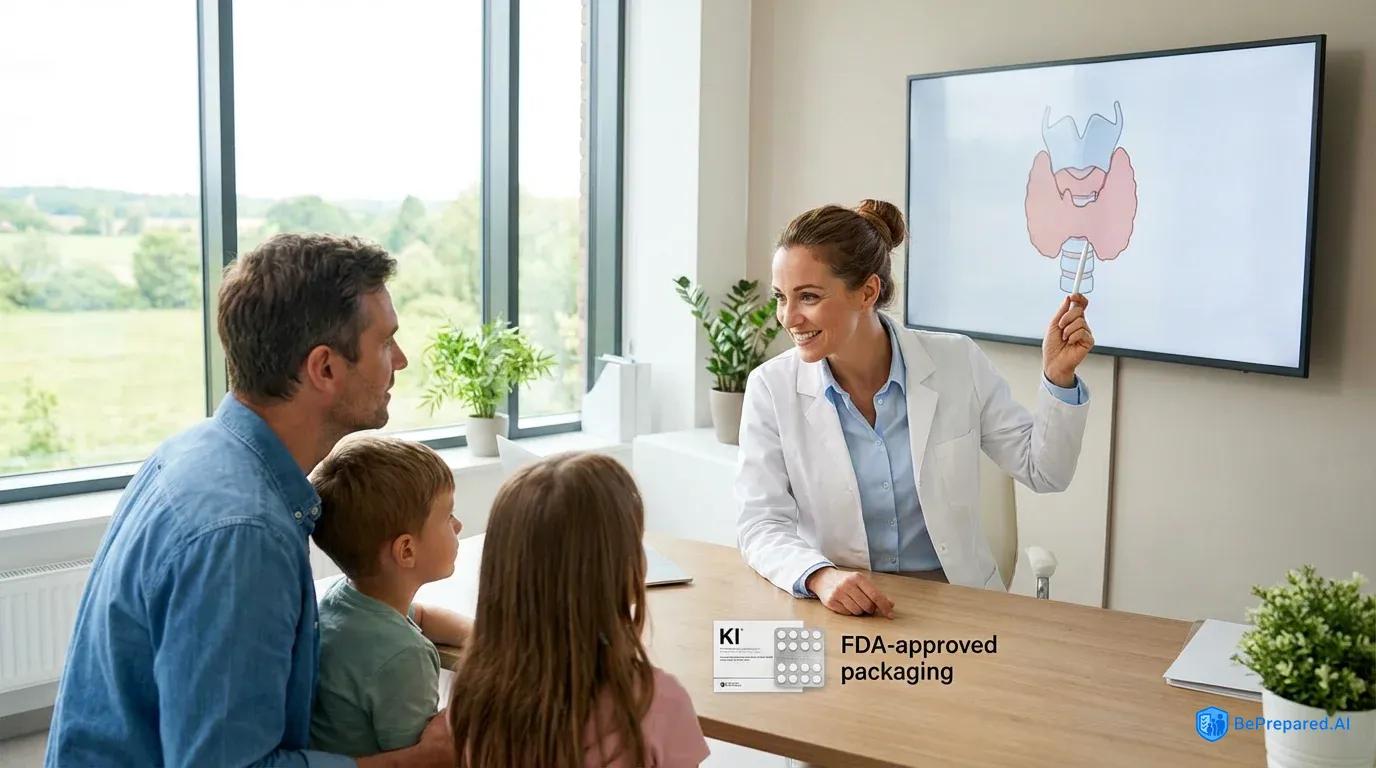
Understanding Potassium Iodide (KI) for Nuclear Events
When Sarah's family moved to within 50 miles of a nuclear power plant, her neighbor handed her a small bottle of pills with a knowing look. "Potassium iodide," the neighbor said. "Just in case." Sarah assumed she'd discovered some kind of miracle radiation shield—a pill that would protect her family from any nuclear disaster. She was only partially right, and the distinction matters enormously.
- Dose Measurements
- Parallel display of tablet (mg) and liquid (mL) equivalents for each age group with precise conversion ratios
- Safety Parameters
- Maximum safe dosage limits and contraindication indicators for each age group
How KI Actually Works
KI works by saturating the thyroid gland with stable, non-radioactive iodine . Your thyroid gland—that butterfly-shaped organ in your neck—becomes completely filled with non-radioactive iodine when you take the pill. Think of it like filling every parking space in a lot: when a nuclear event releases radioactive iodine-131 into the environment and you breathe it in or consume contaminated food or water, that dangerous isotope finds no room to lodge in your thyroid because stable iodine has already claimed every receptor site. The radioactive iodine passes through your system without being absorbed, eventually leaving your body through normal elimination processes.
This protection is both powerful and remarkably limited. The thyroid gland concentrates iodine because it needs this element to produce hormones that regulate metabolism, growth, and development. During a nuclear reactor accident or detonation, radioactive iodine-131 becomes one of the most significant threats because it behaves identically to stable iodine in your body—except it emits radiation that can cause thyroid cancer, particularly in children whose thyroid cells divide rapidly . By blocking this one pathway, KI prevents what could otherwise become a widespread public health crisis. Following the Chernobyl disaster, regions that distributed potassium iodide saw dramatically lower rates of thyroid cancer compared to areas that didn't .
What KI Doesn't Protect Against
Here's what keeps preparedness experts awake at night: the widespread misconception that KI offers comprehensive radiation protection. KI only protects the thyroid gland and not other organs from radiation . It doesn't shield you from external radiation exposure—standing near a radiation source will harm you whether you've taken KI or not. The cesium-137, strontium-90, plutonium, and dozens of other radioactive materials released during nuclear events will affect your body exactly as they would without KI. You could take a handful of potassium iodide tablets and still suffer severe radiation sickness from gamma rays or contamination from other isotopes.
The other critical limitation involves timing and duration. Potassium iodide isn't a vaccine that provides long-term immunity—it's a temporary shield with a limited protection window. Your body continuously processes and eliminates the iodine you've ingested, so protection wanes as time passes . This means KI works as part of a time-sensitive response to a specific event, not as general protection you can take once and forget about. Understanding these boundaries transforms KI from a misunderstood "radiation pill" into what it actually is: a targeted, time-dependent tool for preventing one specific type of radiation damage during the acute phase of a nuclear emergency.
Proper Dosing and Timing
The FDA's dosing guidelines for potassium iodide read like a precision instrument manual because, fundamentally, that's what they are—instructions for calibrating your body's defense against a specific threat . Getting the dose wrong means either inadequate protection or unnecessary side effects, and the correct amount varies dramatically based on age.
Age-Based Dosing Requirements
Adults over 18 and nursing mothers should take 130mg of KI —typically one tablet, though you'll need to check your specific product since formulations vary. Pregnant women also take this same 130mg dose despite common misconceptions that pregnancy requires adjustment; the CDC explicitly confirms that protecting the mother's thyroid (and consequently the developing fetus) outweighs potential risks . Children between 3 and 18 years old require 65mg , which usually means half a tablet or one smaller-dose pediatric tablet. The dosing gets more nuanced for the youngest and most vulnerable: infants and toddlers from one month to 3 years old need 32mg, while newborns under one month receive just 16mg .
These age-based distinctions exist because thyroid size, metabolic rate, and radiation sensitivity change throughout development. A newborn's thyroid is extraordinarily small and vulnerable, requiring protection but also at higher risk from the side effects of excessive iodine. An adolescent's rapidly growing thyroid needs more robust protection but can handle a larger dose. These recommendations come from decades of research into thyroid physiology and radiation medicine .
The Critical Timing Window
Timing transforms KI from merely helpful to genuinely protective. KI is most effective when taken 48 hours before to 8 hours after exposure . Take KI during this period, and you achieve maximum thyroid protection. The protection curve slopes downward from there but may remain significant: taking KI beyond the optimal window could still provide partial protection, though effectiveness diminishes with time .
Beyond 24 hours after initial exposure, the calculus changes entirely. Most of the radioactive iodine that would have been absorbed has either already lodged in your thyroid or passed through your system. Taking KI at this point offers minimal benefit and exposes you to side effects without corresponding protection. This is why authorities emphasize that KI is an emergency medication for acute events, not a daily supplement or preventive measure you take "just to be safe" .
Duration and Repeat Dosing
The duration question trips up many people building preparedness plans. A single dose of potassium iodide provides protection for a limited period. If you're in a contaminated environment where you continue breathing radioactive iodine or consuming contaminated food and water, you may need subsequent doses. The FDA indicates that adults can potentially take one dose daily for several days if exposure continues, but this requires guidance from public health authorities who can assess the ongoing threat . Children and infants face stricter limitations—generally, the youngest populations should receive only a single dose unless public health officials specifically recommend otherwise, as their thyroids are more sensitive to both radiation and excess iodine .
Picture this scenario: A nuclear power plant 30 miles from your home experiences a serious accident on Tuesday morning. You take your first KI dose at 10 AM when authorities issue the evacuation order. You're stuck in traffic, making slow progress away from the affected area. By Wednesday morning, you're still within the potential contamination zone, and authorities report that radioactive releases continue. This is when you'd consider a second dose—but you'd base that decision on official guidance, not guesswork. If by Wednesday evening you've reached a safe distance and authorities confirm that releases have stopped, you'd discontinue KI even though you only took two doses from your supply .
The protocol differs from antibiotics or other medications where you "finish the course." With potassium iodide, you take it only while the specific threat of radioactive iodine exposure continues. Stop the threat, stop the medication. This approach minimizes side effects while maximizing protection during the critical window. Side effects of KI at recommended doses are rare and generally mild , but can include skin rashes, stomach upset, and in uncommon cases, thyroid dysfunction .
Storage and Shelf Life
Your potassium iodide tablets won't help anyone if they've degraded into an ineffective powder when you finally need them. Proper storage isn't complicated, but it demands the same attention you'd give to any critical emergency equipment.
Optimal Storage Conditions
The ideal storage environment for KI maintains consistent, moderate temperatures, though specific optimal ranges may vary by manufacturer . What damages potassium iodide isn't occasional temperature variation but prolonged exposure to heat, which accelerates chemical breakdown. Storing KI in a car's glove compartment, where summer temperatures can exceed 130°F, will degrade your supply years before the printed expiration date. Similarly, freezing temperatures won't necessarily destroy KI, but repeated freeze-thaw cycles can compromise tablet integrity and potency.
Moisture represents the other major threat. KI tablets are hygroscopic—they absorb water from the air—and moisture exposure can cause them to disintegrate or undergo chemical changes that reduce effectiveness . This is why quality KI products come in sealed foil blister packs or bottles with desiccant packets. Once you've opened that seal, the clock accelerates. Store your KI in its original packaging, keep it tightly sealed, and consider placing the entire package in a larger waterproof container if you live in a humid climate or keep your emergency supplies in a basement prone to dampness.
Expiration Dates and Degradation
The FDA has approved various potassium iodide formulations with different expiration dates from manufacture, depending on the specific product . These dates reflect conservative estimates based on stability testing—the point at which manufacturers can guarantee full potency. Research suggests that properly stored potassium iodide may maintain potency beyond labeled expiration dates . However, relying on expired medication during an actual emergency introduces unnecessary uncertainty into an already stressful situation.
Visual inspection provides a basic degradation check. KI tablets should appear uniform in color and consistency. Discoloration, particularly yellowing, suggests oxidation. Tablets that crumble easily, show cracks, or have begun to dissolve indicate moisture exposure . Any strong chemical odor beyond the slight iodine smell that's normal for these products signals degradation. When you spot these signs, replacement isn't optional—it's essential.
Maintenance Schedule
Practical preparedness means building replacement into your routine. Mark your calendar to inspect KI supplies annually, checking both the physical condition and the expiration date. If you're within a year of expiration, order replacement stock. This approach ensures you're never caught in an emergency with questionable medication, and it spreads the cost of maintaining your preparedness supplies over time rather than forcing expensive last-minute purchases when a crisis makes KI scarce and expensive.
Ready to ensure you have all the critical components for nuclear preparedness? Create a personalized preparedness plan based on your location and family needs.
Integration with Nuclear Preparedness Plan
Marcus thought he had nuclear preparedness handled. He'd purchased KI for his entire family, stored it properly, and even quizzed his kids on the correct doses. Then during a preparedness workshop, the instructor asked him a simple question: "What's your plan for the first 48 hours after a nuclear event?" Marcus realized his entire strategy consisted of taking a pill. He'd missed the forest for a single tree.
Primary Protection Strategies
Potassium iodide plays a supporting role in nuclear preparedness, not the starring one. The leading strategies for surviving a nuclear event follow the principle of time, distance, and shielding. Time means minimizing how long you're exposed to radiation. Distance means maximizing space between you and the radiation source. Shielding means placing mass—concrete, earth, dense materials—between you and radioactive particles or rays . KI addresses none of these primary protective factors. It's a supplement to these strategies, not a replacement.
Consider a realistic scenario: A nuclear power plant experiences a significant release 40 miles from your home. The immediate priority isn't swallowing a pill—it's getting indoors, closing windows and doors, shutting off ventilation systems that draw outside air, and moving to an interior room or basement where multiple walls and floors provide shielding . You're implementing the "shelter in place" protocol that radiation experts universally recommend for the initial hours of most nuclear emergencies. During this phase, you'd also take your age-appropriate KI dose because you're potentially breathing air that contains radioactive iodine, and you want your thyroid saturated before that exposure accumulates.
Essential Kit Components Beyond KI
Your preparedness plan extends far beyond KI. Your emergency kit should include N95 or P100 respirators that filter radioactive particles from the air you breathe—protecting your lungs from contamination that KI doesn't address . You need stored water and food that won't be contaminated by fallout, because eating and drinking contaminated materials introduces radioactive isotopes throughout your body, not just to your thyroid. A battery-powered or hand-crank radio becomes essential for receiving official guidance about evacuation routes, contamination zones, and when it's safe to leave shelter. None of these elements are optional extras—they're core components that work together with KI to form comprehensive protection.
The communication plan deserves particular attention because nuclear events create chaos that fragments families. Your children might be at school, your partner at work, and you at home when an incident occurs. Predetermined meeting points, out-of-area emergency contacts who can relay messages, and clear decision rules about who goes where under different scenarios prevent the dangerous improvisation that happens when people panic . Your family needs to know not just how much KI to take, but whether they should shelter at school or attempt to come home, what the rally point is if home isn't accessible, and how to confirm everyone's safety when cell networks fail.
Scenario-Specific Planning
Specific scenario planning clarifies when KI fits into your response and when it doesn't. A nuclear detonation—whether from a weapon or dirty bomb—creates immediate, intense radiation that requires sheltering to survive the initial blast and fallout. You'd take KI during the shelter period, but the iodine protection is secondary to getting underground or into a heavily shielded space . A nuclear power plant accident typically develops more slowly, potentially giving you hours of warning to evacuate before significant releases occur. In this scenario, you might take KI as you prepare to evacuate, providing protection during the time you're traveling through potentially contaminated areas. A transportation accident involving radioactive materials might require KI if the materials include medical isotopes or other iodine sources, but many radiological incidents involve materials that don't threaten the thyroid at all—making KI irrelevant to that specific emergency .
This integration extends to training and practice. Your family should conduct shelter-in-place drills that include retrieving emergency supplies, sealing a safe room, and yes, practicing the KI administration process—but in the context of the complete response sequence. Children need to understand that taking KI is one step in a longer process, not a magic shield that makes everything safe. Adults need to resist the psychological trap of taking action (swallowing a pill) and then assuming they've done enough, when the real work of maintaining shelter discipline, monitoring official communications, and preparing for potential evacuation still lies ahead.
Following Official Guidance
The most sophisticated preparedness plans account for different threat levels and official guidance. Public health authorities will announce whether KI is recommended for your specific location based on the type of incident, wind patterns, distance from the source, and predicted contamination levels . Sometimes you'll be outside the zone where KI provides meaningful benefit. Other times, the radioactive release won't include significant iodine-131, making KI unnecessary regardless of your location. Your plan should include decision points: "If authorities recommend KI for our zone, we take it immediately. If we're in a voluntary evacuation zone, we take KI and begin evacuation. If we're outside the affected area, we monitor the situation but hold KI in reserve."
This nuanced approach prevents both dangerous complacency and wasteful panic. You're not ignoring the KI tool in your kit, but you're also not treating it as the entire kit. You've built a layered defense where potassium iodide protects your thyroid, sheltering protects your whole body from external radiation, stored supplies prevent contamination through ingestion, respirators protect your lungs, and distance ultimately removes you from danger entirely. Each layer compensates for the limitations of the others, creating resilience that no single measure could provide alone.
Pros and Cons of Potassium Iodide
Understanding both the strengths and limitations of KI helps you set realistic expectations and make informed decisions during an emergency.
Advantages
Highly effective for its specific purpose. When taken at the right time, KI provides excellent protection against radioactive iodine uptake by the thyroid gland . This single function, performed well, can prevent thyroid cancer in populations exposed to nuclear incidents.
Simple to administer. Unlike complex medical interventions, KI requires no special training or equipment. You swallow a tablet. This simplicity means anyone can use it correctly under stressful conditions.
Long shelf life when properly stored. KI can remain viable for years, making it practical for long-term emergency preparedness . You're not constantly replacing expired stock like you would with some medications.
Relatively inexpensive. Compared to other emergency preparedness equipment, KI tablets cost little. A family supply typically runs less than the cost of a basic emergency radio.
Backed by extensive research. Decades of studies and real-world experience, including post-Chernobyl data, confirm KI's effectiveness and safety profile . You're not relying on untested theory.
Limitations
Protects only one organ. The thyroid receives all the benefit; your other organs remain vulnerable to radiation damage . This narrow focus means KI can't be your only protective measure.
Effective only against one isotope. Radioactive iodine-131 is the sole threat KI addresses. Nuclear events release numerous other dangerous isotopes that KI doesn't protect against .
Time-sensitive effectiveness. Miss the critical window, and KI's benefit drops significantly. You can't take it days after exposure and expect meaningful protection .
Requires repeat dosing during prolonged exposure. A single dose doesn't provide indefinite protection. Continued exposure demands additional doses, which increases the risk of side effects .
Potential side effects. Though rare at recommended doses , allergic reactions, thyroid dysfunction, and gastrointestinal upset can occur. Infants face higher risks from excessive iodine.
Creates false sense of security. The biggest danger might be psychological: people who take KI sometimes believe they're fully protected and neglect other critical safety measures like sheltering and evacuation.
Actionable Recommendations
Based on the evidence and expert guidance, here's what you should do to incorporate KI effectively into your nuclear preparedness plan:
Purchase age-appropriate KI for your household. Calculate doses for each family member based on current ages, and buy accordingly. Don't forget to account for infants who require special formulations.
Store KI properly in a cool, dry location. Keep tablets in original packaging, away from heat sources and moisture. Consider a waterproof container for added protection.
Set annual inspection reminders. Check your KI supply every year for signs of degradation and approaching expiration dates. Replace stock within a year of expiration.
Learn the dosing guidelines for each family member. Post a quick-reference chart with your emergency supplies showing who takes how much. Don't rely on memory during a crisis.
Understand when to take KI and when to wait. Study the timing guidelines and commit to following official guidance rather than acting on fear or guesswork.
Build KI into a comprehensive plan. Ensure you have sheltering supplies, respirators, stored food and water, communication tools, and evacuation routes planned. KI is one piece, not the whole puzzle.
Practice your emergency response. Run drills that include the entire sequence: sheltering, taking KI, monitoring official communications, and preparing for potential evacuation.
Identify your local emergency information sources. Know which radio stations, websites, or apps your local authorities will use to issue guidance during a nuclear event.
That's what genuine nuclear preparedness looks like—and potassium iodide, properly understood and properly integrated, plays its essential but limited part in keeping you and your family safe.