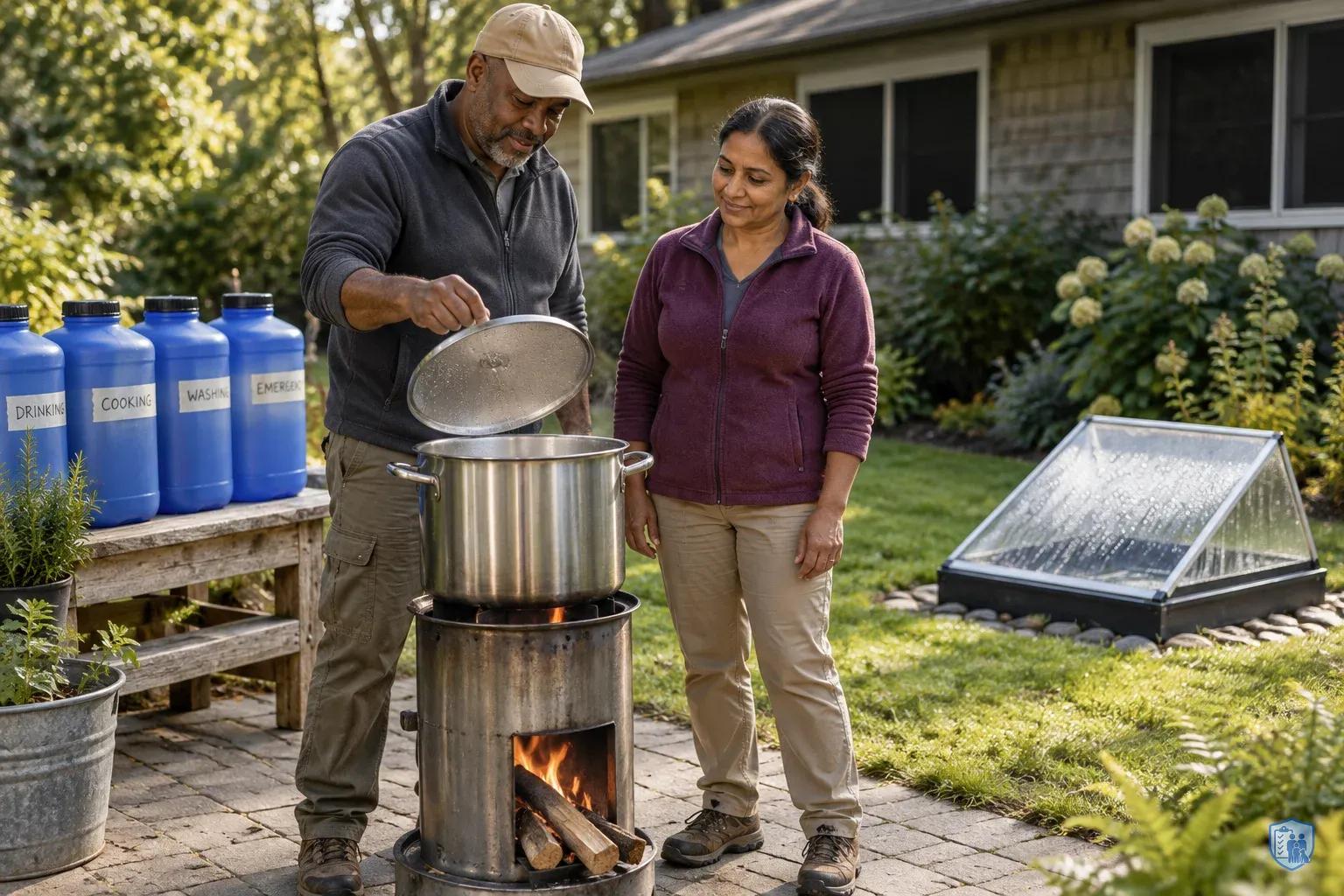
Distillation is your backup water plant, not your water supply
A cooking pot, an inverted lid, and a cup are enough to make distilled drinking water with no electricity and no special equipment . If you own those three things, you already own a working water still.
Picture day six of a regional grid failure. The stored jugs in the hall closet are running low, and the filter cartridges you bought two years ago are spent. The tap either runs dry or runs cloudy. Extended power outages can disrupt communications, water, and transportation, and they can cause water contamination . That combination is why a non-electric way to make water belongs in a serious plan, provided you put it in the right place.
That place is the third of three layers:
- Stored water. FEMA recommends one gallon per person per day for several days, covering drinking and sanitation . This carries you through the first days of any grid-down or shelter-in-place event. For bulk quantities, see our water storage hub.
- Simple treatment. Boiling or certified filtering handles clear freshwater with a biological risk . If you rely on a filter, confirm that its NSF/ANSI certification covers the contaminants you actually face.
- Distillation. It handles difficult or unknown sources, and it keeps producing after the stored water and filter cartridges are gone. Distillation means boiling water and collecting only the vapor that condenses .
Distillation backs up stored water and never replaces it. Distillation is slow and fuel-hungry , and the energy math in the Advanced section puts numbers on that.
Scope Covered: household-scale drinking-water distillation using a stovetop, a wood or rocket stove, and solar. Not covered: reverse-osmosis watermakers, municipal-scale treatment, lab-grade purity certification, and alcohol distillation. Legal note: distilling alcohol is illegal in the US without federal permits issued by the Alcohol and Tobacco Tax and Trade Bureau (TTB). Federal law, including 26 U.S.C. § 5601, sets the penalties. Use a water still for water only.
This guide is organized so most readers can stop early. Sections 2 through 4 hold the core: what distillation removes, how it compares to boiling and filtering, and three step-by-step methods. Sections labeled Advanced cover fuel math, still design, solar arrays, carbon post-treatment, and storage rotation. Read those when you are ready to size a system.
What distillation removes, and what it can carry over
Distillation heats water into steam and condenses that steam in a separate clean container. Anything that does not vaporize at water's boiling point stays behind in the boiling vessel. Think of it as lifting the water out of its baggage and leaving the baggage in the pot.
That mechanism explains what stays behind. Distillation effectively removes inorganic contaminants such as metals (including lead), nitrate, iron, and hardness minerals, and the boiling process inactivates microorganisms . Distillation removes microbes that resist boiling and disinfection, along with heavy metals, salts, and most other chemicals . Salts, sediment, and most dissolved and particulate material stay in the boiler.
| Removes | Does not reliably remove |
|---|---|
| Salts (seawater, brackish water) | Volatile compounds that boil at or below water's boiling point (certain solvents, fuels, VOCs) |
| Heavy metals, including lead | Tritium (part of the water molecule) |
| Nitrates | Anything splashed or dripped into the clean side |
| Iron and hardness minerals | |
| Sediment and particulates | |
| Pathogens, including those that resist boiling and disinfection |
Distillation has three limits. Understand each one before you trust a batch.
Limit 1: volatile carryover. Volatile organic compounds with boiling points near or below water's can vaporize and condense with the distillate . Think solvents, fuels, and some pesticide components. Engineered distillers address this with gas vents , and you can reduce the risk at home with two habits.
First, discard the first portion of distillate from every batch, because volatiles may come over early. Pick a fixed amount and write it down, such as the first 5 percent of the expected batch volume, so the habit stays repeatable. This is a field practice, not a lab-certified standard, and no published source sets that figure.
Second, when chemical contamination is suspected, pass the distillate through activated carbon as a post-treatment step . Treat both habits as precautions that improve your odds, not guarantees.
Limit 2: tritium. Tritium is a radioactive isotope of hydrogen, so it is chemically part of the water molecule, and household distillation cannot separate it. If your concern is radiological or other CBRN contamination, testing and response go beyond what a stovetop still can promise. Start with our water contamination defense guide.
Limit 3: recontamination of the clean side. Distillation can produce clean water and then spoil it. A dirty condensing surface, an unwashed collection vessel, or splashing from a hard boil can carry raw water into the distillate. A hard boil is a common cause, because bursting bubbles throw droplets upward. That is why you pre-filter turbid water and keep the boil gentle, as the methods section explains.
Distill, boil, or filter? Choosing the right tool for your source water
Matching the tool to the source saves fuel, and fuel is the scarcest resource in a long outage. EPA calls boiling the surest method to kill disease-causing organisms. Bring water to a rolling boil for 1 minute, or 3 minutes above 6,500 feet . Boiling does nothing about salts, metals, or nitrates, and it slightly concentrates them as water evaporates . Distillation removes the heavy metals, salts, and most other chemicals that boiling and disinfection leave behind .
| Factor | Distilling | Boiling | Filtering (certified) |
|---|---|---|---|
| Best for | Salt, metals, nitrates, unknown contamination | Clear freshwater with biological risk | Clear freshwater with biological risk |
| Fuel/energy | Very high | Low | None (manual) |
| Output speed | Slow | Fast | Moderate |
| Consumables | Fuel; carbon if you post-treat | Fuel | Cartridges |
| Removes salts and metals | Yes | No | Standard filters do not desalinate; check the certification for specific metals |
| Setup attention | High | Low | Low |
Distillation's trade-offs are energy cost, slow output, and the attention it demands. Its advantages are that it needs no consumables beyond fuel and, where volatiles are suspected, carbon. It also removes dissolved salts and metals. Boiling is cheap but narrow. Filtering is convenient but depends on spare cartridges, and a standard filter will not turn seawater into drinking water.
- Rain catchment, pond or stream: boil or filter
- Rain catchment risks roof debris and biological contamination. Settle it, cloth-filter it, then boil or filter. Pond or stream water carries biological risk and possible runoff. Boil or filter it if it is clear and rural, and distill it if you suspect runoff.
- Well near farmland: distill + carbon
- The main risks are nitrates and pesticides. Distill, discard the first portion of each batch, and pass the distillate through activated carbon. Nitrate removal is a documented strength of distillation.
- Flood water: distill + carbon
- The main risks are pathogens, fuels and chemicals. Distill, discard the first portion, and add carbon, because volatile compounds such as fuels and solvents can vaporize and condense with the distillate.
- Seawater: distill (stovetop or solar)
- The main risk is salt. Boiling does not remove salts, and standard filters do not desalinate. Distill it, and dispose of the concentrated brine away from gardens and water sources.
- Unknown industrial-area water: distill + carbon
- The main risk is unknown chemicals. Distill, discard the first portion, and pass the distillate through carbon. Treat the results with caution, since both habits improve your odds but are not guarantees.
- Fuel-budget rule
- Reserve distilled water for drinking and cooking. Use boiled or filtered water, or untreated water where appropriate, for sanitation and cleaning. A household that distills its dishwater burns through fuel far faster.
Decision matrix by source
| Source | Main risk | Recommended treatment |
|---|---|---|
| Rain catchment | Roof debris, biological | Settle and cloth-filter, then boil or filter |
| Pond or stream | Biological, possible runoff | Boil or filter if clear and rural; distill if runoff is suspected |
| Well near farmland | Nitrates, pesticides | Distill, with first-portion discard and carbon. Nitrate removal is a documented strength of distillation [4] |
| Flood water | Pathogens, fuels, chemicals | Distill, discard the first portion, and add carbon; see the contamination defense guide |
| Seawater | Salt | Distill (stovetop or solar) |
| Unknown industrial-area water | Unknown chemicals | Distill with discard and carbon, and treat results with caution |
Apply a budget rule on top of the matrix: reserve distilled water for drinking and cooking. Use boiled or filtered water, or untreated water where appropriate, for sanitation and cleaning. A household that distills its dishwater will burn through fuel far faster than one that does not.
Step-by-step: three non-electric distillation methods
Pre-filter before every method. Let turbid water settle, then pour it through a clean cloth. This reduces foaming, scorching, and splash carryover. A few minutes of prep protects every batch that follows.
Method 1: stovetop pot and inverted lid (Ready.gov field method)
This is the reassurance method. It uses ordinary kitchenware and follows Ready.gov's instructions. The Ready.gov method is to fill the pot halfway, tie a cup to the lid handle so it hangs right-side-up without touching the water, boil for 20 minutes, and collect the water that drips into the cup .
- Fill the pot halfway with water.
- Tie a cup to the lid handle so it hangs right-side-up when the lid is inverted. The cup must not touch the water.
- Boil for 20 minutes with the lid inverted on the pot.
- Collect the water that drips from the lid into the cup. That water is distilled.
Ice or cold water placed on top of the inverted lid should improve condensation. This is our addition to the Ready.gov method, not part of it. Like a gentle boil, it is an optimization, not a requirement. Discard the first portion of the batch, as described earlier. Expect small yields. A pot-and-lid setup is a proof of concept and an emergency fallback, not a production line.
Safety: Never seal a boiling vessel. Pressure can build to the point of rupture. Every still needs an open vent path.
Safety: Never boil to dryness. Concentrated contaminants become residue that can scorch, carry over into your distillate, and damage equipment. Stop before the vessel runs dry.
- Use sealed, food-grade containers
- Store distilled water in clean, sealed, food-grade containers such as HDPE #2, PETE #1, or glass. Sealed distilled water is generally stable, but dirty containers or open air can contaminate it. Cover the collection vessel and keep open-air exposure to a minimum while collecting.
- Step 1: Sanitize before filling
- Sanitize every container before you fill it with distilled water.
- Step 2: Label every container
- Mark each container with the date, the source, and the treatment method, for example "distilled + carbon".
- Step 3: Store cool, dark, and away from fuel
- Keep containers somewhere cool and dark, away from fuels and chemicals.
- Step 4: Rotate and inspect
- Use the oldest water first (first in, first out). Check seals on a regular schedule and replace any container that is damaged or cloudy. Add distilled water to the regular rotation of your stored water instead of keeping it as a separate stash.
- Tip: Pour to improve taste
- Distilled water tastes flat because distillation removes minerals and dissolved gases. Pour it back and forth between clean containers to restore some dissolved air and improve the taste.
Method 2: purpose-built stovetop or wood-fired still
A purpose-built still has a boiler vessel, a condenser (a coil or a straight tube cooled by water or air), and a collection vessel. It generally produces more water per hour than a pot and lid, although output depends on heat input and condenser capacity. Run it at a gentle, steady boil rather than a violent one, because a hard boil throws raw droplets into the vapor path. For fuel-fired operation, take it outdoors onto a rocket stove or wood fire, where fuel is renewable and ventilation is free.
Safety: Use camping stoves, wood fires, and charcoal grills only outdoors and away from windows. Combustion appliances used indoors create a carbon monoxide hazard . Restrict any indoor option to your household's installed kitchen range, and keep a battery-powered CO alarm in the living space.
Safety: Use only food-safe materials. Never use automotive parts, radiator hose, or unknown tubing anywhere in the vapor or water path.
Method 3: basin-style solar still
A solar still uses a shallow dark basin, a sloped glass or clear polycarbonate cover, and a collection channel along the lower edge. Sunlight heats the basin water, vapor rises, condenses on the cooler cover, and runs down into the channel. Orient the still toward the sun and keep the seals tight. Refill the basin daily, and flush out residue regularly.
Rules for all methods
Discard the first portion of every batch, and stop before the vessel runs dry. When you distill seawater, dispose of the concentrated brine away from gardens and water sources. This is a water still, and you use it for water only.
Shelter-in-place note: if going outdoors is unsafe, rely on stored water first. Use a solar still on a secure balcony or porch. Otherwise, distill only on your installed kitchen range, and never use camping stoves, grills, or open flame indoors.
Download the Off-Grid Still Safety and Materials Checklist, and verify every component is food-safe before your first test batch.
Advanced: energy math, still materials, and realistic solar output
This section is for readers sizing a system.
Physics sets distillation's cost. Using standard textbook values for water, heating 1 L from 20°C to 100°C takes about 0.09 kWh (specific heat 4.186 kJ/kg·K times 80 K equals approximately 335 kJ). Vaporizing that liter takes about 0.63 kWh (latent heat of vaporization about 2,257 kJ/kg). The theoretical total is about 0.7 kWh per liter. At about 3.785 L per gallon, that is roughly 2.7 kWh of heat per gallon.
Real-world needs run higher. Stove inefficiency, heat loss from the boiler, and wind all raise the bill. Budget with your own measured fuel use per liter, not the theoretical figure.
Fuel budgeting method
(liters per day) times (measured fuel per liter) times (days of outage) equals fuel stockpile.
Get the per-liter figure by running a timed, weighed test batch. Weigh the fuel before and after, and measure the distillate volume.
Worked example: a household of four reserves distilled water for drinking and cooking only. We assume about 2 L per person per day, a planning figure rather than a published standard. Adjust it for climate, activity, and diet.
- Liters per day: 4 times 2 equals 8 L
- Theoretical heat: 8 times 0.7 equals 5.6 kWh per day
- Per week: about 39 kWh
Now compare that with the 1 gallon per person per day guideline , which covers drinking and sanitation. For four people that is 4 gallons, about 15 L, or roughly 10.6 kWh per day theoretical and 74 kWh per week. Distilling all of it would nearly double the energy bill, at about 1.9 times the drinking-and-cooking figure. That is why you reserve distillate for drinking and cooking.
Now assume, for illustration only, that 20 percent of your fuel's energy reaches the water. The 39 kWh weekly minimum then becomes about 195 kWh of fuel energy. Dry wood is commonly cited at roughly 4 to 5 kWh per kilogram, which puts the requirement on the order of 40 to 50 kg of wood per week. Your stove, pot, wood species, and weather will differ, so measure.
Get the Distillation Fuel Budget Worksheet. Enter your test-batch numbers and calculate exactly how much fuel your household needs for a 30-day outage.
Still materials and design
Choose stainless steel, glass, copper joined with lead-free solder, and food-grade silicone. Confirm that any component carries food-contact certification, such as NSF or FDA compliance, before it touches the vapor or water path. Avoid galvanized metal, PVC of unknown grade, automotive parts, and mystery tubing.
A good design has a vented boiler with no sealed pressure path, a condenser sized for the heat input, an easy-clean collection vessel, and a drain for residue. If you can't scrub it, it will eventually contaminate your output.
Solar realism
Improvised dig-a-hole survival solar stills typically yield small volumes, so do not build a plan around one. Purpose-built basin stills can produce more, but output tracks sunlight closely, with large seasonal and cloudy-day drops. No brochure can promise a yield for your unit, and neither can we. Measure it yourself over several days.
Then size an array by multiplying your measured per-unit output and adding a margin for winter and cloud. Pair it with combustion distillation as a backup.
Carbon post-treatment
When volatiles are suspected, pass the distillate through food-grade activated carbon. Replace the carbon on a schedule, because spent carbon may release captured contaminants back into your water. Date the cartridge when you install it. Carbon is the one consumable in this system, so stock spares in proportion to your planned use.
Storing, rotating, and improving the taste of distilled water
Making distilled water is half the job. Keeping it clean until you drink it is the other half. FEMA's baseline of one gallon per person per day for several days still anchors your stored supply, and distilled production folds into it.
Containers and labeling
Use clean, sealed, food-grade containers, such as HDPE #2, PETE #1, or glass. Sanitize them before filling. Label every container with the date, source, and method (for example, "distilled + carbon"). Store containers somewhere cool and dark, away from fuels and chemicals.
Handling
Sealed distilled water is generally stable, but it can pick up contaminants from dirty containers or open air. Minimize open-air exposure during collection. Cover the collection vessel.
Advanced: rotation
Use the oldest water first (first in, first out). Inspect seals on a regular schedule, and replace any container that is damaged or cloudy. Fold distilled production into the regular rotation of your stored water rather than keeping it as a separate stash.
Taste and minerals
Distilled water tastes flat because distillation strips out its minerals and dissolved gases. Pouring it back and forth between clean containers restores some of the dissolved air and improves the taste. A normal diet supplies most of the minerals people need, so occasional or emergency use of distilled water is unlikely to cause a mineral problem. Health authorities, including the WHO, have raised questions about long-term exclusive use of demineralized water. If you expect to drink distillate exclusively for an extended period, discuss it with a health professional.
For bulk storage quantities and container planning, see the water storage hub.
Build it and test it before the grid goes down
An untested still is a theory. The household that runs a timed batch on a calm Saturday learns how much fuel it needs, where the splash points are, and whether the output tastes acceptable. The household that first tries it on day six learns all of that while thirsty.
Use this action checklist:
- Set up and test at least one non-electric method now: stovetop pot and lid, a purpose-built still, or a solar basin.
- Run a timed test batch. Record liters per hour, fuel used, and taste, then update your fuel budget.
- Pre-stage everything in one place: food-safe still components, a pre-filter cloth, activated carbon, labeled containers, and a battery CO alarm.
- Assign your layers. Stored water covers the first days and shelter-in-place periods. Boiling or filtering covers routine biological risk. Distillation covers long outages and difficult sources.
Distillation needs no filter cartridges and can run on fire or sunlight, which makes it independent of the grid and of most consumable supply chains. That makes it a durable way to keep producing safe water during an extended grid-down event, and it works best on top of a stored-water foundation.
Build and test your still this weekend: grab the complete Off-Grid Water Production Kit list and run your first timed batch before the grid goes down.