1. Why Earthquake Myths Can Put You in Danger
Picture this: the floor starts to rattle, and your brain hands you a rule you learned years ago. Maybe it was "stand in a doorway," from a teacher or a movie. If so, you're in good company. Many of us picked up earthquake "rules" from old drills, films, and social media posts.
Here's the thing: there's little time to react when the ground shakes, so your first move matters. Believing a myth is normal, and it's easy to fix. Let's walk through six common myths and swap each one for what FEMA, the Red Cross, and the USGS actually recommend. Both FEMA's Ready.gov and the American Red Cross advise Drop, Cover, and Hold On when the ground starts shaking .
Preparedness can feel like a mountain of to-dos, but you don't need special gear or training. You just need accurate information and one small step at a time. Let's get you started.
2. Myths #1 and #2: "Run Outside" and "Stand in a Doorway"
Myth: When shaking starts, run outside.
Fact: If you're inside, stay inside until the shaking stops. Ready.gov says not to run outside . The Red Cross also recommends staying where you are rather than running to another room or outside .
Why: Picture trying to sprint across a boat deck in rough water. The floor is moving, and you can easily lose your footing. Moving around also means more time in motion, and falling objects may be near exits. Staying put keeps things simple.
Myth: A doorway is the safest spot in the house.
Fact: FEMA specifically says not to get in a doorway .
Why: This one is very common, and plenty of us learned it as kids. Advice changes as experts learn more, and that's nothing to feel bad about. The newer guidance is easier to follow, too, because you don't need to find a special spot.
The Red Cross adds a simple rule: get safe where you are, right now . Skip the hunt for the "perfect" spot. Skip the doorway. Get under a sturdy table or next to an interior wall .
3. What to Do Instead: Drop, Cover, and Hold On
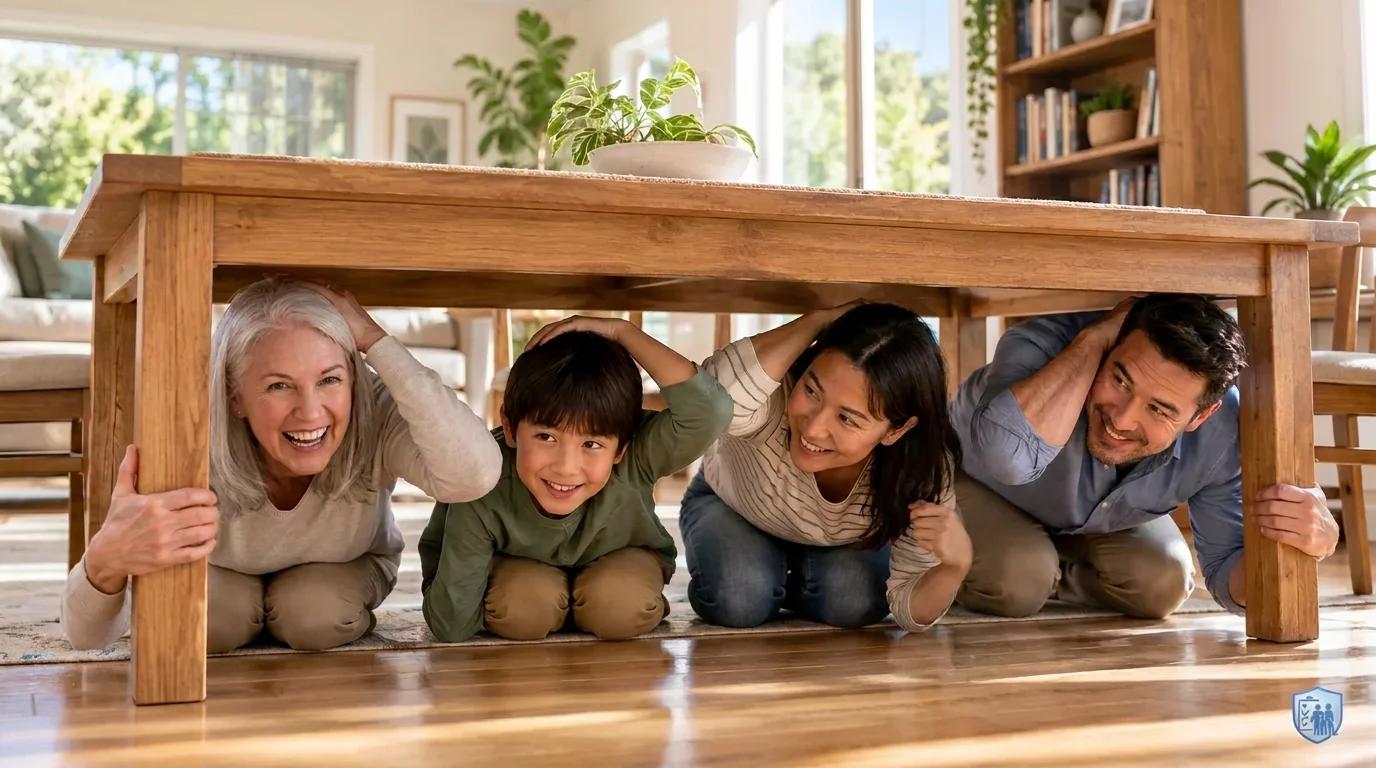
Here's the good news: the right move is simple enough to remember when your heart is pounding. FEMA directs people to Drop, Cover, then Hold On, and the Red Cross says to do it whenever you feel shaking . That includes shaking that seems small at first.
- DROP. Get down onto your hands and knees so the shaking can't knock you over.
- COVER. Protect your head and neck with your arms. If a sturdy table or desk is close, get under it.
- HOLD ON. Stay in your protected position until the shaking stops. If you're under a table, hold on to it.
Ready.gov's full page has the step-by-step details, including tips for different situations . For example, if you're in bed, turn face down and cover your head and neck with a pillow . If you use a wheelchair or walker, check that page for steps that fit your situation.
These moves work best when they feel automatic. Think of a fire drill at school: you didn't have to think, you just went. Practicing a few times can help build that same habit.
Want to make these steps stick? Pick one "Drop, Cover, Hold On" practice time with your household this week. It only takes a few minutes, and it's a great first win.
- Myth: Experts can predict the next big one
- According to the USGS, neither the USGS nor any other scientists have ever predicted a major earthquake, and they don't expect to know how in the foreseeable future.
- What scientists can actually do
- The USGS can calculate the probability that a significant quake will happen in an area over a certain number of years. It cannot name the day.
- Be skeptical of date claims
- Doubt any post, video, or website claiming a quake will strike on a certain date.
- Myth: Hot, still, or cloudy days are 'earthquake weather'
- The USGS says there's no such thing as earthquake weather. Earthquakes begin many kilometers below the surface, where weather conditions have no effect.
- Why these myths are risky
- Waiting for a warning or the 'right' kind of day can make you put off getting ready. If a predicted date passes with nothing happening, it's easy to relax when you shouldn't.
- Prepare now, not on a forecast
- Earthquakes can happen any day, in any weather. Take small steps now, like practicing Drop, Cover, and Hold On with your household this week.
4. Myths #3 and #4: "Scientists Can Predict Quakes" and "Earthquake Weather"
Myth: Experts can tell you when the next big one will hit.
Fact: According to the USGS, neither the USGS nor any other scientists have ever predicted a major earthquake, and they don't expect to know how in the foreseeable future . What the USGS can do is calculate the probability that a significant quake will happen in an area over a certain number of years . Be skeptical of any post, video, or website claiming a quake will strike on a certain date .
Myth: Hot, still, or cloudy days are "earthquake weather."
Fact: The USGS says there's no such thing as earthquake weather. Earthquakes begin many kilometers below the surface, where weather conditions have no effect .
It's tempting to treat these as harmless trivia, but they can slow you down. If you're waiting for a warning, or for the "right" kind of day, you may put off getting ready. And if a predicted date passes with nothing happening, it's easy to relax when you shouldn't.
Think of it like driving. Nobody knows which commute might have a problem, so you buckle up every time. Earthquakes can happen any day, in any weather . The good news is that you don't need a forecast to get ready. Small steps you take now will help on any day.
- Anchor tall furniture
- Anchor tall furniture, such as bookcases and dressers, to wall studs with straps or brackets.
- Strap your water heater
- Strap your water heater with metal straps so it can't tip over and break gas or water lines.
- Keep heavy items low
- Consider moving heavy items to lower shelves.
- Move heavy decor away from beds
- Consider keeping heavy frames or mirrors away from beds and couches.
- Check older foundations
- FEMA P-530 identifies unbraced cripple walls and foundations that aren't bolted down as weaknesses that may need seismic retrofitting. Cripple walls are the short walls between the foundation and the first floor. Retrofits are often a job for a qualified professional, so if your home is older, or you rent and aren't sure, ask for an assessment.
5. Myth #5: "My Home Is Fine Just the Way It Is"
Many earthquake injuries at home come from things that fall or tip over, not only from buildings collapsing . Picture a tall bookcase that has stood quietly for years. In a strong quake, it could topple in seconds. FEMA's homeowner guide, Earthquake Safety at Home (FEMA P-530), explains how to anchor tall furniture and secure water heaters . These make great weekend projects, and you can tackle them one at a time.
- Anchor tall furniture. Anchor tall furniture, such as bookcases and dressers, to wall studs with straps or brackets .
- Strap your water heater. Strap your water heater with metal straps so it can't tip over and break gas or water lines .
- Think low. Consider moving heavy items to lower shelves.
- Rethink wall decor. Consider keeping heavy frames or mirrors away from beds and couches.
Some older homes have deeper weak spots. FEMA P-530 identifies unbraced cripple walls and foundations that aren't bolted down as structural weaknesses that may need seismic retrofitting . Cripple walls are the short walls between the foundation and the first floor. Retrofits are often a job for a qualified professional, so if your home is older, or you rent and aren't sure, ask for an assessment.
You don't have to solve it all at once. Pick one item from the list and start there.
Ready for your next easy win? Check out our beginner's guide to securing furniture and your water heater for earthquakes.
6. Myth #6: "Once the Shaking Stops, You're Safe"
The shaking ends, but the need to stay alert doesn't always end with it. Aftershocks, broken glass, and damaged gas lines can all cause trouble after the shaking stops . Consider putting on sturdy shoes before you walk around, then look over your surroundings. Gas is the part people ask about most, so here's a calm, simple plan.
- Only shut off the gas if you suspect a leak . Ready.gov lists the signs: a gas smell, a hissing sound, or a broken line .
- Once it's off, the gas company usually needs to turn it back on . The source says it should be restored only by a qualified professional or the utility company .
- If you smell gas or hear hissing, many utilities advise leaving the building and calling from a safe place. Check your gas company's guidance to be sure.
- Avoid matches, lighters, and candles when you're checking for a leak. A flashlight is a safer choice.
- If an aftershock hits, Drop, Cover, and Hold On again .
Utility procedures vary, so check with your local gas company. It's smart to ask whether you need a special tool to shut off your gas. This week, walk outside and find your meter and valve. That's a five-minute job you can check off right away.
- Myth: Run outside when shaking starts
- Fact: If you're inside, stay inside until the shaking stops. Drop, Cover, and Hold On where you are.
- Myth: A doorway is the safest spot
- Fact: FEMA says not to get in a doorway. Get under a sturdy table or next to an interior wall.
- Myth: Scientists can predict quakes
- Fact: No scientists have ever predicted a major earthquake. Be skeptical of claims that a quake will strike on a certain date, and prepare now.
- Myth: There is 'earthquake weather'
- Fact: Earthquakes begin many kilometers below the surface, where weather has no effect. They can happen any day, in any weather.
- Myth: My home is fine just the way it is
- Fact: Many home injuries come from things that fall or tip over. Anchor tall furniture to wall studs and strap your water heater with metal straps.
- Myth: Once the shaking stops, you're safe
- Fact: Aftershocks, broken glass, and damaged gas lines can still cause harm. Shut off gas only if you smell gas, hear hissing, or see a broken line. If an aftershock hits, Drop, Cover, and Hold On again.
7. Your Quick Myth-vs-Fact Recap
You've just done something many people never do: you questioned what you "knew" about earthquakes. Here's the short version, and you don't need to memorize it all today.
- Don't run outside. Stay put and Drop, Cover, and Hold On.
- Skip the doorway. Get under a sturdy table or next to an interior wall.
- Ignore predictions and "earthquake weather." Prepare now instead.
- Anchor furniture and strap your water heater.
- After the shaking, check for gas leaks safely and be ready for aftershocks.
FEMA, the American Red Cross, and the USGS are reliable sources for accurate earthquake safety information . Preparedness doesn't have to feel overwhelming. One small step this week, like practicing a drill or strapping one bookcase, makes a real difference.
Now that you've cleared up the myths, explore our earthquake preparedness checklist and take it one easy step at a time.