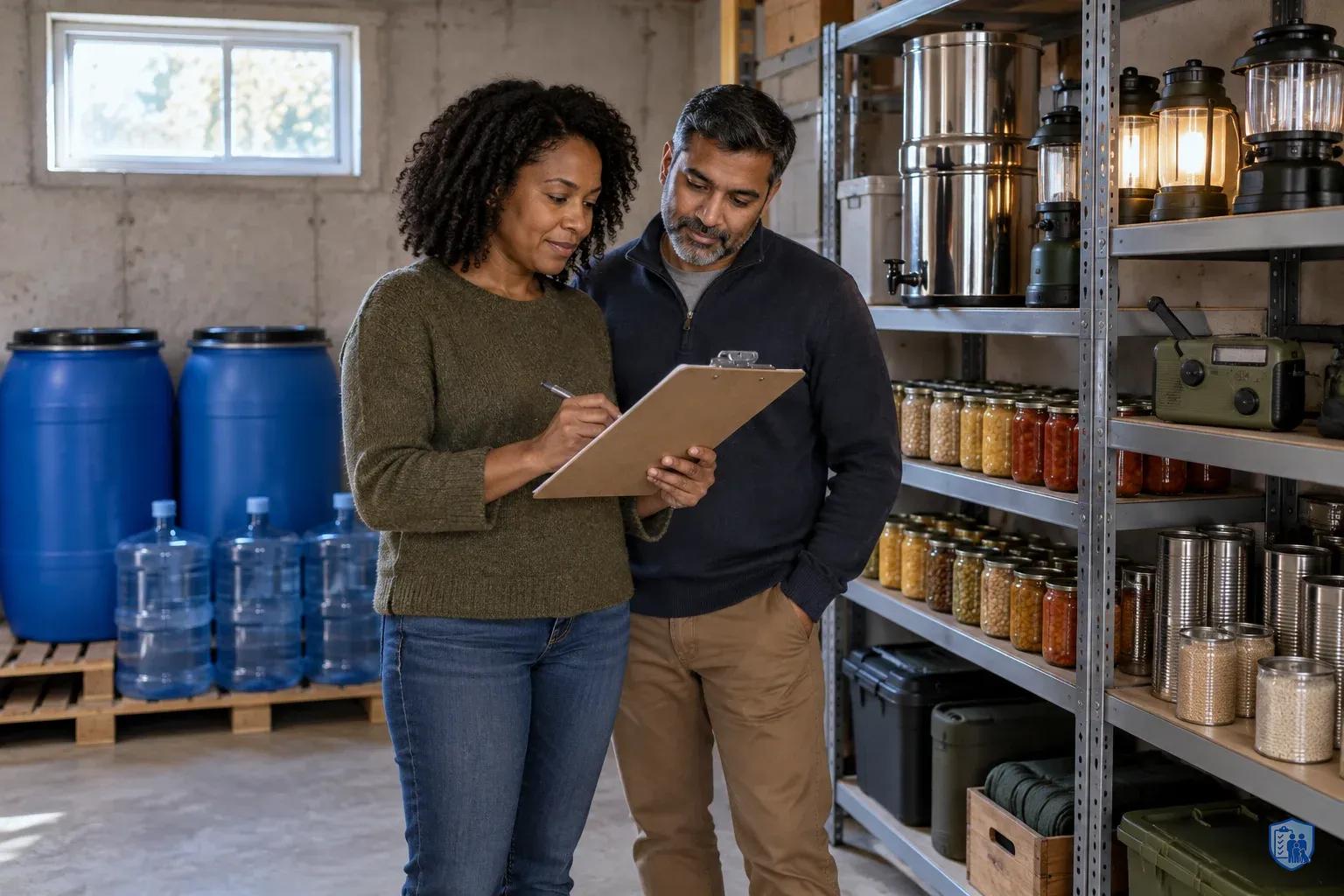
1. Scope, Assumptions, and the 90-Day Household Systems Model
Picture the second night of a regional grid failure. The tap runs for a few minutes, then sputters and dies. Your phone shows no bars, and the house is silent in a way you have never heard. Nothing dramatic has happened, yet every system you depend on has quietly stopped.
Scope box Covered: household-scale water storage, purification, sanitation, emergency cooking, and safe supplemental heat. Not covered: well drilling, whole-house fuel system installation, and water contaminated by chemicals or fuel. If your water is chemically or fuel contaminated, you need an alternate safe source and guidance from your local health department. Linked out, not covered in depth: EMP and Faraday hardware.
This guide assumes a grid-down event, whether from an electromagnetic pulse, a cyberattack, or grid overload. The event removes electricity and may disrupt municipal water pumping and treatment. It could also force your household to shelter in place for up to 90 days. Treat the plan as insurance, not panic. You are not predicting collapse. You are building a system that fails gracefully if collapse arrives.
Start from the official baseline. FEMA and Ready.gov basic kit guidance calls for at least 72 hours of supplies, including one gallon of water per person per day for at least three days. From there, scale deliberately in four tiers: 3 days, 2 weeks, 30 days, and 90 days. Each tier is a checkpoint you can verify before you buy for the next. A household that has honestly completed the 30-day tier has already solved most of the hard problems.
Before you buy hardware, write down your critical loads: the water filter pump if you use one, CO alarms, medical devices, communications, and lighting. Size generators, batteries, and solar-plus-storage to that list, not the reverse. The Department of Energy notes that solar plus storage can provide backup power during electrical disruptions and help keep essential services such as communications running . A short list of modest loads keeps a system like that affordable.
Three outcomes drive everything that follows: no electricity, no clean water, and shelter in place. Every system here maps to at least one of them. Storage and purification answer no clean water. Fuel and power planning answer no electricity. Sanitation, routines, and drills answer the long confinement.
Finally, plan for information continuity. The National Weather Service describes NOAA Weather Radio as an all-hazards radio network that works with the FCC's Emergency Alert System . A battery or hand-crank unit gives you official alerts when internet and cellular service are gone .
- FEMA minimum: 360 gallons
- FEMA and Ready.gov call for at least one gallon of water per person per day. For four people over 90 days, that is 4 × 1 × 90 = 360 gallons. Treat it as a floor for drinking and minimal needs, not a comfortable budget.
- Planning budget: 720 gallons
- Plan around 2 gallons per person per day: about 0.75 for drinking, 0.25 for cooking, 0.5 for hygiene and 0.5 for sanitation. For four people that is 4 × 2 × 90 = 720 gallons. This is the author's assumption, not an agency figure. Add allowances for pets, medical needs, heat and illness, and round up to 800.
- Food-grade drums (55 gal)
- Each holds about 457 lb of water when full, since water weighs roughly 8.3 lb per gallon. Drums have the smallest footprint per gallon and the lowest cost. You cannot move them once filled, and you need a pump or siphon to draw water out.
- 5-7 gallon jugs
- Each holds about 41-58 lb of water. Jugs are portable and stackable, and a single failure loses little water, but they take more space overall. Only store containers you can lift when full.
- Commercial bottled water
- Usually the highest cost per gallon of the three options, but it comes sealed and dated. It suits the first two tiers well. Rotate it first-in, first-out using the date printed on the package.
- Date and rotate self-filled water
- Use food-grade containers and sanitize them with the bleach method on the current CDC emergency water storage page. Store them away from sunlight and chemicals, and label each with its fill date. Refresh the water every six months, and tighten that interval if the CDC page is stricter.
2. Water Storage Math: Sizing and Rotating a 90-Day Supply
Most households that claim "plenty of water" have never multiplied it out. Two cases of bottled water feel like security until you run the numbers. A standard case holds 24 bottles of 16.9 oz, or about 3.2 gallons. Two cases total roughly 6.3 gallons, which lasts four people about 1.6 days at one gallon per person per day. Do the arithmetic first, because the real numbers are larger than intuition suggests.
The formula
Total gallons = people × gallons per person per day × days
Agency baseline. FEMA and Ready.gov recommend at least one gallon of water per person per day. For a household of four over 90 days, that is 4 × 1 × 90 = 360 gallons. Treat that as a floor for drinking and minimal needs, not a comfortable budget.
Planning assumption (not an agency figure). Most households find one gallon per person per day is tight. I plan around 2 gallons per person per day, split roughly as follows:
- Drinking: about 0.75 gallon
- Cooking and food prep: about 0.25 gallon
- Hygiene, including handwashing: about 0.5 gallon
- Sanitation and cleaning: about 0.5 gallon
Worked example: 4 × 2 × 90 = 720 gallons. Adjust these splits to your household's actual needs.
Then add allowances. Pets, medical needs, hot climates, nursing mothers, and illness all raise consumption. Illness in particular can spike demand just when you can least afford a shortfall. Round up: if the math says 720, plan for 800.
Container strategy
You will likely mix container types, so compare them honestly. Water weighs roughly 8.3 lb per gallon, which matters for floor loading and for moving supplies. The weights below count water only and exclude the container itself.
- Food-grade drums (55 gal): about 457 lb of water when full. They have the smallest footprint per gallon and the lowest cost. You cannot move them once filled, and you need a pump or siphon to draw from them.
- 5-7 gallon jugs: about 41-58 lb of water each. They are portable and stackable, and a single failure loses little. They do take more space overall.
- Commercial bottled water: usually the highest cost per gallon of the three, but it is sealed and dated. It suits the first two tiers well.
Hauling is the real constraint. If you cannot lift a container when full, you cannot use it when you need it.
- Store liquid fuel in approved containers
- Keep gasoline and other liquid fuels only in approved containers. Store them away from ignition sources and living areas, ideally in a cool, well-ventilated space such as a detached shed.
- Date and rotate liquid fuel
- Write the date on each fuel container and rotate gasoline and other liquid fuels on a calendar schedule.
- Run generators at least 20 feet away
- Run portable generators outdoors only, at least 20 feet from doors, windows, and vents. Use heavy-duty outdoor-rated cords.
- Never run a generator in enclosed spaces
- Never use a generator indoors, including in garages, carports, and enclosed porches. Install battery-powered or battery-backup CO alarms on every level and near sleeping areas.
- Use a transfer switch for house wiring
- Never connect a generator to house wiring without a code-compliant transfer switch or interlock installed by a qualified electrician.
- Cool down before refueling
- Turn the generator off and let it cool before you refuel it.
Fill, store, and rotate
CDC recommends food-grade water storage containers when possible. It also publishes a bleach-solution method for sanitizing containers before filling. Follow the ratio and contact time on the current CDC emergency water storage page rather than a number from memory. Store containers away from sunlight and chemicals, and label each with its fill date.
For rotation, I use a conservative planning assumption of refreshing self-filled water every six months. Confirm that against the replacement interval on the CDC page and tighten it if the CDC is stricter. Rotate commercial bottled water first-in, first-out (FIFO), using the date printed on the package.
Stored water is only one layer. Pair it with a renewable source, such as rain catchment or a nearby surface source, plus the purification capacity covered next. Without that pairing, you are only buying time.
Download the 90-Day Household Systems Calculator and Rotation Calendar. Enter your household size and get your water, fuel, and sanitation targets in minutes, before the next storm does the math for you.
3. Layered Purification: Boil, Disinfect, Filter, and Know When Not to Treat
Think of purification like home security. A single lock stops casual trouble, but layers stop the determined kind. Each method has gaps, and layering covers them. Filtration removes sediment and many pathogens. Boiling and chemical disinfection inactivate pathogens. Together they handle what any one method misses.
Follow this sequence for water from a renewable or questionable source.
- Settle and pre-filter. Cloudy water can defeat disinfectants and clog filters, and CDC's emergency water treatment guidance calls for clearing it first. Let the sediment settle. Then pour the water through a clean cloth or coffee filter into a second container.
- Filter. Run the water through your filter into a clearly marked clean container.
- Kill what remains. Boil it or disinfect it chemically, following the CDC's boiling and bleach-disinfection procedures for emergency water. Take the boil duration and bleach dosage from the current CDC page. Use unscented household bleach or purification tablets exactly as instructed.
- Cover and label. Store the treated water in a clean, covered container and log it.
Boiling is the most reliable pathogen control. CDC's own messaging calls it the surest method. It also consumes fuel, and every gallon you boil comes out of the budget in the next section. If you plan to boil a large share of your water, test-cook it and log the fuel use as described there. Do not assume your fuel will stretch.
Filtration comes in two main styles. Gravity-fed filters need no effort and suit families, since you fill the top chamber and walk away, but throughput is slow. Pump filters are faster and compact, but they have moving parts, need maintenance, and demand your hands. In both cases, stock spare elements sized to 90 days of throughput. Check the manufacturer's rated capacity, divide your total treated volume by it, and buy that many elements plus a spare.
Now the hard stop. CDC states that water suspected of fuel or toxic-chemical contamination should not simply be boiled or chemically treated, because those methods cannot make it safe. Use bottled water or another safe source, and contact the health department. This is why your stored water matters even if you own an excellent filter. A sheen, a fuel smell, or a nearby spill means you stop treating and start rationing the stored supply.
Finally, keep discipline in the process. Maintain a written purification log with date, source, method, and volume. Keep a dedicated set of clearly marked dirty and clean containers, ideally in different colors. That way no one ever pours treated water into a container that held raw water.
4. Sanitation When Toilets Cannot Flush
Water-system failure rarely announces its second act. Once pumping stops, toilets may stop flushing, and sewers can fail or back up. Most people discover the problem when the house begins to smell, which is far too late to improvise.
Plan for zero flushing. Pour-flushing with potable water feels logical, but it takes a gallon or more per flush. At that rate it quietly drains the supply you built so carefully.
The two-bucket system
Set up two buckets with a toilet seat or a stable seating arrangement.
- Bucket one collects liquid waste.
- Bucket two is lined with a heavy-duty bag and collects solids. Cover each deposit with sawdust or cat litter, and keep a tight-fitting lid on at all times.
Seal and tie full bags, then move them to a designated outdoor container away from the water supply and food storage. Follow local guidance on disposal once services resume. Never bury waste near any water source.
Hand hygiene
CDC advises that handwashing with safe water and soap is a key way to prevent illness during water emergencies. Budget water for it, which is why my planning split includes a hygiene allowance. Build a gravity-fed handwashing station: a jug with a spigot on a shelf, a basin underneath, soap, and a towel you wash regularly. Keep hand sanitizer as a backup, not the primary method.
90-day consumables (planning estimates)
These quantities are my planning estimates for a household of four, not agency figures. Scale them by household size.
- Heavy-duty bags: 1-2 per day, so 90-180
- Cover material: roughly one 25-lb bag of cat litter every 2-3 weeks, so 5-7 bags over 13 weeks (or equivalent sawdust)
- Disposable gloves: 2-3 pairs per week, so 26-39 pairs (round up to 40)
- Disinfectant: enough for daily surface wiping; stock to your usage
- Toilet paper: 1 roll per person per week is a common starting point, so 52 rolls
- Soap: 1 bar per person per month, so 12 bars
The routine
Sanitation failures drive illness and morale problems, so run the system like a job, not a chore. Assign roles and a daily routine. One person empties and replaces bags, another refills the handwashing station, and the whole household wipes shared surfaces on a set schedule. Rotate the assignments so nobody carries the worst task for 90 days.
5. Cooking and Heating Fuel: Estimating, Storing, and Powering Critical Loads
A neighbor of mine once said he had "plenty of propane" because he owned four cylinders. He had never cooked a full day on one. When he finally tried, he found that boiling water on top of his normal meals changed the math entirely. Do not guess at fuel. Measure it.
The fuel log method
Run a timed test-cook of a typical day's meals, plus boiling for water treatment, on each stove type you own. Weigh or measure the fuel before and after, and log the result.
Total fuel = daily fuel used (from your log) × 90 days × (1 + safety margin)
For example, if your log shows one canister consumed daily, multiply by 90, then add a margin. I use 25-50% as a planning estimate to cover cold weather, wind, and sloppy days. Treat that range as my assumption, not an agency figure. I deliberately avoid quoting generic per-day consumption numbers, because they vary too much by stove, pot, and technique. Your log beats any chart.
Diversify fuels. Propane cylinders, a wood supply for a code-installed stove, and canned fuels together mean that one failure does not halt cooking. Use each stove only where it is rated to be used. Outdoor stoves stay outdoors.
Storage
Store gasoline and other liquid fuels only in approved containers . Keep them away from ignition sources and living areas, ideally in a cool, well-ventilated space such as a detached shed. Rotate gasoline and other liquid fuels on a calendar, and write the date on each container.
Non-negotiable safety rules
- Run portable generators outdoors only, at least 20 feet from doors, windows, and vents, using heavy-duty outdoor-rated cords .
- Never connect a generator to house wiring without a code-compliant transfer switch or interlock installed by a qualified electrician .
- Turn the generator off and let it cool before you refuel it .
- Store liquid fuels only in approved containers, away from ignition sources and living spaces.
- Use only the battery and charger made for a device. Stop using any battery that shows odor, color change, excess heat, swelling, leaking, or odd noises .
- Do not charge devices on beds or couches. Do not leave them charging unattended or plugged in after a full charge .
Power without combustion
Solar plus storage can provide backup power during electrical disruptions . For a critical-loads list of radio, lighting, phone charging, and a filter pump, a small panel and battery bank can reduce reliance on fuel. Size the system from your own load list rather than a generic kit. Lithium-ion batteries add their own risk, so retire any unit that shows the warning signs above .
Food safety on day one
CDC food safety guidance is specific. Keep refrigerator and freezer doors closed. Discard refrigerated perishables after 4 hours without power. A full, closed freezer keeps food safe for up to 48 hours, and a half-full freezer for up to 24 hours. Plan to eat the refrigerated food first, then the freezer contents, then shelf-stable stores. Group frozen items together and keep the freezer as full as practical, because that helps it hold temperature longer.
6. Indoor Combustion Rules and Safe Supplemental Heat
Carbon monoxide kills quietly. You cannot see it, smell it, or taste it, and a family can fall asleep in a warm room that is slowly poisoning them. Every rule below exists because someone, somewhere, decided "just this once" would be fine. Treat this section as a checklist, not a discussion.
Carbon monoxide rules
- Install battery-powered or battery-backup CO alarms on every level and near sleeping areas. NFPA and CDC guidance both treat working CO alarms as a core safeguard whenever fuel-burning equipment is in use.
- Never rely on smell. CDC notes that CO is colorless and odorless.
- Never use a generator, charcoal grill, camp stove, or outdoor-rated heater indoors, including in garages, carports, and enclosed porches. CDC carbon monoxide guidance is explicit on grills, stoves, and generators, and NFPA gives the same warning for generators .
- Never heat your home with a gas oven. CDC carbon monoxide prevention guidance warns against it.
- Verify that any fuel-burning indoor appliance is rated and installed for indoor use before you rely on it. If you cannot confirm that, do not run it.
Space heater rules
- Choose space heaters listed by a recognized testing laboratory with automatic tip-over shutoff .
- Keep anything that can burn at least 3 feet from the heater .
- Turn heaters off when you leave the room or go to sleep .
- Plug heaters directly into a wall outlet, not an extension cord or power strip . In a grid-down scenario, electric heaters will often be unusable anyway, so do not build your plan around one.
Passive heat strategy
Because safe powered heat is limited, build your plan around retaining the heat you already have.
- Consolidate the household into one well-insulated room, ideally small and interior.
- Insulate windows with blankets, towels, or insulating film.
- Layer clothing, and add sleeping bags rated for your climate.
- Use hot-water bottles, heated with fuel you budgeted in the previous section.
- Close off unused rooms and seal door gaps with towels.
CO poisoning symptoms
Know them: headache, dizziness, weakness, nausea, vomiting, chest pain, confusion, and blurred vision. CDC lists all of these. If anyone shows symptoms, get everyone outside to fresh air immediately and seek help. Do not go back inside to "check the alarm" first. Run through these symptoms with every household member, including children old enough to understand. That way nobody mistakes poisoning for the flu.
7. Integration Drill and 90-Day Rotation Calendar
An untested plan is an assumption. You can own every item in this guide and still discover on night one that the filter is missing a gasket or the bucket lid does not seal. A drill finds those failures while a hardware store is still open.
Drill steps
- Run a 72-hour grid-off drill. Shut off the main breaker, or simulate the outage by not touching anything electric.
- Live on stored water only, and cook outdoors.
- Use the sanitation station and handwashing setup for the full period.
- Log every failure: what broke, what was missing, what annoyed you.
- Scale up to a weekend drill, then audit water, fuel, filters, and consumables against the 90-day math.
Quarterly rotation calendar
Build a recurring calendar covering:
- Water refresh per your chosen interval, with fill dates on every container
- Fuel rotation for gasoline and other liquid fuels
- CO alarm and battery checks, since NFPA and CDC guidance rely on working alarms as a core safeguard around fuel-burning equipment
- Filter inspection and spare element count
- Food FIFO rotation
Shelter-in-place resilience
Ninety days is a long time inside the same walls. Set daily routines with wake times, meals, chores, and quiet hours. Assign roles and rotate them. Keep offline entertainment on hand, such as books, board games, cards, and craft supplies. Hold a short structured check-in each day, where everyone says how they are doing and what they need. Morale is a resource, so budget it like any other.
OPSEC
Share inventories only with household members and trusted mutual-aid partners. Never post supplies, fuel, or generator setups publicly.
Printable checklist summary
- Water: formula completed, containers labeled and dated, rotation scheduled
- Purification: layers in place, spare filter elements stocked, log started
- Sanitation: buckets, bags, cover material, soap, handwashing station
- Fuel: test-cook logged, fuel totals calculated, approved containers
- Safety: CO alarms tested, generator rules posted, no indoor combustion
- Information: NOAA Weather Radio with battery or hand-crank power
- Routine: roles assigned, entertainment stocked, check-ins scheduled
Start your 72-hour grid-off drill this weekend. Download the printable drill checklist and CO safety card now, and find your weak points while the stores are still open.