Understanding EMP Threats to Food Storage
The fluorescent hum of your chest freezer stops. The digital temperature display on your refrigerator goes dark. Across your neighborhood, across your city, across entire regions, every electronic system controlling food preservation falls silent simultaneously. This isn't a simple power outage where backup generators kick in—the generators won't start either. Their electronic ignition systems, fuel injection controls, and voltage regulators have all been rendered inoperable by an electromagnetic pulse event. Within hours, temperatures begin to rise in storage facilities. Within days, millions of pounds of food begin to spoil.
An electromagnetic pulse represents one of the most comprehensive threats to modern food storage infrastructure because our entire preservation ecosystem depends on electronic controls. Understanding the nature of these threats requires examining three distinct EMP categories, each with unique characteristics that affect food storage systems differently.
Solar electromagnetic pulses, generated by coronal mass ejections from the sun, create geomagnetically induced currents that flow through long-distance power transmission lines. The 1859 Carrington Event demonstrated this threat's potential when telegraph systems across North America and Europe failed, with some operators reporting equipment catching fire. Modern analysis suggests a similar event today would disable transformers across continental power grids, leaving electronic food storage systems without power for months or potentially years .
Nuclear electromagnetic pulses result from high-altitude nuclear detonations, typically 40 to 400 kilometers above Earth's surface. The gamma radiation from such explosions interacts with atmospheric molecules, creating a cascade of electromagnetic energy that propagates outward at the speed of light. A single high-altitude detonation over central North America could affect electronic systems across the entire continental United States. The E1 component of a nuclear EMP—occurring in the first nanoseconds—can generate extremely high field strengths sufficient to destroy semiconductor junctions in unprotected electronics. The E2 component resembles lightning but occurs simultaneously across vast areas, overwhelming conventional surge protection. The E3 component, lasting tens to hundreds of seconds, induces currents in long conductors similar to solar storms but with greater intensity .
Non-nuclear electromagnetic pulse weapons represent an emerging threat category. These devices use conventional explosives to compress magnetic flux or employ specialized microwave generators to produce localized but intense electromagnetic fields. While their effective range measures in hundreds of meters rather than thousands of kilometers, their accessibility to non-state actors and potential for targeted attacks against critical food storage facilities makes them a concerning development. Testing conducted by the Department of Homeland Security has demonstrated that commercially available components can be assembled into devices capable of disrupting electronics through standard building walls .
Modern food storage vulnerability extends beyond simple refrigeration failure. Contemporary storage facilities employ sophisticated electronic monitoring systems tracking temperature, humidity, atmospheric composition, and contamination indicators. Research has shown that 90% of electronic food monitoring systems experienced immediate failure during EMP simulation testing, with the remaining 10% exhibiting degraded performance or intermittent operation . These failures cascade through interconnected systems.
Electronic inventory management systems that track product rotation and expiration dates become inaccessible. Automated climate control systems that adjust cooling based on load and external conditions freeze in their last state or default to non-operational modes. Security systems monitoring access to storage areas fail, potentially allowing contamination or theft during the chaos following an EMP event.
The vulnerability assessment becomes more concerning when examining backup systems. Standard emergency generators incorporate electronic governors controlling engine speed, voltage regulators managing output, and often electronic fuel injection systems. These components contain the same vulnerable semiconductors as primary systems. Uninterruptible power supplies and battery backup systems include charge controllers, inverters, and monitoring circuits—all susceptible to EMP damage.
Even manual backup systems in modern facilities often incorporate electronic components. A mechanically-driven cooling system might use electronic thermostats or control boards. A gravity-fed water system might employ electronic flow sensors or automated valves.
The infrastructure supporting food storage faces similar vulnerabilities. Municipal water supplies necessary for evaporative cooling systems depend on electronic pump controls and pressure regulators. Natural gas supplies for absorption refrigeration systems flow through pipelines controlled by electronic monitoring and valve systems. The supply chain delivering replacement parts for any mechanical systems relies on electronic logistics, payment systems, and transportation coordination. EMP events can disrupt or damage electronic equipment across large geographic areas , potentially affecting the entire technological ecosystem supporting food preservation across regional or national scales.
Designing EMP-Resistant Storage Infrastructure
Building truly resilient food storage infrastructure requires understanding that protection operates on multiple levels, each addressing different aspects of electromagnetic vulnerability. The foundation of EMP-resistant design rests on Faraday cage principles, named for scientist Michael Faraday who discovered that an enclosure made of conductive material shields its interior from external electromagnetic fields.
When electromagnetic radiation encounters a conductive surface, it induces currents in that conductor. These currents generate their own electromagnetic fields that oppose and cancel the incoming radiation, preventing it from penetrating the enclosure.
Constructing an effective Faraday cage for food storage protection demands attention to specific design parameters that determine shielding effectiveness. The enclosure must be continuous—any gap or seam longer than one-twentieth the wavelength of the electromagnetic radiation you're protecting against becomes a potential entry point. For the high-frequency components of a nuclear EMP, this means gaps must remain smaller than approximately one centimeter. Properly constructed Faraday cages provide 99.9% protection against electromagnetic pulse effects , reducing field strengths from potentially destructive levels to manageable values below one volt per meter.
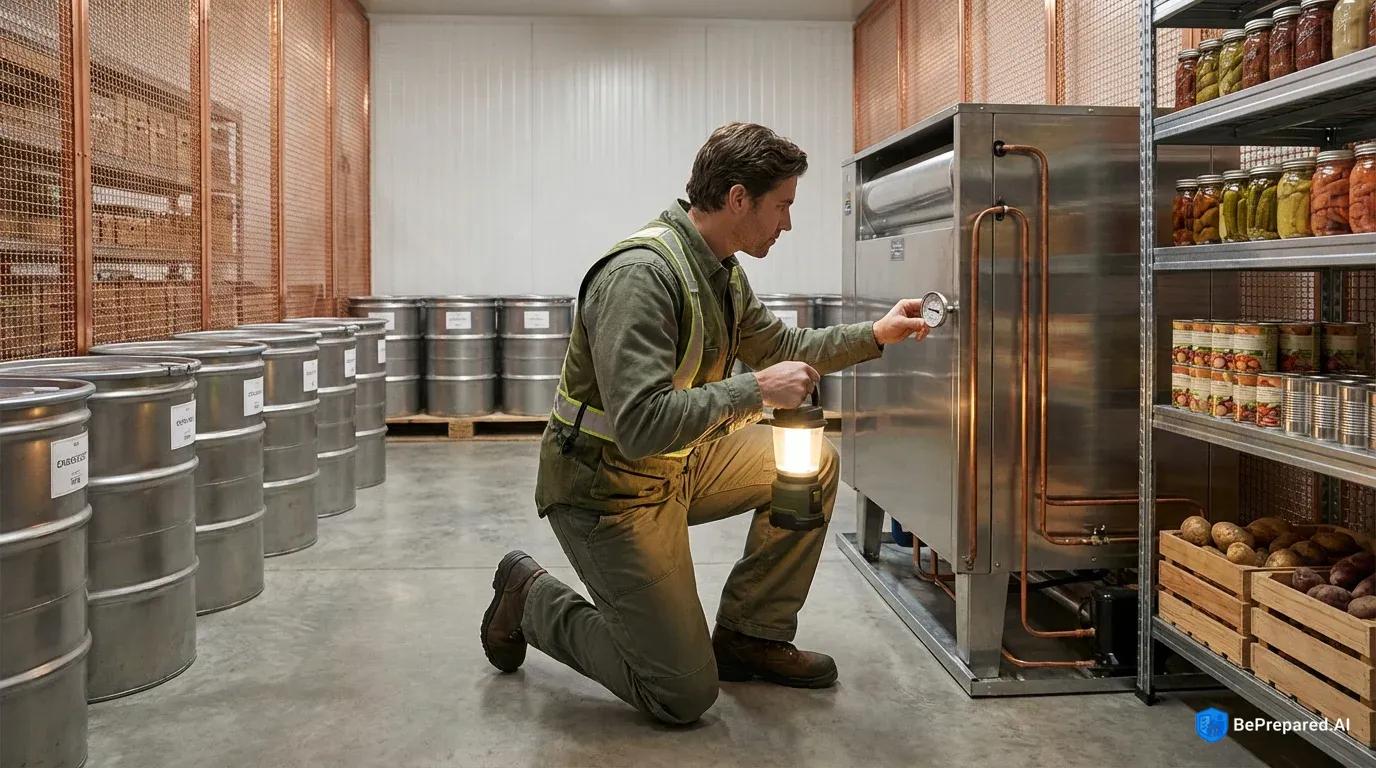
The practical implementation of Faraday protection in food storage facilities begins with the building envelope itself. A dedicated storage structure can incorporate a continuous metal shell as part of its basic construction. Six-mil copper sheeting applied to wall, floor, and ceiling surfaces creates an effective shield when joints are soldered or brazed to ensure electrical continuity.
Galvanized steel panels with welded seams provide robust protection at lower material cost, though copper offers superior conductivity and corrosion resistance for long-term installations. The enclosure must extend below ground level to prevent electromagnetic energy from entering through the foundation—either by continuing the metal shell beneath the floor or by ensuring the structure sits on conductive ground with proper bonding.
Every penetration through your Faraday cage requires careful treatment to maintain shielding integrity. Ventilation ducts necessary for air circulation must incorporate waveguide-beyond-cutoff sections—essentially honeycomb structures where individual cell dimensions remain small enough to block electromagnetic wavelengths while allowing air passage. Commercial waveguide ventilation panels designed for electromagnetic shielding applications provide measured attenuation exceeding 100 decibels across relevant frequency ranges.
Doors into protected spaces need continuous electromagnetic gaskets—conductive material that compresses when the door closes, creating electrical contact around the entire perimeter. These gaskets typically use beryllium copper fingers or conductive fabric embedded with silver-plated copper threads, maintaining conductivity even after thousands of opening cycles.
Electrical power entering a Faraday-protected space presents the most challenging penetration to address. Any conductor passing through the shield can act as an antenna, channeling electromagnetic energy directly into the protected area. The solution employs filtered power entry panels that allow 60-hertz electrical power to pass while blocking higher-frequency electromagnetic pulse components.
These filters use combinations of capacitors and inductors arranged to shunt high-frequency energy to ground before it enters the protected space. Military-grade power line filters achieve attenuation exceeding 80 decibels from 10 kilohertz through 10 gigahertz, effectively blocking all three components of a nuclear EMP while permitting normal power transmission .
Beyond electromagnetic shielding, truly resilient food storage infrastructure incorporates non-electronic backup systems that maintain functionality regardless of electromagnetic effects. Mechanical refrigeration systems using absorption cooling technology operate without electric motors or electronic controls. These systems employ a heat source—which can be natural gas, propane, kerosene, or even solar thermal collectors—to drive a thermodynamic cycle using ammonia and water or lithium bromide and water as working fluids.
The entire process operates through heat differentials and gravity, with no electronic components required. Properly designed absorption refrigeration systems can maintain temperatures around 45°F in insulated storage spaces without any electrical input, relying instead on the consistent heat output from fuel combustion or solar collection .
The infrastructure supporting these mechanical systems requires equal attention to EMP resistance. Fuel storage for absorption refrigeration should include gravity-fed delivery systems eliminating the need for electric pumps. A propane or natural gas system can operate entirely through pressure differentials and mechanical regulators—devices using springs, diaphragms, and lever mechanisms to control flow without electronic components.
Water supplies for evaporative cooling or humidification can utilize elevated storage tanks that feed distribution systems through gravity, with flow controlled by float valves and mechanical pressure regulators identical to those used in pre-electronic plumbing systems.
Create a personalized preparedness plan based on your location and family needs to prioritize EMP-safe food storage, backup power, and mechanical safeguards.
Thermal mass integration represents another crucial infrastructure element that doesn't appear in most modern storage designs but provides invaluable resilience. Incorporating large volumes of water, sand, gravel, or concrete within your storage space creates a thermal reservoir that resists temperature changes. A well-insulated 12x12-foot storage room with six inches of concrete in the floor and walls contains approximately 8,000 pounds of thermal mass.
This mass, once cooled to 45°F, will absorb heat energy from external sources and stored food products, slowing temperature rise dramatically if active cooling fails. Testing has demonstrated that properly designed thermal mass systems can maintain safe storage temperatures for 48 to 72 hours after cooling system failure, providing critical time for backup system activation or emergency food relocation.
The physical layout of EMP-resistant storage infrastructure should facilitate natural thermodynamic processes that aid preservation. Cool air sinks while warm air rises—a simple principle that becomes a powerful tool when incorporated into storage design. Positioning cooling systems or cool air intakes low in the storage space while providing warm air exhaust points high in the structure creates natural convection currents that circulate air without electric fans.
Similarly, incorporating a double-wall design with an air gap between exterior and interior walls creates a thermal buffer zone. Ventilation through this gap, driven by stack effect as warm air rises and escapes through high vents while cool air enters low vents, carries away solar heat gain before it reaches the interior storage space.
Ground coupling provides another passive infrastructure element that enhances resilience. At depths below approximately eight feet, soil temperature remains relatively constant year-round, typically between 45°F and 58°F depending on geographic location. Partially or fully underground storage structures benefit from this stable temperature environment, requiring less active cooling to maintain optimal storage conditions.
Even above-ground structures gain thermal stability by incorporating earth berming—banking soil against exterior walls to depths of several feet. This earth contact moderates temperature swings and reduces the cooling load that mechanical systems must handle, extending the operational duration of fuel-dependent backup systems.
Food Storage Systems and Methods
The intersection of EMP resilience and long-term food preservation requires understanding that different food categories demand different storage approaches, each with specific vulnerabilities to electromagnetic events and unique solutions for maintaining viability. Dry goods storage represents the most EMP-resistant category because properly processed and packaged dry foods require no active environmental control beyond basic temperature and humidity management.
Whole grains, dried beans, white rice, pasta, and dehydrated vegetables can maintain nutritional value and edibility for extended periods when stored in appropriate conditions . The key to extreme-longevity dry goods storage lies in creating an environment hostile to the chemical and biological processes that cause degradation.
Oxidation—the reaction between food molecules and atmospheric oxygen—breaks down fats, destroys vitamins, and creates off-flavors. Moisture enables enzymatic activity within food and supports microbial growth. Temperature accelerates both chemical and biological degradation, with reaction rates approximately doubling for every 18°F temperature increase. Insect infestation can destroy entire storage inventories if breeding populations become established. Addressing each of these factors through non-electronic methods creates storage systems that function identically before and after an EMP event.
Oxygen exclusion for dry goods employs several approaches that require no electronic components. Oxygen absorber packets containing iron powder provide the simplest solution—the iron oxidizes preferentially, consuming oxygen within a sealed container and reducing atmospheric oxygen concentration below 0.1%. These packets work through pure chemistry, requiring no activation or monitoring.
For larger-scale storage, nitrogen displacement offers an alternative. Food-grade nitrogen gas, denser than air, can be introduced at the bottom of a storage container while atmospheric air vents from the top, progressively replacing oxygen-rich air with an inert nitrogen atmosphere. The process requires only a nitrogen cylinder with a mechanical pressure regulator—no electronic components involved.
Container selection for dry goods storage significantly impacts long-term viability and EMP resilience. Mylar bags—polyester film laminated with aluminum—provide excellent oxygen and moisture barriers while remaining completely passive. These bags, heat-sealed after filling and oxygen absorber insertion, create a stable micro-environment around stored food. The aluminum layer blocks light that would otherwise degrade vitamins and accelerate oxidation.
For institutional-scale storage, food-grade steel drums with gasketed lids provide robust protection. A 55-gallon drum can hold substantial quantities of wheat or rice, creating a significant food reserve in a single, manageable container. The steel provides complete light blocking, excellent oxygen barrier properties when properly sealed, and inherent protection against rodent damage.
Moisture control in dry goods storage operates through desiccant materials that absorb water vapor from the atmosphere, maintaining low relative humidity that prevents microbial growth and clumping. Silica gel desiccant packets, commonly seen in commercial packaging, can be reused indefinitely—when saturated, heating in an oven drives off absorbed moisture, regenerating the desiccant's capacity.
For larger storage spaces, bulk desiccants like calcium chloride can be placed in open containers throughout the storage area. These materials absorb moisture from the air until reaching equilibrium, typically maintaining relative humidity around 15% in sealed or semi-sealed environments. Mechanical humidity control using desiccant dehumidifiers operates without electronic components—air flows through a desiccant bed that absorbs moisture, then through a regeneration section where heat from a gas flame or solar collector drives moisture from the desiccant, creating a continuous drying cycle.
Temperature management for dry goods doesn't require refrigeration, but cooler storage significantly extends shelf life. A storage area maintained at 50°F preserves dry goods approximately twice as long as storage at 70°F, and four times as long as storage at 90°F. Achieving these temperatures without electronic cooling in temperate climates can be accomplished through strategic design.
Underground or partially-underground storage spaces naturally maintain temperatures close to soil temperature—typically 50-55°F in most North American locations. Above-ground storage buildings with adequate insulation, reflective roofing to minimize solar heat gain, and ventilation systems that introduce cool night air while restricting hot daytime air can maintain temperatures 10-20°F below outdoor ambient temperatures through purely passive means.
Canned goods storage presents different challenges because the preservation method—heat sterilization and hermetic sealing—has already occurred during processing. Your role involves maintaining conditions that preserve can integrity and prevent the gradual quality degradation that occurs even in sealed containers. Commercial canning creates shelf life measured in years, with products typically remaining safe and nutritious under proper storage conditions. Extended storage beyond manufacturer recommendations remains possible but requires optimal conditions that non-electronic systems can reliably provide.
The primary threat to canned goods longevity comes from can corrosion, which eventually compromises the hermetic seal or creates pinhole leaks allowing contamination. Corrosion accelerates in humid environments and at higher temperatures. Maintaining relative humidity below 50% dramatically extends can life, preventing the surface rust that eventually penetrates the steel.
This humidity control can be achieved through the same desiccant systems used for dry goods, operating through purely mechanical or chemical processes. Temperature control follows similar principles—cooler storage extends shelf life, with each 10°F reduction approximately doubling the duration before noticeable quality degradation occurs.
Can rotation systems ensure oldest products are consumed first, preventing storage beyond optimal timeframes. These systems require no electronics—simple gravity-fed can dispensers using inclined shelves allow new cans to be loaded at the back while older cans roll forward for retrieval at the front. The first-in-first-out rotation happens automatically through gravity, requiring no monitoring systems or power input.
For larger storage operations, dated inventory logs maintained on paper provide tracking capability without electronic dependency. A simple notation system recording acquisition date and expected use-by date enables effective inventory management using nothing more sophisticated than a pencil and notebook.
Frozen food storage represents the most EMP-vulnerable category because it demands continuous active cooling to maintain temperatures at or below 0°F. However, mechanical freezing systems using absorption refrigeration technology can maintain these temperatures without electronic components. An absorption freezer operates identically to the absorption refrigerators discussed earlier but achieves lower temperatures through higher heat input and different working fluid concentrations.
These systems can reliably maintain 0°F in well-insulated freezer compartments using propane, natural gas, or kerosene as heat sources, with fuel consumption typically ranging from 1,500 to 2,500 BTU per hour depending on freezer size and insulation quality.
The critical vulnerability in frozen storage isn't the freezing system itself but the interruption that occurs if an EMP event disables your primary electric freezer before backup systems activate. Thermal mass again provides crucial resilience—a chest freezer filled with food and ice contains substantial thermal mass that resists temperature rise. Testing demonstrates that a well-insulated chest freezer, kept closed, maintains safe frozen storage temperatures for 48 hours after power loss. This window provides time to activate backup mechanical freezing systems or transfer products to EMP-protected freezers already operating on mechanical cooling.
Ice production and storage creates additional thermal mass while providing a versatile cooling resource. Mechanical ice-making systems using absorption refrigeration can produce ice continuously from water input and fuel, requiring no electronic components. Large-scale ice storage in heavily insulated ice houses—a technology predating electric refrigeration—maintains frozen ice for months.
Historical ice houses using 12-inch thick walls filled with sawdust insulation kept ice harvested in winter frozen through summer months. Modern insulation materials like polyurethane foam achieve equivalent performance with 6-inch thickness, making ice storage a practical component of EMP-resistant food preservation systems.
Root cellaring represents the oldest form of food storage and remains entirely EMP-proof because it relies purely on environmental conditions created through structural design. Root cellars maintain temperatures between 32°F and 40°F with high humidity—ideal conditions for storing root vegetables, apples, pears, and certain other produce for months.
Traditional root cellar design positions the storage space partially or fully underground, utilizing stable soil temperatures. Ventilation pipes—one drawing air from near ground level, another exhausting from the ceiling—create natural air circulation through stack effect. Cool outside air, denser than warm air, flows into the lower pipe, circulates through the storage space, and pushes warm air out through the upper pipe. This circulation occurs continuously without fans or power input, maintaining optimal temperature and preventing stagnant air that would promote mold growth.
Humidity control in root cellars typically involves maintaining high moisture levels rather than reducing humidity. Dirt floors or gravel floors over dirt naturally release moisture into the air, maintaining the 80-95% relative humidity that prevents vegetables from drying out during storage. Containers of water placed throughout the cellar evaporate slowly, humidifying the air through natural processes.
Temperature fine-tuning occurs by adjusting ventilation—opening vents wider when outside temperatures are cold to introduce more cooling, closing vents partially when outside temperatures are warm to restrict heat entry while maintaining some air circulation.
The combination of these storage methods—dry goods in oxygen-free, moisture-controlled environments; canned goods in cool, dry spaces; frozen products in mechanically-cooled freezers; and fresh produce in root cellars—creates a comprehensive food preservation system that functions independently of electronic infrastructure. Each component operates through physical, chemical, or thermodynamic principles that electromagnetic pulses cannot disrupt.
The diversity of methods ensures that even if one system experiences problems, multiple backup approaches remain operational, providing the redundancy essential for true resilience. Store at least a three-day supply of non-perishable food as your baseline, then expand your storage capacity using these EMP-resistant methods to build genuine long-term security.
Monitoring and Maintenance Protocols
The most sophisticated EMP-resistant storage infrastructure fails without consistent monitoring and maintenance, yet these critical functions typically rely heavily on electronic sensors and computer systems in modern facilities. Developing effective non-electronic monitoring systems requires understanding what parameters matter for food preservation and how mechanical or visual indicators can track these parameters with accuracy approaching electronic systems.
Research comparing manual monitoring protocols to electronic systems has demonstrated that properly designed and consistently executed manual monitoring can provide accuracy comparable to electronic sensors while maintaining complete EMP immunity .
Temperature monitoring represents the most critical parameter for most food storage applications. Non-electronic temperature measurement employs several proven technologies, each with specific advantages for different applications. Alcohol or mercury thermometers—sealed glass tubes containing liquid that expands and contracts with temperature changes—provide direct visual temperature readings requiring no power or calibration.
Industrial-grade thermometers with metal cases and large, easy-to-read scales can be permanently mounted in storage spaces, providing continuous temperature indication. These instruments maintain accuracy within ±1°F across their operating range and function reliably for decades with no maintenance beyond occasional cleaning.
Bi-metallic strip thermometers offer an alternative that's particularly useful for alarm functions. These devices use two different metals bonded together—as temperature changes, differential expansion between the metals causes the strip to bend. This bending can drive a pointer across a dial for visual indication, or can be used to trigger mechanical switches at specific temperature thresholds.
A bi-metallic strip thermometer can be configured to release a spring-loaded flag or ring a mechanical bell when temperature exceeds a preset limit, providing unmistakable warning of storage condition deviation without requiring constant observation.
Maximum-minimum thermometers provide crucial information about temperature excursions that might occur between monitoring checks. These specialized instruments contain markers that are pushed by the expanding liquid column and remain at the highest and lowest positions reached, showing the temperature range experienced since the last reset. Checking a maximum-minimum thermometer daily reveals whether your storage space experienced any problematic temperature spikes or drops during the previous 24 hours, even if conditions have returned to normal by the time you conduct your inspection.
Humidity monitoring without electronic sensors employs hygrometers based on materials that physically change with moisture content. Hair hygrometers use human or animal hair, which lengthens as it absorbs moisture and shortens as it dries. This length change, amplified through a mechanical linkage, drives a pointer across a calibrated scale.
While less precise than modern electronic sensors, quality hair hygrometers provide accuracy within ±5% relative humidity—sufficient for food storage applications where you're maintaining conditions well within safe ranges rather than operating at critical thresholds. Dial hygrometers combining bi-metallic strip temperature sensors with hair humidity sensors provide both readings in a single instrument, simplifying monitoring in each storage area.
Paper-based humidity indicators offer a simpler approach for applications where precise values matter less than knowing whether humidity remains within acceptable ranges. These indicators use paper impregnated with cobalt chloride or similar compounds that change color based on moisture content. A card might show blue when humidity is below 30%, purple between 30-50%, and pink above 50%, providing immediate visual confirmation that conditions remain appropriate for dry goods storage. These indicators require no calibration, no maintenance, and no interpretation beyond simple color comparison.
Atmospheric composition monitoring becomes relevant for storage employing oxygen exclusion or controlled atmosphere techniques. While electronic oxygen sensors dominate modern applications, chemical oxygen indicators provide non-electronic alternatives. These devices contain compounds that change color in the presence of oxygen—remaining one color in oxygen-free environments and shifting to a different color when oxygen concentration exceeds specified thresholds.
Oxygen indicator tablets placed inside sealed storage containers provide visual confirmation that oxygen levels remain below critical thresholds without requiring any measurement equipment.
For larger controlled-atmosphere storage rooms, mechanical oxygen monitoring can employ a candle or oil lamp. These devices consume oxygen during combustion—if oxygen concentration drops below approximately 16%, the flame extinguishes. This simple test, conducted by briefly introducing a lamp into the storage atmosphere through an airlock, provides definitive confirmation of low oxygen conditions. While crude compared to electronic sensors providing precise percentage readings, this method reliably indicates whether oxygen levels remain in the range necessary to prevent aerobic degradation and insect activity.
Inspection protocols form the foundation of effective non-electronic monitoring. Establishing regular inspection schedules ensures problems are detected before they compromise significant food quantities. Daily inspections should include temperature and humidity readings in each storage area, visual examination of storage containers for any signs of damage or degradation, and verification that mechanical systems are operating correctly.
Check that absorption refrigerators maintain appropriate temperatures, that ventilation systems show evidence of air movement, and that no unusual odors suggest spoilage or contamination.
Weekly inspections extend beyond basic parameter checks to examine food products directly. Rotating through different sections of your storage inventory, open containers to verify that dry goods remain free-flowing without clumping that would indicate moisture intrusion, that canned goods show no signs of swelling or leakage, and that frozen products maintain solid state without ice crystal formation suggesting freeze-thaw cycling. This hands-on examination catches problems that instrument readings might miss—a compromised package seal, the beginning of insect infestation, or subtle changes in product appearance that precede obvious spoilage.
Monthly maintenance activities address the systems supporting food storage rather than the food itself. Absorption refrigeration systems require inspection of burner assemblies to ensure clean, efficient combustion; examination of flue systems to verify proper venting; and checking of coolant levels if your system design permits access.
Mechanical ventilation systems need examination of dampers to ensure they move freely, inspection of air intakes and exhausts for blockage, and verification that gravity-driven airflow continues unobstructed. Desiccant dehumidification systems require regeneration cycling—heating saturated desiccant to drive off absorbed moisture and restore moisture-absorbing capacity.
Quarterly maintenance extends to structural elements and protection systems. Faraday cage integrity should be verified by inspecting electromagnetic gaskets on doors for compression and continuity, examining all penetrations through the shield to ensure waveguide vents remain unobstructed and power line filters show no physical damage, and testing electrical continuity across shield joints using a simple battery-powered multimeter.
This represents one of the few electronic devices that serves a purpose in EMP-resistant infrastructure because it can be stored in a protected container and used only during testing. Research suggests that regular quarterly inspections can significantly extend system lifespan compared to reactive maintenance approaches that address only obvious failures .
Record keeping provides the historical context necessary to identify gradual trends that might indicate developing problems. A bound logbook—paper and pen requiring no power—should document every inspection and maintenance activity. Temperature and humidity readings recorded daily create a baseline showing normal seasonal variations and making anomalies immediately apparent.
Maintenance activities logged with dates and observations allow you to track component lifespan, predict when preventive replacement might be necessary, and identify recurring issues suggesting systemic problems rather than random failures.
Inventory records maintained in the same logbook track food acquisition dates, storage locations, and rotation activities. This information enables effective first-in-first-out management, ensures products are consumed before exceeding optimal storage duration, and provides accountability if multiple people access the storage system.
The discipline of written record-keeping, while seemingly primitive compared to computerized inventory management, creates resilience that electronic systems cannot match—your logbook remains accessible and functional regardless of electromagnetic events, power availability, or technological failures.
The integration of these monitoring and maintenance protocols creates a management system as resilient as the physical infrastructure it oversees. Temperature, humidity, and atmospheric conditions are tracked through instruments that function identically before and after an EMP event. Inspection protocols catch problems early through direct observation rather than sensor alerts.
Maintenance activities preserve system functionality through scheduled attention rather than reactive crisis response. Record keeping provides institutional memory that persists regardless of technological disruption. Together, these elements ensure that your EMP-resistant food storage infrastructure delivers reliable long-term preservation, maintaining your food security through whatever challenges electromagnetic events might bring.
- Vacuum Sealed Storage
- Manual pump system, oxygen-free environment, 2-5 year shelf life for dry goods, requires 15% moisture or less
- Mechanical Dehydration
- Hand-cranked or solar dehydrator, reduces moisture to 10-20%, 2-5 year shelf life with proper storage