What defensible space is and why it works
The ground within a few steps of your walls is the part of a wildfire plan you control most directly. You can't change the weather, the slope behind your lot, or the forest across the road. You can decide what sits next to your siding, how your shrubs are spaced, and whether pine needles pile up in your gutters. Those choices are cheap, and they matter.
Defensible space is the managed buffer between your home and the vegetation around it. It slows or stops fire spread and reduces the fuel that can carry flames or embers to the structure . Think of it as a moat made of maintenance instead of water.
Your risk depends partly on where you live. The U.S. Fire Administration defines the wildland urban interface (WUI) as the zone of transition between unoccupied land and human development, where structures meet or intermingle with undeveloped wildland vegetation . If your neighborhood backs onto open space, or houses are scattered among trees and brush, you likely live in it . Tens of millions of U.S. homes sit in WUI areas, so you have plenty of company.
NFPA and Firewise USA organize the work into the Home Ignition Zone, which has three parts: Immediate (0-5 feet), Intermediate (5-30 feet), and Extended (30-100 feet, reaching out to 200 feet) . Ready.gov similarly recommends a fire-resistant zone free of leaves, debris, and flammable materials for at least 30 feet from your home .
Defensible space reduces risk. It does not guarantee a house will survive, and it works best alongside fire-resistant building materials . It also doesn't require a barren lot. A well-designed buffer looks intentional, with clean edges, gravel paths, and spaced plantings.
The rest of this guide moves outward through the three zones, then covers plants, trade-offs, and a phased plan.
Step 1: Harden the immediate zone (0-5 feet)
Do this first. Embers can travel well ahead of a fire front and may land against your house even when the flames are still far away. That makes the zone touching your walls the most important one. NFPA's guidance for this zone calls for cleaning roofs and gutters of dead leaves and needles and moving mulch, firewood, and other flammable materials away from exterior walls . Work through this checklist before touching anything farther out.
Clear the roof and gutters. Dead leaves and pine needles are ready-made kindling if embers land on them. Clean the valleys, the roof edges, the gutters, and any spot where a roof meets a wall.
Pull mulch back from the foundation. Bark and wood mulch is a fuel source right beside your siding. Many fire agencies suggest gravel, river rock, or pavers instead, since these materials don't burn.
Move firewood. A woodpile against the house is a fuel stack beside your wall. Store it well away from the structure.
Check under decks, porches, and stairs. Debris tends to collect in these spaces, and embers can slip in. Clear what's there, and avoid using the space for storage.
Clear combustibles from the walls. Patio cushions, doormats, trash bins, and propane tanks are common examples. Move them away from siding or store them in a garage or shed.
Choose fire-resistant materials for repairs. Ready.gov advises using fire-resistant materials when building, renovating, or making repairs . When a deck board, fence section, or door sweep needs replacing, upgrade it.
Ember-resistant vents and screening belong in this same zone, because attic and crawlspace openings can give embers a way inside. See our guide to ember-resistant vents for what to look for and how to install them.
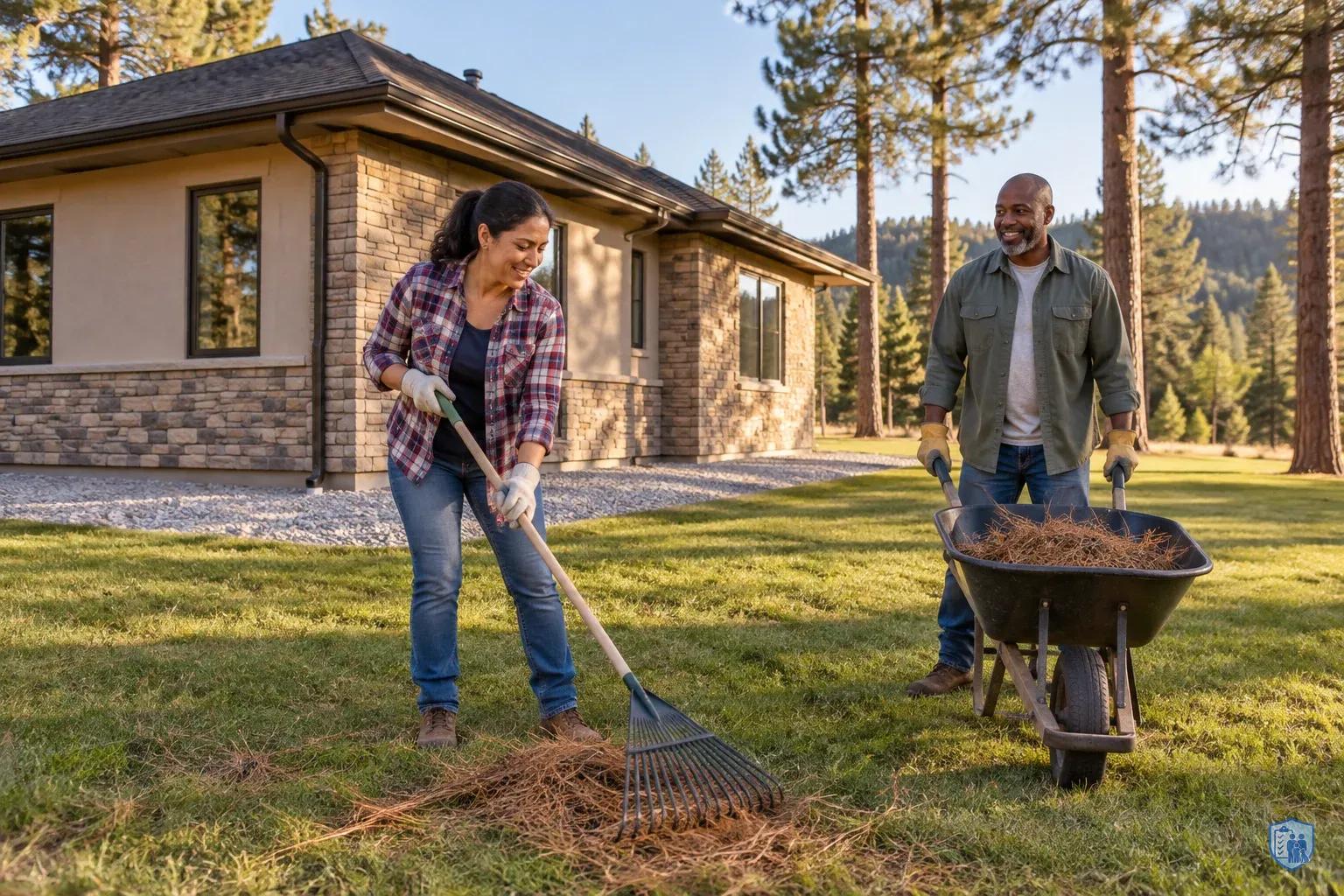
A practical example: a homeowner spends one Saturday raking the roof edge, shoveling bark away from the foundation, and relocating a woodpile. The job takes little more than time and effort, and it removes the fuel closest to the house.
Step 2: Thin and space the intermediate zone (5-30 feet)
The goal here is to break up continuous fuel. Fire shouldn't be able to travel easily along the ground or climb into the tree canopy. NFPA's Intermediate zone covers 5 to 30 feet from the home, which lines up with Ready.gov's advice to keep at least 30 feet around the house free of leaves, debris, or flammable materials .
Two ideas guide the work. Horizontal spacing is the gap between plants across the ground. A continuous hedge works like a fuse, carrying flame from one end to the other, while gaps between shrub groupings break that path. Vertical spacing deals with ladder fuels. Ladder fuels are plants and branches at stepped heights that let a low fire climb into the canopy; remove shrubs under trees, low-hanging branches, and tall grass at the base of trunks . Take away the rungs and the ladder stops working.
In practice, this zone calls for the following:
- Keep lawns and native grasses mowed short and watered as conditions allow . NFPA's figure for grass height is 4 inches or less .
- Remove ladder fuels. NFPA also suggests pruning trees 6 to 10 feet up from the ground .
- Group shrubs in islands with open space between them, and keep gaps between shrubs and trees instead of planting a continuous screen . For trees, NFPA's guidance calls for about 18 feet between crowns .
- Use hardscaping as fuel breaks. Paths, patios, and driveways give fire little to burn, so lay them out to interrupt plant continuity. This is a common recommendation among fire agencies, so confirm the details locally.
- Keep the whole zone clear of leaf litter, debris, and stored flammables.
These numbers are a starting point. Local fire agencies may set different figures for your region, so check with them before you buy a single tool.
Fire moves faster uphill, so spacing needs to increase on slopes . Call your local fire department or forestry agency before you start. Some areas have mandatory defensible space rules and inspection programs, and the requirements vary by location.
- Immediate zone: 0-5 feet (do this first)
- Clean dead leaves and pine needles from roofs and gutters. Move mulch, firewood, and other flammable materials away from exterior walls. Many fire agencies suggest gravel, river rock, or pavers instead of bark mulch because they don't burn.
- Intermediate zone: 5-30 feet
- Break up continuous fuel. Keep grass mowed to 4 inches or less. Remove ladder fuels and prune trees 6 to 10 feet up from the ground. Group shrubs in islands with open space between them, and leave about 18 feet between tree crowns.
- Extended zone: 30-100 feet, can extend out to 200 feet
- The goal is to reduce fire intensity, not to create bare ground. Remove dead trees, fallen branches, and heavy ground litter. Thin dense stands of small trees and brush. Bring in professionals for large tree removal, steep slopes, or work that needs permits.
- Coordinate with neighbors
- Never clear land you don't own. Start with your own property, then talk to neighbors whose yards overlap your zones. Offer to compare plans or share a contractor for a bulk quote. Your HOA or a Firewise USA community may be able to organize group work.
- Reduces risk, doesn't guarantee survival
- Pair defensible space with fire-resistant building materials and ember-resistant vents. Re-check your zones before and during fire season, and after storms or heavy leaf drop, because vegetation regrows.
Step 3: Manage the extended zone (30-100+ feet)
In this zone, the goal is not bare ground. It is to reduce fire intensity and slow its spread before flames reach the inner zones. NFPA's Extended zone covers 30 to 100 feet from the home and can extend out to 200 feet . A thinned, tidy woodland can still look natural while burning less fiercely.
Focus on these tasks, which reflect common NFPA and fire-agency practice. Confirm the details with your local agency:
- Remove dead trees, fallen branches, and heavy accumulations of ground litter.
- Thin dense stands of small trees and brush so fire has a harder time moving through.
- Watch for structures in this zone. Sheds, fences, and play sets can become fuel sources, so factor them into your plan.
- Coordinate with neighbors when zones overlap property lines. Fire does not stop at a fence.
- Bring in professionals for large tree removal, steep slopes, or work that needs permits.
Many properties don't include the full 100 to 200 feet, and you should never clear land you don't own. Start with the part that is yours. Then talk to the neighbors whose yards fall within your extended zone, and whose extended zones include yours. Offer to compare plans or share a contractor for a bulk quote.
If your street has an HOA, ask whether it manages common areas or can organize group work. Firewise USA is an NFPA program , and many communities use it to assess risk together and plan shared projects. Check the program's own materials for how it works. Public land or utility easements nearby are a question for the managing agency, not something to handle yourself.
Defensible space is one piece of wildfire readiness. Build your full plan with our guides to ember-resistant vents, evacuation go-bags, and smoke protection.
- Junipers: remove or relocate
- Local fire agencies often flag junipers because of their dense, resinous foliage. Resinous or oily foliage and dense, twiggy growth are traits to move away from the home.
- Ornamental grasses: cut back
- Ornamental grasses can build up dry thatch unless you cut them back. Dry, brittle foliage and heavy buildup of dead stems or litter are traits to keep away from the home.
- Conifers against walls
- Conifers planted against walls put resinous fuel right at your siding. Loose, papery bark and fine needles are traits to relocate away from the home. Clean dead needles from roofs and gutters.
- Favor succulents and low groundcovers
- Near structures, consider low-growing groundcovers and succulents where your climate allows. Keep them trimmed and free of dead material, and leave gaps between plantings. Favor high-moisture leaves and low sap or resin content.
- Space and prune trees
- Favor an open growth habit, smooth bark, and broad leaves. NFPA suggests pruning trees 6 to 10 feet up from the ground and keeping about 18 feet between tree crowns. Remove shrubs growing under trees.
Which plants to remove, keep, or replace
Start with this principle: no plant is fireproof. Any plant can burn under the right conditions. Placement, spacing, and maintenance matter as much as species. A fire-resistant shrub planted in a dense row and choked with dead twigs can still carry fire. Ready.gov's advice to keep the zone free of leaves, debris, and flammable materials applies to dead plant matter and litter just as much as to stored items .
Suitable species vary widely by climate, so a trait-based comparison is more useful than a species list. Treat the table below as general guidance, and confirm it with your cooperative extension office or fire agency:
| Trait | Remove or relocate away from the home | Keep or favor near the home |
|---|---|---|
| Moisture | Dry, brittle foliage | High-moisture leaves |
| Sap and resin | Resinous or oily foliage | Low sap or resin content |
| Structure | Dense, twiggy growth | Open growth habit |
| Dead material | Heavy buildup of dead stems, needles, or litter | Little dead material, easy to maintain |
| Bark and needles | Loose, papery bark; fine needles | Smooth bark; broad leaves |
A few common examples deserve a second look. Junipers are often flagged by local fire agencies because of their dense, resinous foliage. Ornamental grasses can build up dry thatch unless you cut them back. Conifers planted against walls put resinous fuel right at your siding. Confirm how each of these behaves in your region before you decide, since conditions differ from one climate to the next.
Near structures, consider low-growing groundcovers and succulents where your climate allows. Keep them trimmed and free of dead material, and leave gaps between plantings.
For region-specific plant lists, contact your local cooperative extension office or fire agency. They know which species perform well locally and which invasives to avoid. Some will also advise on a specific property.
Weighing the trade-offs
Defensible space has real benefits, and it has real costs. Look at both before you commit your budget and your weekends.
Pros: It reduces risk to your home and gives firefighters a safer place to work . Many of the first tasks cost mostly time, such as clearing gutters and moving firewood. It can make your property look cleaner and more deliberate. It may help you meet local rules if your area has them.
Cons: It does not guarantee your house will survive . It takes ongoing work, because vegetation regrows and leaves keep falling. Larger jobs, such as tree removal and hardscaping, can cost real money. Thinning can change privacy, shade, and the look of your yard.
For most people, the math favors action, especially in the Immediate zone, where the effort is small and the payoff is highest. Pair the work with fire-resistant building materials and ember-resistant vents to get the most from it .
Your defensible space implementation plan
Defensible space is easier when you break it into phases. NFPA identifies the Immediate zone as the area for cleaning roofs and gutters and moving flammable materials away from walls , which is why it comes first.
Phase 1: This weekend
- Clear gutters and the roof of leaves and needles.
- Pull flammables from the 0-5 foot zone, including cushions, doormats, bins, and propane tanks.
- Move firewood away from the house.
Phase 2: Within a month
- Replace foundation mulch with gravel, river rock, or pavers.
- Remove ladder fuels in the 5-30 foot zone.
- Space shrubs into groupings with gaps, and use hardscape as fuel breaks.
Phase 3: This season
- Begin thinning in the extended zone, on land you own or have permission to work.
- Get quotes for professional tree work.
- Talk to neighbors, your HOA, or your local Firewise USA community.
Ongoing maintenance
- Re-check before and during fire season, and after storms or heavy leaf drop. This is a practical routine, not a fixed rule.
- Replace worn fencing, decking, and other materials with fire-resistant options. Ready.gov advises using fire-resistant materials when building, renovating, or making repairs .
Take dated before-and-after photos at each phase. They may be useful as records, and they can help if your area runs a local inspection program or you talk with your insurer.
Budget realistically. Phase 1 tasks mostly cost time and effort. Phase 2 adds the cost of gravel or pavers, and tree removal and larger hardscaping projects are the biggest expenses. Spread them across seasons if you need to.
Avoid power tools such as mowers, trimmers, and chainsaws during red-flag warnings or in dry, windy conditions. A spark from a blade striking a rock can start a fire, and agencies such as CAL FIRE publish equipment-use guidance worth reading. Where you can, work during cooler, calmer parts of the day. Keep a charged hose nearby that reaches the work area. Ready.gov recommends having a hose that reaches your whole property .
Defensible space is never "done." Vegetation regrows, leaves fall, and fences age. A short seasonal routine does more good than a single heroic cleanup.
Download our printable Defensible Space Checklist, organized by zone and phase. Then walk your property this weekend and start checking items off.