1. Reserves, Not Hoarding: Why Steady Rotation Is the Responsible Move in a Money Crisis
Picture a Tuesday evening. Your card declines at the grocery store, the clerk says the payment network is "acting up," and the people behind you start checking their phones. Nothing is wrong with the shelves. The trouble is the plumbing that moves money.
That is often how a financial crisis shows up. Banking disruption, currency devaluation, and job loss can bring higher prices, payment failures, and short, panic-driven gaps in what's available, though they rarely empty every store. That pattern is my read of how these events tend to play out, not a guarantee. Preparing for it is responsible, not paranoid, and you have nothing to feel guilty about.
The difference between a reserve and hoarding is simple. A strategic reserve is built gradually, sized to your household, made of things you already eat and use, and rotated before it expires . Hoarding means bulk buying during a shortage, buying more than you can use before it spoils, or clearing shelves your neighbors need. Ready.gov's advice: store nonperishable food your household will actually eat, and account for special dietary needs, infants, and pets .
Building slowly in normal times is also the ethical choice. When you already have a buffer, you skip the checkout scramble, and that leaves more on the shelf for everyone else. Ready.gov also notes that ATMs and credit card systems may not work during an emergency or power outage . A buffer therefore has to cover payments as well as groceries.
This series builds a 30-day layer, then 60, then 90. It covers food, medication, hygiene, cash, documents, and spare parts. It closes with three local or skill-based swaps that cut your exposure to long supply chains. The pace is budget-friendly: add a few extra items per shopping trip. No single spree is required.
- 30-Day Base: Start with a household audit
- Before buying anything, list every household member with their diets, allergies, infants, pets, daily medications and medical devices. Then name your top three vulnerabilities so they set your priorities.
- 30-Day Base: Food, water and hygiene
- Build menus from calorie-dense staples you already eat, such as rice, oats, pasta, beans, nut butters, canned fish and meat, oil and shelf-stable milk. Store at least one gallon of water per person per day. Stock hygiene supplies based on what you actually use in 30 days.
- 30-Day Base: Medical list, cash and documents
- Keep an up-to-date list of medicines, doses, conditions, allergies and medical supply needs, plus a basic over-the-counter and first-aid kit. Ask your pharmacist or prescriber about anything prescription-related. Keep a small amount of cash at home in a safe place and copies of IDs, insurance and financial records in one secure folder.
- 60-Day Layer: Deepen food security
- Double the staples you eat weekly. Plan to eat perishables first, then frozen items, then shelf-stable food. Date everything and rotate first-in, first-out. After a power loss, food may stay safe about 4 hours in a closed refrigerator, 48 hours in a full freezer and 24 hours in a half-full freezer. When in doubt, throw it out.
- 60-Day Layer: Medical continuity
- Ask your pharmacist or provider about emergency medication supplies, refill timing and your state's refill laws. Set up mail-order or telehealth options before you need them. Take a first aid or CPR class and keep a printed first-aid reference. Stock consumables such as glucose test strips, CPAP supplies, contact lens solution and backup eyeglasses.
- 90-Day Layer: Cash, documents and spare parts
- Keep small bills at home, but avoid panic withdrawals. FDIC insurance covers $250,000 per depositor, per insured bank, for each account ownership category. Keep printed documents in a folder or fireproof pouch that trusted household members can reach. Stock spare parts such as filter cartridges, batteries, fuses and chargers. Store cooking fuel outside living areas and never burn grills or camp stoves indoors.
2. Step 1: Audit Your Household and Build the 30-Day Layer
Start with paper, not purchases. Many people who buy first end up with a pantry full of food nobody wants. Work through these steps in order.
1. Run a household audit. List every household member, along with diets, allergies, infants, pets, daily medications, and medical devices. Then name your top three vulnerabilities. A diabetic family member, a baby on formula, and a well pump that needs electricity would each steer your priorities differently.
2. Build the food layer from what you already eat. Choose calorie-dense staples such as rice, oats, pasta, dried or canned beans, nut butters, canned fish and meat, cooking oil, and shelf-stable milk. Sketch simple menus, like rice and beans with canned tomatoes or oatmeal with peanut butter, and buy to match them. Menus keep you from collecting random cans that never become dinner.
3. Set your water baseline. FEMA recommends at least one gallon of water per person per day . Our water article covers storage containers and treatment, so this piece won't repeat that ground.
4. Write down your medical picture. The FDA advises keeping an up-to-date list of your medicines, doses, medical conditions, allergies, and medical supply needs . Add a basic over-the-counter and first-aid kit. It should cover pain or fever, allergies, stomach upset, and wound care, plus anything specific to your household. Skip improvised stockpiling here. Talk to your pharmacist or prescriber about anything prescription-related .
5. Match hygiene to real usage. Count what you actually go through in 30 days: soap, toothpaste, toilet paper, menstrual products, diapers, and sanitation supplies. If your household uses four rolls of toilet paper a week, you need about seventeen for 30 days. Don't guess high.
6. Set aside cash and documents. Ready.gov advises keeping a small amount of cash at home in a safe place . The right figure depends on your household, so decide it yourself rather than copying someone else's number. The CFPB recommends safeguarding important financial and identity documents . Gather copies of IDs, insurance policies, and financial records into one secure folder.
Do this audit once and the rest of the plan gets easier and cheaper. Download the printable 30/60/90-Day Reserve Tracker to log what you have, what to rotate, and your next check date.
3. Step 2: The 60-Day Layer: Deepen Food Rotation and Medical Continuity
Once your 30-day base feels steady, the second layer is about depth and discipline. Think of it like deepening a well: the opening stays the same size, but you reach more water.
1. Double the staples that store well. Pick the items your household eats weekly and keep twice as much. Rice, oats, and canned beans are good candidates. If you wouldn't eat it on an ordinary Wednesday, it doesn't belong in the layer.
2. Write a rationing plan before you need one. My recommendation for stretching calories is to eat perishables first, then frozen items, then shelf-stable food. Put the order on an index card inside the pantry door so anyone in the house can follow it. This answers the food shortage risk without panic buying, because you already know the order and you already have the food.
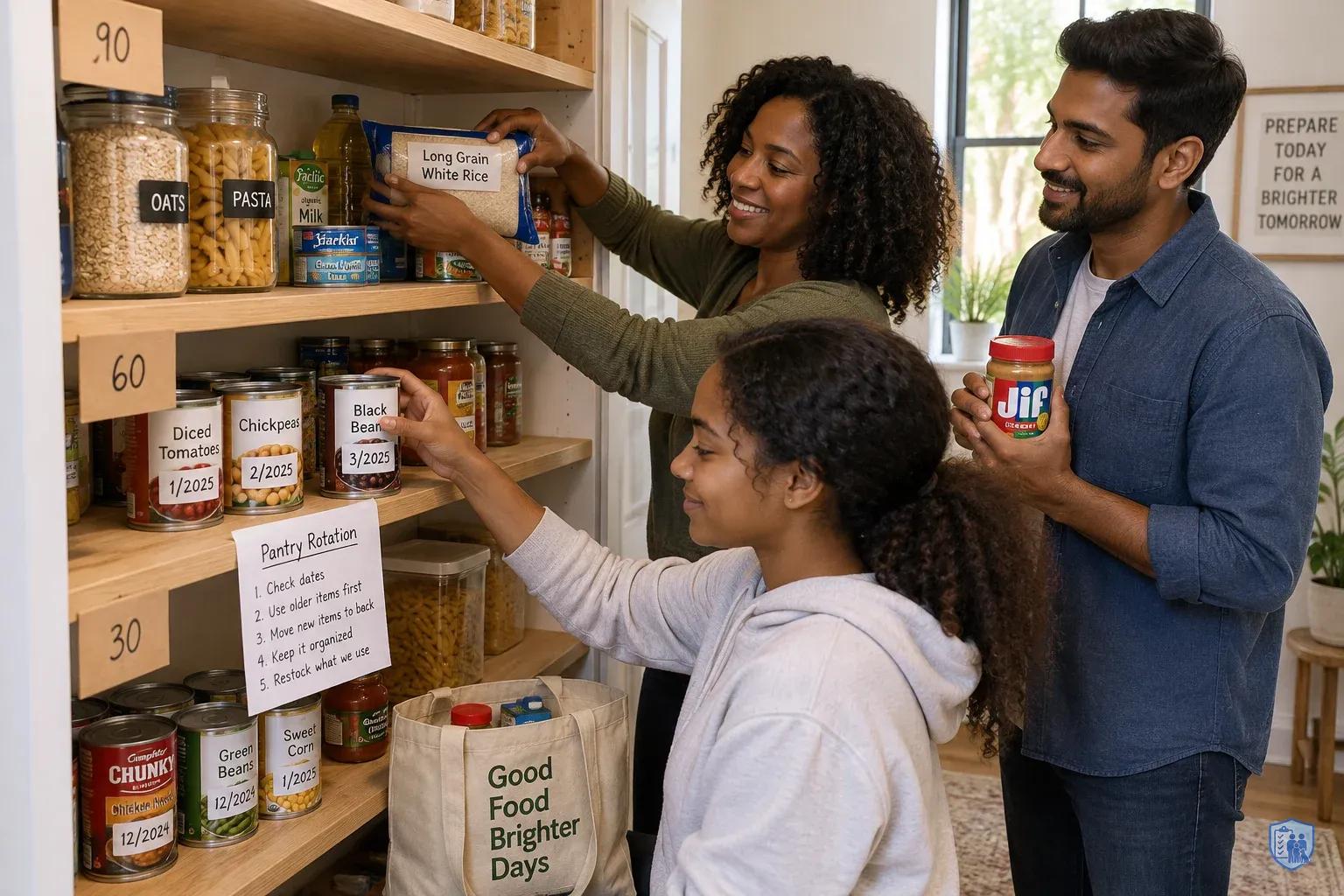
3. Rotate first-in, first-out. Date everything with a marker, put new stock at the back, and cook from the front. A reserve that rotates is an extension of your kitchen. One that doesn't turns into a museum of expired cans.
4. Know the outage rules. After a power loss, use appliance thermometers and the clock. Widely published CDC and USDA food-safety guidance says food may stay safe for about 4 hours in a closed refrigerator, 48 hours in a full freezer, and 24 hours in a half-full freezer, as long as the doors stay closed. Check FoodSafety.gov for the current numbers before you need them. When in doubt, throw it out.
5. Plan for no medical access with people, not just supplies. The FDA advises talking with your pharmacist or health care provider about emergency medication supplies and your state's refill laws . Ask about refill timing and emergency refill rules. Ask whether mail-order or telehealth options exist through your provider, and set them up before you need them.
6. Build skills next to supplies. Take a first aid or CPR class, and keep a printed first-aid reference in the kit. A guide on paper still works when your phone doesn't.
7. Cover medical consumables. Glucose test strips, CPAP supplies, contact lens solution, and a backup pair of eyeglasses all stall daily life when they run out. Add them to your audit list and tracker.
4. Step 3: The 90-Day Layer: Cash, Documents, and Spare Parts for a Banking Disruption
A money crisis hits payments first. The third layer protects your ability to function when the financial system stumbles. Here's what to put in place:
- Keep small bills at home in a secure spot. The CFPB notes that electronic payments and ATMs may be unavailable in emergencies and recommends having access to cash . Small bills matter because merchants may be unable to make change for a large one when registers are down.
- Skip the panic withdrawal. The standard FDIC deposit insurance amount is $250,000 per depositor, per insured bank, for each account ownership category . That covers deposit accounts, not investments . Pulling everything out of the bank swaps a protected balance for the risk of theft, fire, or loss .
- Keep documents printed and secured. Hold copies of IDs, insurance cards, your medication list, account numbers, and bill contacts in a folder or fireproof pouch. Make sure trusted household members know where it is and can reach it. A folder only you can open fails the first time you're away.
- Stock spare parts for things that would stall your household. Good candidates include replacement water filter cartridges, batteries, a basic tool kit, bike tubes, fuses, appliance belts, and backup chargers. Walk around your home and ask what single broken part would hurt most. Then buy that part.
- Store cooking fuel safely. Keep fuel outside living areas in proper containers . Use labeled, non-glass containers, and never burn grills, charcoal, or camp stoves indoors, because carbon monoxide gives no warning. The CPSC's portable generator alert covers the same invisible hazard . Our energy safety article covers fuel in more depth.
In a banking disruption, small practical backups matter more than dramatic ones. A household with cash on hand, documents in one place, and a spare filter cartridge isn't waiting on a bank or a shipping truck to fix an ordinary problem.
- Pick three distant dependencies
- List the items you rely on distant suppliers for, then pick three to make less fragile. Use one formula for each: dependency, then alternative, then first action this month, with a date. Aim for realistic, small swaps, not total self-sufficiency.
- Store-bought bread → Home baking
- Replace store-bought bread with home baking from stored flour. First action this month: bake one practice loaf.
- Faraway greens → Container garden
- Replace fresh greens from far away with a container herb or greens garden. First action this month: start one pot on a sunny sill.
- Specialty repair → Skill or tool share
- Replace a specialty repair with a learned skill or a neighborhood tool share. First action this month: learn one repair, or ask one neighbor about sharing tools.
- Talk to neighbors and keep the swaps alive
- Ask neighbors what skills they have and whether anyone would trade tool access for help with a project. Mutual aid should never be your only fallback. Share skills openly, but don't broadcast the size of your reserves. Review your three swaps twice a year.
5. Step 4: Replace Three Distant Dependencies with Local, Skill-Based, or Shared Alternatives
More stuff only goes so far. Resilience also comes from needing less of what travels a long way to reach you. Start by listing the items you rely on distant suppliers for, then pick three to make less fragile. Aim for realistic, small swaps, not total self-sufficiency.
Use one formula: dependency → alternative → first action this month.
| Dependency | Alternative | First action this month |
|---|---|---|
| Store-bought bread | Home baking from stored flour | Bake one practice loaf |
| Fresh greens from far away | Container herb or greens garden | Start one pot on a sunny sill |
| A specialty repair | A learned skill or neighborhood tool share | Learn one repair, or ask one neighbor about sharing tools |
Copy this template for your own list:
Dependency: ________ → Alternative: ________ → First action this month: ________ (date: ____)
Look locally for the alternatives. Farmers markets, local farms, co-ops, and community gardens can shorten the chain between you and your food. Visit them now and learn the names behind the stalls. A relationship built over a few Saturdays is worth far more than a cold call in a crisis.
Have a first neighbor conversation too. Ask what skills people have and whether anyone would trade tool access for a hand with a project. Mutual aid supplements your reserves, but it should never be your only fallback.
Keep some operational sense. Share skills openly, but don't broadcast the size of your reserves. Being known as the neighbor who can fix a bike or bake bread builds goodwill. Being known as the neighbor with a full basement invites trouble.
6. Step 5: Lock In a Rotation Schedule and Take Action This Week
A reserve is only as good as its upkeep. Put the checks on a calendar so they happen without willpower.
1. Monthly: Pull the oldest food forward and use it in normal meals. Replace what you used.
2. Quarterly: Review the medical kit and medication list, check expiration dates, and update your documents.
3. Twice a year: Review cash, spare parts, and your three local swaps. Is the herb pot alive? Did you bake that loaf?
4. Use FEMA's checklist as a sanity check. FEMA's supply list includes nonperishable food, sanitation supplies, a manual can opener, and family documents . If a power outage left you with a full pantry and no way to open a can, you'd feel it fast.
The Tradeoffs, Plainly
No plan is free, so weigh the costs before you commit.
Pros:
- A rotating reserve keeps you out of the checkout scramble and can soften price spikes.
- Cash, documents, and spare parts cover the small failures that happen far more often than big ones.
- Local skills and neighbor ties pay off in ordinary life, not just in a crisis.
Cons:
- Reserves tie up money and storage space, and food you never eat is wasted money.
- Cash at home can be lost or stolen, which is why you keep only a small amount.
- Skills and swaps take time to learn, and some will not stick. That's fine, because you only need three.
This week's checklist:
- Top off your 30-day food plan.
- Review your medical kit and written medication list.
- Set the recurring rotation reminder on your calendar.
Grow your layers gradually as your budget allows, adding a few items per trip. And when stores are short, stop buying. Your preparation was meant to keep you out of that line, so leave what's on the shelf for the neighbor who didn't have the chance to prepare.
That's the quiet confidence this plan is meant to give you: a pantry that turns over, a folder that's ready, a few skills, and a neighbor or two you know by name. Pick your three dependency swaps now with our fill-in worksheet, then join the next Personal Fortress email for Week 6.