Small Livestock: Your Protein Insurance on One Acre
The grocery store shelves looked different in March 2020. Where packages of chicken breasts once sat neatly stacked, there were empty spaces. The meat counter, usually abundant with choices, showed gaps that grew wider each day. For millions of families, that moment crystallized an uncomfortable truth: our protein supply depends entirely on systems we don't control. When those systems falter, whether from economic disruption, supply chain failures, or currency devaluation, the average household has perhaps two weeks of protein stored in their freezer, if that.
This vulnerability drives more people toward small livestock operations than ever before. Between 2020 and 2022, backyard livestock adoption increased by over 300% as economic disruptions made the fragility of our food systems impossible to ignore . These weren't just homesteaders or rural farmers making this choice. Suburban families, urban dwellers with small yards, and people who'd never considered raising animals suddenly recognized that controlling your protein supply means controlling one of the most critical elements of family food security.
The numbers tell a straightforward story. A properly managed small livestock operation on just one to two acres can provide 60-80% of a family's annual protein needs . That's not optimistic projection, it's a documented reality for thousands of families who've made the commitment to protein independence. The calculation is straightforward: a family of four needs roughly 500-700 pounds of protein annually. A combination of chickens, rabbits, and goats on a single acre can produce substantial usable protein each year, along with eggs and dairy products that further extend your food security.
The shift in thinking required here moves beyond normal economic considerations. During stable times, raising your own livestock might seem like an expensive hobby when chicken breasts cost four dollars per pound at the supermarket. But economic crises fundamentally change that calculation. When currency devaluation makes that same pound of chicken cost twelve dollars, or when it's simply unavailable at any price, the value proposition transforms completely. Your backyard flock isn't competing with grocery store prices anymore. It's competing with scarcity and the very real possibility that conventional protein sources become unaffordable or inaccessible for extended periods.
Chickens: Maximum Protein Per Square Foot
Chickens represent the gateway species for most small livestock operations, and for good reason. The space efficiency of a well-designed chicken system exceeds virtually every other protein source available to the small-scale producer. A flock of 10-15 hens requires only 200-300 square feet when you account for both the coop structure and an attached outdoor run . On a standard suburban lot, this footprint fits comfortably in a corner of the backyard while still leaving space for other uses.
The production numbers from chickens divide into two categories that serve different strategic purposes. For egg production, modern laying breeds deliver 250-300 eggs per hen annually under proper management . This translates to roughly five eggs per day from a ten-hen flock, providing a family of four with consistent protein while generating surplus for barter or preservation. Each egg contains approximately six grams of complete protein, meaning your small flock produces around 30 grams of protein daily just from eggs, before you consider meat production at all.
Meat production follows a different calculation entirely. Dual-purpose breeds that provide both eggs and meat typically reach processing weight of 5-7 pounds in 16-20 weeks. A more focused meat bird operation using Cornish Cross or similar fast-growing breeds can produce 6-8 pound birds in just 8-10 weeks. The feed conversion ratio here matters significantly: chickens convert approximately 2-3 pounds of feed into one pound of live weight. For finished meat yield, expect roughly 70% of live weight as usable protein, meaning a 6-pound bird provides about 4 pounds of meat.
Housing requirements scale efficiently with flock size. Each hen needs approximately 3-4 square feet inside the coop and 8-10 square feet in the outdoor run . A coop measuring 8 by 8 feet (64 square feet) comfortably houses 16-20 hens, with an attached run of 12 by 16 feet (192 square feet) providing adequate outdoor space. These dimensions assume you're supplementing with commercial feed rather than relying entirely on foraging, which would require significantly more space per bird.
The economic structure of chicken operations involves both initial setup costs and ongoing feed expenses. Initial investment includes the coop structure ($300-800 depending on whether you build or buy), fencing and run materials ($150-300), feeders and waterers ($50-100), and your starter flock ($150-300 for 10-15 laying hens). Feed costs run approximately $15-25 per month for a dozen hens, assuming layer pellets at $15-20 per 50-pound bag. During economic disruptions when commercial feed prices spike or availability becomes uncertain, this represents your primary vulnerability in chicken operations.
Local regulations present the most significant variable in chicken feasibility. Over 60% of suburban areas now permit backyard chickens with appropriate permits, though restrictions on flock size and rooster ownership vary widely . Most municipalities that allow chickens cap flock size at 6-12 birds and prohibit roosters due to noise concerns. Setback requirements typically mandate coops be positioned at least 10-25 feet from property lines and neighboring structures. These regulations aren't mere bureaucratic obstacles. They exist to prevent legitimate neighbor conflicts and public health issues. Compliance protects your operation from forced shutdown during times when you need it most.
Pros of chicken operations:
- Minimal space requirements fit most suburban lots
- Legal in most jurisdictions with proper permits
- Quick return on investment through daily egg production
- Relatively low startup costs compared to other livestock
- Gentle learning curve for beginners
Cons of chicken operations:
- Vulnerable to predators without proper protection
- Egg production drops significantly in winter months
- Dependent on commercial feed during crises
- Processing meat birds requires skill development
- Noise from hens can still bother close neighbors
- Minimum Space Requirements
- 4 sq ft per bird inside coop, 10 sq ft per bird in outdoor run for standard breeds
- Run Configuration
- Rectangular 20x16 ft run maximizes space efficiency while allowing natural foraging behaviors
- Vertical Space Utilization
- Multi-level roosting at 2-4 ft heights and elevated feeders optimize small footprint layouts
Rabbits: High-Efficiency Protein Production
Rabbits occupy a unique position in small livestock systems due to their extraordinary feed conversion efficiency and minimal space requirements. Where chickens convert feed at a 2-3:1 ratio, rabbits achieve approximately 3-4 pounds of feed per pound of live weight gain while producing meat that's 20-21% protein by weight, higher than chicken or most other livestock . This efficiency matters enormously when feed costs rise or availability becomes uncertain during economic crises.
The foundation of rabbit meat production is the breeding trio: one buck and two does. This configuration avoids inbreeding issues while maximizing production from minimal animals. A single doe produces 6-10 kits per litter and can be bred 4-5 times annually, though many experienced producers recommend 3-4 litters per year to maintain doe health and kit quality. With two does on staggered breeding schedules, you're processing 8-12 rabbits every 6-8 weeks year-round. Each rabbit reaches processing weight of 4-5 pounds in 10-12 weeks, yielding approximately 2-2.5 pounds of finished meat. Annual production from a single breeding trio reaches 200-250 pounds of usable protein .
Housing systems for rabbits require careful attention to ventilation, predator protection, and waste management. The classic wire hutch system works well for most climates, with each breeding rabbit requiring a cage measuring 30 by 36 inches and 18 inches high. Does need larger cages (36 by 48 inches) to accommodate nest boxes during kindling. The entire breeding trio setup, including grow-out space for young rabbits awaiting processing, fits comfortably in 100 square feet, a 10 by 10 footprint that can be positioned against a garage wall, under a covered porch, or in a dedicated shed structure.
Feed requirements for rabbits center on high-quality pellets supplemented with hay for digestive health. A breeding doe consumes approximately 6-8 ounces of pellets daily, with intake increasing during lactation. Growing rabbits eat roughly 4-6 ounces daily until processing weight. Total feed costs for a breeding trio plus continuous grow-out rabbits run $40-60 monthly, assuming pellet costs of $18-25 per 50-pound bag. Unlike chickens that can supplement heavily through foraging, rabbits require consistent pellet nutrition for optimal growth rates and reproductive success.
Processing represents the psychological barrier that stops many people from pursuing rabbit production. Unlike chickens, which most people conceptualize as livestock, rabbits occupy an ambiguous cultural space that makes processing emotionally complex for some producers. The practical reality involves a straightforward process that takes 10-15 minutes per animal once you develop competency. Many successful rabbit operations maintain strict separation between breeding stock (which are named and treated as permanent residents) and grow-out animals (which are viewed as meat production from day one). This mental framework helps producers maintain the emotional distance necessary for consistent processing schedules.
Year-round production capability gives rabbits significant advantages during extended economic disruptions. Unlike chickens, which reduce or cease egg production during extreme heat or cold, rabbits breed and produce consistently across seasons with appropriate housing protection. Does kindle successfully in temperatures from 40-75 degrees Fahrenheit, covering most seasonal variation in moderate climates. This reliability means your protein production continues regardless of when crisis conditions emerge or how long they persist.
Pros of rabbit operations:
- Exceptional feed conversion efficiency reduces costs
- Minimal space requirements fit anywhere
- Year-round production regardless of season
- Quiet operation won't disturb neighbors
- High-quality lean protein with excellent nutrition profile
Cons of rabbit operations:
- Processing creates emotional challenges for many people
- Limited legal protections compared to traditional livestock
- Requires consistent daily care without flexibility
- Heat sensitivity demands careful summer management
- Cultural resistance to rabbit meat in some regions
Goats: Dual-Purpose Protein and Dairy
Goats represent the largest space commitment in small livestock systems, but they deliver protein diversity that chickens and rabbits cannot match. The distinction between dairy goats and meat goats fundamentally shapes your operation. Dairy breeds like Nigerian Dwarf, Nubian, or Alpine focus production on milk, which provides both direct nutrition and the foundation for cheese, yogurt, and other preserved dairy products. Meat breeds like Boer or Kiko prioritize growth rate and carcass quality. For the one-acre operation focused on economic resilience, dairy goats typically offer superior value through daily milk production plus the option to raise surplus kids for meat.
Space requirements for goats exceed chickens and rabbits by an order of magnitude. Each goat needs a minimum of 200 square feet for adequate exercise and browsing, meaning two dairy goats require a 400 square foot dedicated area, roughly 20 by 20 feet . This calculation assumes you're supplementing with hay and grain rather than depending entirely on pasture, which would require 500-1000 square feet per goat for sustainable grazing. The shelter structure needs only 15-20 square feet per goat for protection from weather and nighttime security, but the total property footprint including fencing and exercise area represents a substantial commitment of your available acre.
Milk production from dairy goats provides remarkable output relative to space investment. Two Nigerian Dwarf does, a smaller breed well-suited to limited acreage, can produce 1-2 quarts of milk daily per doe during peak lactation . Larger breeds like Nubians or Alpines can deliver 1-2 gallons daily from two does. This milk contains 6-10% butterfat depending on breed, significantly higher than cow milk at 3-4%, making it exceptional for cheese production. A gallon of goat milk yields approximately 1-1.5 pounds of soft cheese or 0.5-0.75 pounds of hard cheese, transforming daily milk production into preserved protein that stores for months.
The lactation cycle requires understanding for realistic production planning. Does must be bred annually to maintain milk production, typically kidding in early spring. Lactation continues for 8-10 months before you dry off the doe for 2-3 months prior to the next kidding. This means your two-doe operation needs staggered breeding schedules to maintain year-round milk availability. One doe kids in February, the other in May, ensuring that when one enters her dry period, the other is in peak production. Kids born from these breedings either become replacement stock, get sold to offset feed costs, or provide meat production if male or surplus to your breeding needs.
Fencing represents the most significant infrastructure investment for goat operations. Goats are legendary escape artists with remarkable jumping ability and persistent testing of any weakness in fence systems. Effective containment requires four-foot high woven wire fencing or cattle panels, with additional considerations for predator protection in areas with coyotes or dogs. Electric wire standoffs at the top of fencing prevent jumping while adding minimal cost. Budget $4-6 per linear foot for quality goat fencing including posts, meaning a 20 by 20 foot pen costs $320-480 just for perimeter security.
Feed costs for goats vary significantly based on available browse and pasture quality. Two dairy goats in milk consume approximately 4-6 pounds of hay daily plus 2-4 pounds of grain for adequate nutrition and milk production. Monthly feed costs run $80-120 for hay and grain combined, making goats the most expensive species to maintain in your integrated system. However, goats excel at converting rough browse, brush, and vegetation that other livestock won't touch into valuable protein. Property corners with overgrown vegetation, fence lines with invasive species, and areas too rough for other uses become productive space when goats can browse them.
Neighbor relations and local regulations require careful attention before adding goats. Unlike chickens that produce brief morning noise, goats vocalize frequently and loudly, especially during breeding season or when separated from herd mates. Does in heat bleat persistently. Bucks in rut emit strong odors and aggressive vocalizations. Most successful small-acreage goat operations keep does only, breeding them via stud service from another farm rather than maintaining a buck on property. This approach eliminates the noise and odor issues that generate neighbor complaints and potential regulatory problems.
Pros of goat operations:
- Daily milk production provides diverse protein sources
- Excellent browsers that clear unwanted vegetation
- Hardy animals that thrive in varied climates
- Milk preserves well as cheese for long-term storage
- Kids provide additional meat production options
Cons of goat operations:
- Highest space requirements of small livestock
- Expensive fencing needed for secure containment
- Daily milking creates inflexible schedule demands
- Noise and odor can create neighbor conflicts
- More complex health management than chickens or rabbits
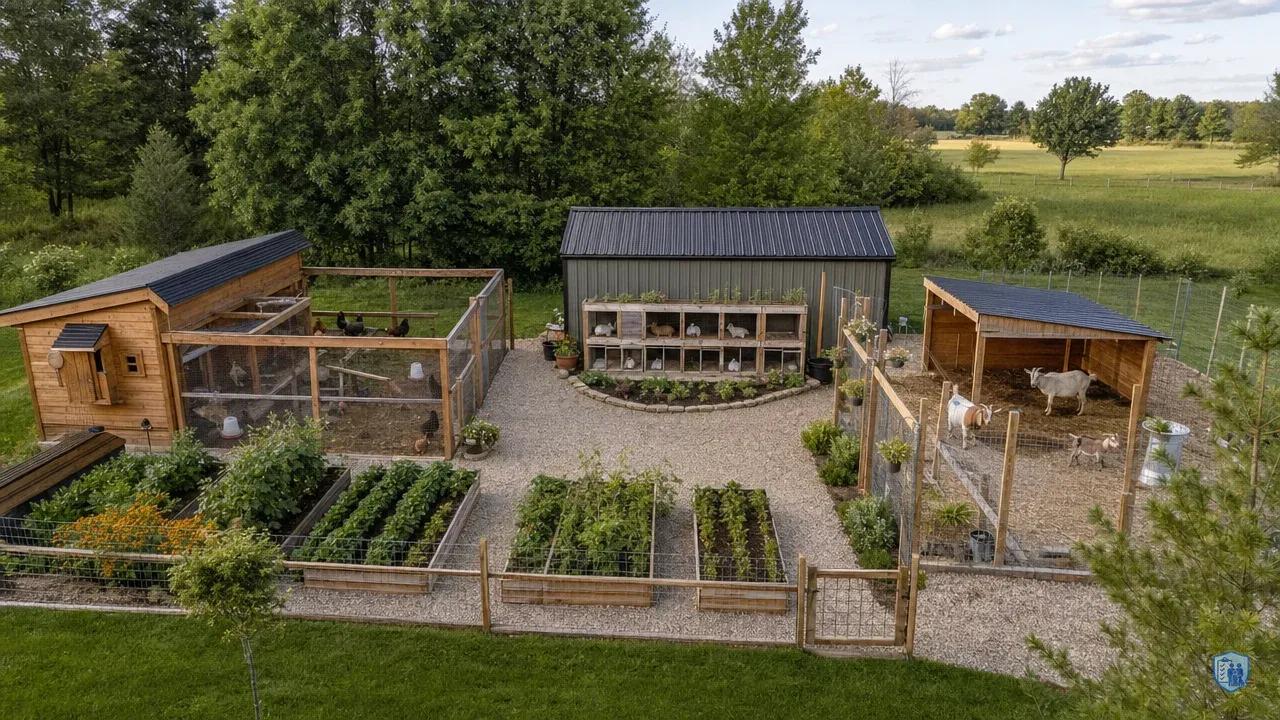
Maximizing Your Acre: Integration and Layout
The difference between three separate livestock operations and an integrated system lies in spatial efficiency and workflow optimization. Proper layout can reduce daily care requirements while increasing overall protein production through efficient space utilization. The key is positioning each species to leverage their natural behaviors while minimizing redundant infrastructure and wasted movement.
Start your layout planning from the fixed point of water access. Every livestock operation requires consistent water availability, and minimizing the distance from your water source to each animal area reduces daily labor and infrastructure costs. Position your chicken coop closest to your house, typically 30-50 feet away, where you'll notice problems quickly and where daily egg collection fits naturally into morning routines. The coop should face south or southeast for natural light and warmth while providing shade during summer afternoons. Attach the chicken run to the coop with a gate system that allows you to expand their ranging area into garden spaces during off-season months.
Rabbit hutches position well along a north-facing wall of an existing structure where they're protected from direct summer sun but receive winter light. The 10 by 10 footprint for your breeding trio and grow-out cages can nestle against your garage, shed, or house foundation, utilizing space that's often wasted. This placement protects rabbits from temperature extremes while keeping them close enough for twice-daily feeding and observation. The concentrated nature of rabbit waste makes collection straightforward. Position a composting area directly beneath or adjacent to hutches for easy waste management.
Goat housing and paddock area requires the largest dedicated space but can incorporate property features that seem like liabilities in conventional landscaping. That steep slope where mowing is difficult? Goats thrive on terrain other livestock struggle with. The overgrown fence line filled with invasive brush? Exactly what goats prefer eating. Position your goat shelter and primary paddock in the area that's least useful for other purposes, then design rotation areas that allow goats to browse and clear vegetation you'd otherwise spend time and money controlling.
The integration opportunity that most producers miss involves rotational grazing and complementary feeding behaviors. Chickens following goats through a browsed area consume insects, scatter goat droppings (reducing parasite loads), and glean seeds and vegetation that goats leave behind. This succession creates healthier pasture while reducing feed costs for both species. Design your goat paddock with gates that allow chicken access during rotation periods. The chickens sanitize the space while the goats move to fresh browse, then roles reverse on a 2-3 week cycle.
Feed storage and processing areas deserve central positioning with weather protection and rodent-proof construction. A single 8 by 10 shed can house feed for all three species plus provide space for processing equipment, medical supplies, and tool storage. Position this structure equidistant from your three livestock areas, the hub of your wheel with spokes leading to each species. This arrangement minimizes the daily walking distance while keeping feed secure and organized. Include dedicated spaces for different feed types since chickens, rabbits, and goats each require species-specific nutrition.
One acre can sustainably support 50-75 chickens, 20-30 rabbits, and 2-3 goats with rotational grazing systems . This density assumes you're managing the space actively rather than simply turning animals loose. Rotation prevents overgrazing, reduces parasite loads, and allows vegetation to recover between grazing periods. Your layout should include multiple paddock sections with gates that facilitate easy rotation without requiring you to catch and move animals manually.
Seasonal considerations reshape your operation dramatically between summer and winter. Summer's challenge is heat management, ensuring adequate shade, ventilation, and increased water availability for all species. Winter demands weather protection, especially for rabbits and chickens that tolerate cold well but suffer from drafts and moisture. Your integrated layout should include seasonal housing options: a deep-bedded winter coop for chickens that's separate from their summer coop, additional wind protection for rabbit hutches, and insulated or heated water systems that prevent freezing. These seasonal adaptations require planning during your initial layout phase, not scrambling to implement them when the first cold snap arrives.
Investment Analysis and Economic Reality
The financial commitment for small livestock operations divides into initial setup costs and ongoing operational expenses, with crisis-time value calculations that differ fundamentally from normal economic conditions. Understanding both sides of this equation helps you make informed decisions about which species to prioritize and how to phase implementation if capital is limited.
Initial setup costs for a combined chicken, rabbit, and goat operation range from $3,000-5,000 depending on whether you build infrastructure yourself or purchase ready-made solutions . Chicken infrastructure accounts for $600-1,200 (coop, run, fencing, feeders, waterers, initial flock). Rabbit setup runs $400-700 (hutches, nest boxes, feeders, waterers, breeding trio). Goat facilities represent the largest investment at $1,500-2,500 (shelter, fencing, feeders, waterers, two does). These figures assume mid-range quality construction that will last 10-15 years with proper maintenance, not premium materials or bargain-basement shortcuts that fail within two seasons.
Monthly operational costs center primarily on feed expenses. Feed costs typically represent 70% of small livestock production expenses . Chickens consume $15-25 monthly in layer pellets and supplements. Rabbits require $40-60 monthly for pellets and hay. Goats demand $80-120 monthly for hay and grain during lactation. Total monthly feed costs run $135-205 for all three species, or roughly $1,620-2,460 annually. Add approximately $200-300 annually for bedding materials, medical supplies, and miscellaneous expenses. Your total annual operational cost reaches $1,820-2,760 for the complete integrated system.
Protein production calculations reveal the return on this investment. Your chicken flock produces 3,650 eggs annually (10 hens multiplied by 365 days, accounting for reduced winter production) plus 40-50 pounds of meat from culled hens and surplus roosters. Your rabbit trio generates 200-250 pounds of meat annually. Your two dairy goats provide 400-600 gallons of milk yearly (which contains substantial protein) plus 60-80 pounds of meat from processed kids. Combined output reaches 400-600 pounds of protein annually, enough to meet 60-80% of a family of four's needs .
The break-even calculation during normal economic conditions assumes you're offsetting grocery costs. At conventional prices of $4 per pound for chicken, $8 per pound for rabbit, $6 per gallon for goat milk, and $3 per dozen for eggs, your annual production value reaches approximately $4,800-6,200. Subtract your $1,820-2,760 operational costs, and net value is $3,040-3,440 annually. With initial setup costs of $3,000-5,000, you reach break-even in 18-20 months of operation .
Crisis-time value transforms this equation completely. During economic disruptions with currency devaluation or supply chain collapse, protein prices can increase 200-400% while availability becomes sporadic or non-existent. Your livestock operation isn't competing with $4 per pound chicken anymore. It's competing with $12-16 per pound chicken that's only available during brief restocking periods followed by empty shelves. The value proposition shifts from financial optimization to food security guarantee. Your $3,000-5,000 investment becomes insurance against protein scarcity, with the "premium" paid through daily care requirements rather than monthly bills.
The hidden costs deserve honest assessment. Your time investment runs 60-90 minutes daily for feeding, watering, egg collection, and basic observation across all three species. Processing time adds another 2-4 hours monthly for rabbits and chickens. Unexpected veterinary costs can spike expenses. A sick goat requiring treatment might cost $150-300 in a single incident. Infrastructure repairs and replacements accumulate over time as weather and animal wear take their toll. Budget an additional 10-15% beyond your calculated operational costs for these unpredictable expenses.
- Initial Investment Costs
- Startup expenses including animal purchase, housing infrastructure, fencing, and essential equipment for each livestock species
- Annual Operating Expenses
- Recurring costs for feed, veterinary care, utilities, labor, and maintenance broken down by species and production scale
- Food Security Value Metrics
- Protein yield per dollar invested, nutritional output, and self-sufficiency ratios to optimize food production goals
Legal Considerations and Getting Started
Legal compliance forms the foundation of sustainable small livestock operations. Your carefully planned system means nothing if local authorities force you to shut down because you failed to research regulations before starting. The good news: over 60% of suburban areas now permit backyard chickens with appropriate permits, and many jurisdictions have expanded allowances for small livestock as food security awareness has grown . The challenge lies in navigating the specific requirements for your location.
Start with your municipal zoning code, typically available through your city or county planning department website. Search for terms like "urban agriculture," "backyard livestock," "keeping of animals," or "agricultural uses in residential zones." These sections detail what species are permitted, how many animals you can keep, setback requirements from property lines, and whether permits are required. Don't assume anything. Regulations vary wildly even between adjacent municipalities. One town might allow unlimited chickens while the neighboring community prohibits them entirely.
Homeowners association restrictions often exceed municipal regulations. If you live in an HOA-governed community, your CC&Rs (Covenants, Conditions, and Restrictions) may prohibit livestock regardless of what city zoning allows. Review your HOA documents carefully, and if livestock restrictions exist, understand your options. Some HOAs have variance request processes that allow exceptions for food security purposes. Others remain inflexible. Know this before you invest in infrastructure and animals.
Health department requirements apply primarily to dairy operations and meat processing. If you're keeping goats for milk production, even for personal consumption, some jurisdictions require inspections and permits. Meat processing regulations typically exempt poultry and rabbits processed on your property for personal use, but selling or bartering processed meat triggers commercial regulations in most states. Research these requirements through your county health department or state agriculture department. Ignorance here can result in serious legal consequences.
Neighbor relations often matter more than legal compliance for long-term operation sustainability. You might have every legal right to keep roosters, but if your neighbors hate the noise and complain constantly, your quality of life suffers even if authorities can't shut you down. Before starting livestock operations, have conversations with adjacent neighbors. Explain your food security goals, describe your planned setup, and ask about concerns they might have. Address noise, odor, and pest management proactively. Many neighbor conflicts arise from surprise and lack of communication rather than the actual impact of well-managed livestock.
Starting small provides the practical path forward for most families. Begin with chickens alone. They're legal in most jurisdictions, require the smallest investment, and teach fundamental livestock management skills. A starter flock of 6-8 hens can provide significant family protein needs while you learn daily care routines, seasonal management, and whether livestock keeping fits your lifestyle . After 6-12 months of successful chicken management, add rabbits if your situation allows. Only after you've proven to yourself that you can maintain consistent care routines should you consider goats, which demand higher skill levels and greater time commitment.
Essential resources for getting started include your local Cooperative Extension office, which provides research-based information specific to your region's climate and conditions . Extension agents offer guidance on breed selection, management practices, and local regulations. Online communities and forums connect you with experienced small livestock producers who've navigated the same challenges you'll face. Local feed stores often have bulletin boards advertising starter flocks, used equipment, and processing services. Building these resource networks before problems arise makes troubleshooting significantly easier when issues inevitably occur.
The practical starting sequence follows a logical progression: research regulations first, then design your layout, build infrastructure, establish your feed supply chain, and finally acquire animals. Rushing this sequence creates problems that undermine your entire operation. Buying animals before infrastructure is ready, or building without understanding regulations, leads to months of frustration and potential failure. Take the time to do this correctly.
Key action steps for getting started:
- Research your local zoning codes and HOA restrictions before any other planning
- Talk with neighbors about your plans before building infrastructure
- Start with chickens only for the first 6-12 months to develop skills
- Build all infrastructure before acquiring animals
- Establish relationships with local feed suppliers and extension agents
- Create a written management plan with daily, weekly, and seasonal tasks
- Budget 15% more than calculated costs for unexpected expenses
Small livestock operations on one acre aren't fantasy. They're functioning reality for thousands of families who've committed to protein independence. The path requires capital investment, daily time commitment, and learning curves that sometimes feel steep. But the payoff during economic disruption, when grocery store shelves empty and prices spike beyond affordability, makes every hour of preparation worthwhile. Your backyard flock, rabbit hutch, and goat paddock become insurance policies that pay dividends precisely when conventional food systems fail. Start small, learn continuously, and scale at a pace that matches your developing skills. The protein security you build becomes one of the most valuable assets your family possesses when economic reality makes it impossible to simply buy what you need.