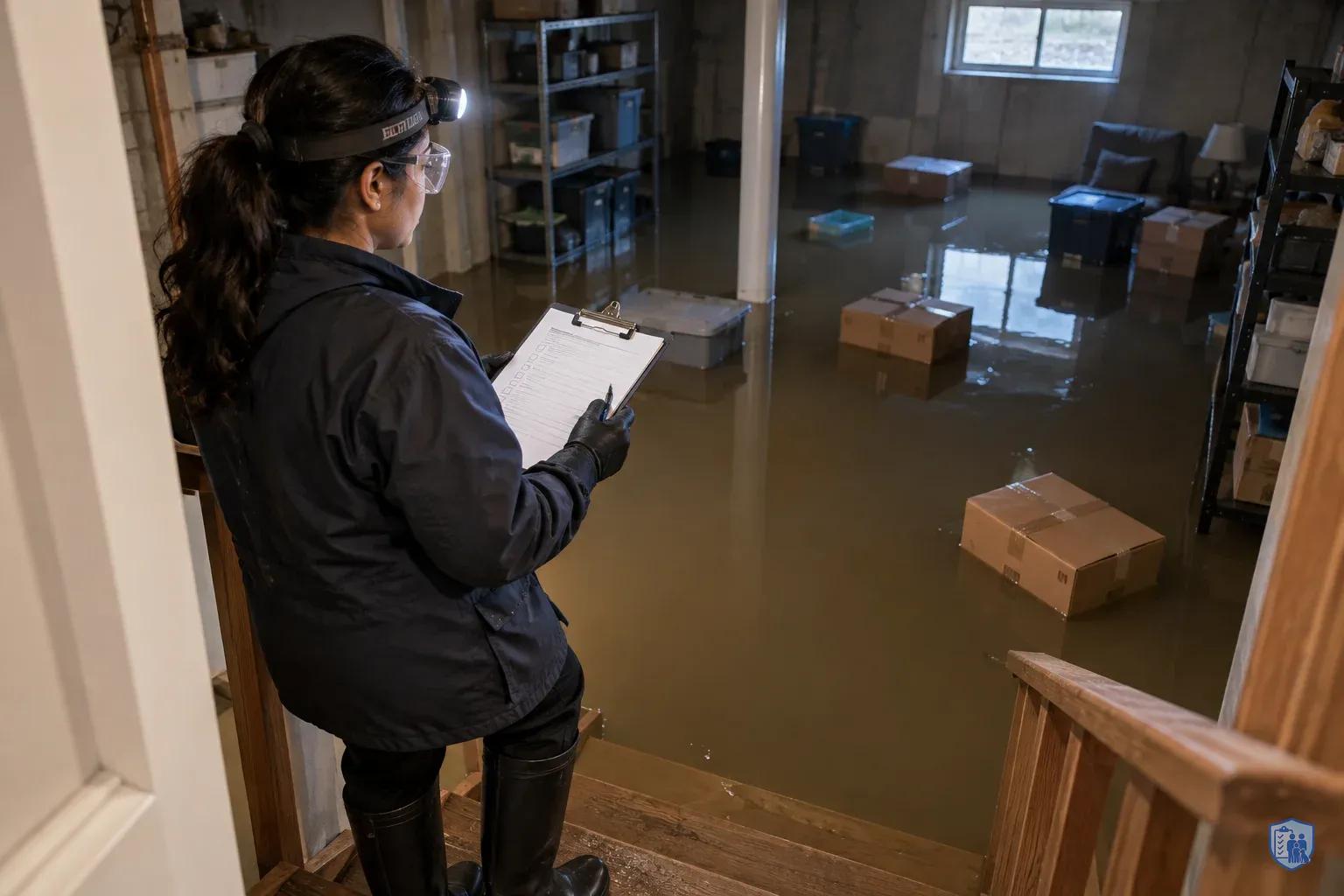
Stop. Breathe. Read This Before You Step Into the Water
You don't have to fix everything today. Here's what matters in the next hour.
Maybe you're standing at the top of the basement stairs right now, flashlight in hand. The beam skates across brown water where your workbench, shelving, and a decade of stored boxes used to be. Every instinct says grab a bucket and start hauling. Hold off for a few minutes, because the water is the least dangerous part of that scene until you know what it's touching.
This guide runs in three time boxes: First Hour, First Day, and First Week. Inside each, two labels keep you oriented. "You can do this yourself" marks work that a prepared, careful homeowner can handle. "Stop and call a professional" marks the points where the hazard outruns your gear and training. Read the safety boxes below before you take any action step.
SAFETY: ELECTRICAL. Never step into standing water to reach a breaker panel. Shut off power only from a dry location. If you can't, call the utility, the fire department, or a licensed electrician. OSHA lists electrical shock among the hazards of flood cleanup .
SAFETY: CONTAMINATION. Assume floodwater contains sewage, chemicals, and sharp debris. CDC/NIOSH guidance describes these hazards for cleanup workers .
SAFETY: CARBON MONOXIDE. Never run generators, gas-powered pumps, pressure washers, or grills inside the home, basement, or garage, or near doors, windows, or vents. OSHA and Ready.gov both warn that fuel-burning equipment used indoors can cause carbon monoxide poisoning.
SAFETY: GAS AND APPLIANCES. Do not relight pilot lights or energize wet appliances, gas systems, or HVAC equipment .
SAFETY: STRUCTURE. Deep water against saturated soil means you must pump out gradually .
SAFETY: VULNERABLE PEOPLE. Keep children, older adults, and anyone with asthma or a weakened immune system out of the cleanup area.
Every item in that box can seriously hurt someone, and none of them is visible from the stairs. Electricity, carbon monoxide, and gas leaks don't announce themselves. Foundation walls under hydrostatic load can fail suddenly. That's why the order of operations matters more than speed.
Calling a professional for electrical, gas, structural, sewage, or extensive mold problems is the expert choice. Experienced preppers know the skill set includes recognizing where your own capability ends. A licensed electrician with a meter makes a better decision about your flooded panel than you do with a flashlight and optimism.
- Power Off From Dry Ground Only
- Never step into standing water to reach a breaker panel. Check power and shut it off only from a dry location. If you can't, call the utility, the fire department, or a licensed electrician.
- Smell Gas? Leave Now
- If you smell gas, leave the house and call the gas utility from outside. Do not relight pilot lights or turn on wet appliances, gas systems, or HVAC equipment.
- Gear Up Before Entering
- Wear waterproof boots, waterproof gloves, and eye protection. Add an N95 or better respirator when mold or dust is likely. Assume the water contains sewage, chemicals, and sharp debris, and wash thoroughly afterward.
- Find and Slow the Source
- Check for a failed sump pump, a surface-water entry point, sewer backup, a failed supply line, or clogged gutters and downspouts. Slow or stop the water only if you can do so safely. If a plumbing line failed, close the main water valve.
- Document Before Moving Anything
- Photograph and video every wall, floor, and item before removing or discarding anything. Keep a tape measure in frame at the waterline to support your insurance claim.
First Hour: Make It Safe, Slow the Water, Document Everything
The first hour is about three jobs: control the hazards, slow the source, and capture evidence. Nothing in it requires heavy lifting. It requires discipline, because the temptation is to start moving things before you've recorded what happened.
The creator at How I Do Things Woodworking opens his flooded-basement walkthrough with the same priority: make the space safe, and cut power if possible before going in. Treat that as a reminder of the order, and rely on the safety sources cited here for the specifics.
Your First Hour Checklist (You Can Do This Yourself)
- Check power and gas status from a dry location. If you smell gas, leave the house and call the gas utility from outside.
- Put on PPE. Wear waterproof boots, waterproof gloves, eye protection, and an N95 or better respirator when mold or dust is likely . CDC/NIOSH lists boots, gloves, and eye protection as basic flood cleanup gear . Plan to wash thoroughly afterward.
- Identify the water source. The usual suspects are a failed sump pump, a surface-water entry point, sewer backup, a failed supply line, or clogged gutters and downspouts. Slow or stop it if you can do so safely. If a plumbing line failed, close the main water valve.
- Photograph and video everything before moving anything. Capture every wall, floor, and item, and keep a tape measure in frame at the waterline. NFIP FloodSmart advises documenting damage with photos or video before removing or discarding items .
Tracing the source is detective work. The same creator walks through checking the sump pump, utilities, gutters, and drains to see where water is entering and how to slow it. Think of it as bailing a boat. You can bail all day, but you have to find the hole first.
Stop and call a professional if:
- The electrical panel is wet or underwater
- You smell gas
- The water is contaminated with sewage
- Walls are bowing or cracking
Gas control valves, wiring, circuit breakers, and fuses that were underwater should be inspected by a qualified professional or the utility before anyone uses them.
The No-Electricity Tie-In
Once the power is off, you're working blind in a space with unknown hazards. Stage your lighting before you go down. Put on a headlamp, set battery lanterns at the base of the stairs, and make sure power banks are charged so your phone can keep photographing and logging. This is where an existing prep inventory pays off. The lighting you staged for a grid-down event now keeps your hands free and your footing sure.
- Run generators outdoors only
- Never run a generator, gas-powered pump, pressure washer, or grill inside the home, basement, or garage, because it can cause carbon monoxide poisoning. Place it outdoors, away from doors, windows, and vents, and use heavy-duty outdoor-rated cords.
- Install CO alarms and never back-feed
- Put battery-powered CO alarms on every level, since a generator running outdoors can still push exhaust toward the house. Never back-feed the house wiring. Have a licensed electrician install a proper transfer switch, and give limited power to the dehumidifiers and pump first.
- Treat the water supply as suspect
- Floodwater can contaminate a private well, and municipal systems may be compromised too. Follow local boil-water notices. Use stored or purified water for drinking, cooking, and handwashing.
- Disinfect water by boiling or bleach
- Boil water for 1 minute, or 3 minutes above 6,500 feet. You can also add 8 drops of 6% unscented bleach per gallon and let it stand for 30 minutes.
- Set up a handwashing station and budget water
- Keep stored water and soap at the top of the stairs. Wash all skin that touched floodwater with soap and clean water. Cleanup also uses water for washing and rinsing, so store more than your usual drinking allowance.
- Isolate the basement and live upstairs
- Close the basement door, seal returns, and live on the upper floors. Keep children, people with asthma, and anyone with a weakened immune system away from the cleanup area and its air. Pace the work, schedule rest, and plan a daily stopping time.
First Day: Extract, Tear Out, Dry, and Open Your Claim
STRUCTURAL CALLOUT: PUMP IN STAGES. If the basement is deeply flooded and the soil outside is saturated, pump the water out gradually. University of Minnesota Extension advises removing roughly one-third of the water per day .
Here is why. Water inside your basement pushes back against the walls and balances the hydrostatic pressure, the force that saturated soil and groundwater exert on the foundation. Drain the basement too quickly and that outside pressure is suddenly unopposed, which can crack or collapse the walls . Think of a cardboard box packed tight with wet sand: it holds only while something supports it.
Day-One Checklist
- Extract standing water with a wet/dry vacuum or an electric submersible pump on a GFCI-protected circuit (a ground-fault circuit interrupter, which cuts power fast if current leaks). Put any gas-powered pump or generator outdoors . Keep it well away from openings.
- Remove wet carpet, padding, baseboards, flooring underlayment, and saturated boxes and furniture. Bag samples of carpet, drywall, and insulation for the adjuster. NFIP FloodSmart recommends keeping them when possible .
- Run fans and dehumidifiers continuously. Open windows or run air conditioning only when the outdoor air is drier than the indoor air. Otherwise you pull more moisture into the space.
- Call your insurer. Start a log of labor hours, receipts, equipment rentals, and discarded items, with photos.
How I Do Things Woodworking demonstrates wet/dry vac extraction in a large basement. It then switches to drying mode with fans, dehumidifiers, and ventilation. Watching it clarifies the pacing. Extraction feels like progress, but drying is the real job, and it takes patience.
Why 24 to 48 Hours
Your target is dry materials within 24 to 48 hours. The EPA says to assume mold growth if a flooded home or its belongings couldn't be dried within 24 to 48 hours . That deadline drives the tear-out decisions. Anything porous that can't be fully cleaned and dried, such as carpet padding, saturated particleboard, and cardboard boxes, goes in the discard pile . Photograph each item before it goes, and keep your samples.
The video's tear-out segment shows the logic. Wet carpet and underlayment trap moisture against the slab, so they have to come out for the space to dry. The creator's advice on logging hours and purchases for an insurance claim is also worth copying. Keep a running note on your phone with a timestamp, task, and receipt photo for each entry. Your adjuster will thank you, and your claim will be easier to defend.
Picture a typical day. By mid-morning the first third of the water is gone and you've paused to let the soil equalize. By afternoon the carpet is bagged and the dehumidifiers are running. By evening your claim is open and your log has a dozen entries. That's a good day.
Stop and call a professional if:
- You have a sewage backup
- More than a few inches of water cover finished living space
- Water keeps rising faster than you can remove it
First Week: Cut Out, Clean, Disinfect, and Watch for Mold
The week ahead follows one explicit order of operations: dry, then clean, then disinfect, then verify dryness, then rebuild. Skipping steps is how a recovered basement turns into a mold problem six weeks later. Mold can begin growing quickly on wet materials , so the dry-first ordering is not optional. Cleaning must also come before disinfecting. Closing a wall over damp framing invites decay.
Week-One Checklist
- Cut out wet drywall. Snap a chalk line. Cut at least 12 inches above the waterline, and remove all wet insulation. FEMA advises both .
- Clean hard surfaces first. Wash concrete, studs, and tile with clean water and detergent. Then disinfect according to the product label. EPA advises detergent and clean water before bleach or other disinfectants .
- Monitor humidity and moisture. Track relative humidity with a hygrometer and check framing with a pin-type moisture meter. Do not close up walls until readings return to normal.
- Inspect hidden mold-prone areas. Check under cabinets, behind tubs, inside wall cavities, and under stair stringers.
CHEMICAL CALLOUT: Never mix bleach with ammonia or other cleaners. EPA warns against mixing cleaning products . Ventilate while cleaning. Follow the label on whatever disinfectant you choose.
Why Cut Above the Waterline
Wet drywall can wick moisture upward like a paper towel dipped in a glass, so the damp zone may extend past the visible stain. That is the practical reasoning behind the 12-inch minimum. The creator at How I Do Things Woodworking explains why baseboards typically come off and why wallboard may need cutting higher than the waterline. Once the wall is open, you can see and dry the cavity instead of guessing.
After demolition and drying, the video moves to cleaning and treating the concrete and lower wall areas. Follow the sequence above rather than any shortcut. Scrub with detergent and clean water, rinse, then disinfect per the label. Choose your disinfectant by its label directions, not by marketing claims.
Verification Matters
Mold hides where air doesn't move. The video continues monitoring in places like bathrooms, under tubs, and inside cabinets, and that's the right instinct. A hygrometer tells you about the room, while a moisture meter tells you about the wood. You need both, because a room can read dry while the bottom plate of a wall stays saturated. Log your readings daily, since the trend matters more than any single number.
HVAC CALLOUT: Do not run a flooded or mold-contaminated HVAC system. EPA advises having flooded systems inspected and cleaned before use . Running one can spread contaminants through the whole house.
Stop and call a professional if:
- Mold is extensive and visible
- A musty odor persists after drying
- Any materials are sewage-contaminated
Working the Cleanup With No Power, No Clean Water, and No Place Else to Go
Floods rarely arrive alone. They often take out the grid, compromise the water supply, and leave you living in a damaged house during the cleanup. If you've built a prep system for any of those, this is the moment to put it to work. Here's how each layer applies.
No electricity
- Light the work area with headlamps and lanterns. Hands-free light matters most on stairs and around debris.
- Run generators outdoors only, positioned away from doors, windows, and vents, as CPSC advises . OSHA's flood cleanup guidance gives the same instruction . Use heavy-duty outdoor-rated cords.
- Never back-feed the house wiring, and never energize flooded circuits until an electrician clears them. Back-feeding can send current up the utility lines and endanger line workers, so a licensed electrician should install a proper transfer switch.
- Prioritize limited power for dehumidifiers and the pump over comfort loads. Drying speed protects the house, and a warm kettle doesn't.
- Install battery-powered CO alarms on every level. A generator running outdoors can still push exhaust toward the house.
No clean water
- Treat the supply as suspect. Floodwater can contaminate a private well, and municipal systems may be compromised too. Follow local boil-water notices, and use stored or purified water for drinking, cooking, and handwashing.
- Know the treatment methods. EPA's emergency disinfection guidance covers boiling and treatment methods . Boil water for 1 minute, or 3 minutes above 6,500 feet. Alternatively, add 8 drops of 6% unscented bleach per gallon and let it stand for 30 minutes .
- Set up a handwashing station with stored water and soap at the top of the stairs. Wash with soap and clean water after any contact with floodwater, and wash all skin that touched it.
- Draw on your storage plan. Cleanup consumes water for washing and rinsing too, so budget beyond your usual drinking allowance.
Shelter in place
- Isolate the basement. Close the door, seal returns, and live on the upper floors. Keep children, people with asthma, and anyone with a weakened immune system away from the cleanup area and its air.
- Pace the work. Rotate tasks, schedule rest, and don't try to finish in two days a job that takes weeks. Exhaustion causes the slips and shortcuts that injure people.
- Acknowledge the strain. Living beside a damaged space for weeks wears on everyone. Plan a daily stopping time, a hot meal from your stores, and something that isn't work.
DIY or Call a Pro? A Quick Decision Table
After days of cleanup, it helps to have one page that answers the question you'll ask repeatedly: should I do this, or hand it off? The table below sorts the work. It follows the logic of OSHA's flood cleanup guidance. OSHA's flood cleanup guidance identifies electrical, structural, and contamination hazards that call for trained responders . Professional evaluation of any appliance or electrical component that was underwater is standard practice before it returns to service.
| You can do this yourself | Stop and call a professional |
|---|---|
| Clean-water flooding under a few inches | Wet electrical panels or wiring |
| Wet/dry vac extraction | Gas appliances and pilot lights |
| Removing carpet and baseboards | HVAC systems that were flooded |
| Running dehumidifiers and fans | Structural cracking or bowing walls |
| Cleaning hard surfaces with detergent | Sewage backup |
| Documentation, photos, and logs | Mold covering large areas |
If you prefer a quick flowchart, run each task through these questions in order:
- Does it involve electricity, gas, or the structure? Yes: call a professional. No: continue.
- Is the water from sewage or an unknown, contaminated source? Yes: call a professional. No: continue.
- Is it clean water under a few inches, or a hard-surface cleanup? Yes: proceed with your PPE and checklist.
- Still unsure? Treat it as a professional job until someone qualified tells you otherwise.
The right side of that table isn't a list of things you're incapable of. It's a list of jobs where the downside is severe and the tools are specialized. For an advanced prepper, knowing where DIY ends is part of the skill set, much like knowing when a medical situation exceeds your first aid training.
Next Steps: Insurance Reality Check and Upgrades So This Doesn't Happen Again
Once the basement is dry and the adrenaline fades, you have a rare opening to fix what let the water in. Start with the paperwork, because that's where many people discover a gap too late.
- Read your flood policy for basement coverage. NFIP basement coverage is limited. It generally applies to specific equipment such as furnaces, water heaters, and sump pumps, and to some appliances like washers, dryers, and freezers. Finished walls, floors, and most contents are generally excluded. Confirm the current details on FloodSmart's basement coverage page and with your agent. Standard homeowners policies typically don't cover flood damage at all, so verify that in your own policy. Review your limits before the next storm, not after.
- Add pump redundancy. Install a battery or water-powered sump pump backup, and verify that your primary pump's capacity matches your site.
- Install a high-water alarm so you hear about a failing pump before the water reaches your stuff.
- Move water away from the foundation. Extend downspouts and regrade soil to slope away from the house.
- Consider a backwater valve, which can keep sewage from flowing back into the house through drains during a surge. Have a licensed plumber confirm the right type and placement for your plumbing.
- Place smart leak sensors near the sump, water heater, and laundry.
- Store documents safely. Keep insurance policies and your elevation certificate in waterproof containers off the basement floor, and keep digital copies elsewhere.
How I Do Things Woodworking closes with a prevention review that covers reviewing insurance, adding water alarms, improving drainage, and evaluating sump pump capacity. It's a practical template. Check the timestamped segments against the video yourself, and pair them with the safety sources in this guide. You'll have both the method and the guardrails.
You've done something hard. A flooded basement tests your patience, your preparation, and your judgment. Each upgrade you make now turns that experience into protection for the next storm.
Build your flood recovery kit today: wet/dry vac, N95 respirators, waterproof PPE, a hygrometer, a moisture meter, and a battery sump backup. Don't wait for the next forecast. Shop the checklist and stage your kit before the water rises.