When every second counts: recognizing the signs you need to leave now
Sarah Martinez was watering her garden on a Tuesday afternoon when she noticed something odd, a light dusting of what looked like gray snow settling on her tomato plants. It was 87 degrees outside. Within twenty minutes, she saw the orange glow on the ridge behind her neighborhood, and fifteen minutes after that, a sheriff's deputy was driving down her street with a loudspeaker announcing mandatory evacuation. Sarah had less than ten minutes to grab what mattered most and leave her home of twelve years.
Recognizing the warning signs of an approaching wildfire means the difference between a safe evacuation and a dangerous one. A fire that seems distant can reach your property in minutes rather than hours. The key is spotting these signs early and acting immediately.
Visible flames or heavy smoke are the most obvious indicators, but by the time you can see flames, your window for safe evacuation may already be closing. Heavy smoke that blocks out the sun or creates an eerie, orange-tinted sky means fire is close, within a few miles at most. If you're seeing actual flames on ridgelines or hillsides, you're looking at minutes, not hours.
Ash falling from the sky is your signal to leave. When ash begins piling up on cars, roofs, and lawns like snowfall, the fire is close enough that burning embers can reach your property. These embers can jump ahead of the main fire and start new fires that quickly surround your neighborhood.
Pay attention to animal behavior. Wildlife has survival instincts honed over millennia. If you see deer, rabbits, or other animals fleeing in the same direction, or birds flying away in unusual numbers, they're telling you something critical. Animals detect danger before we do, and their mass exodus is a reliable warning sign.
Strong, erratic winds pushing smoke toward your location mean the fire is being driven in your direction. Wind accelerates wildfire, and shifting winds can change a fire's direction with terrifying speed. If you feel hot, dry winds carrying the smell of smoke, and especially if you notice sudden wind changes, the situation is getting worse fast.
Official evacuation orders should trigger immediate action. When authorities issue an evacuation warning, start preparing to leave. When they upgrade to a mandatory evacuation order, you need to be in your vehicle and moving within minutes. You may have only minutes to evacuate once fire is visible in your immediate area .
Your escape route game plan: multiple ways out
Most people know one way to get home, the route they drive every day. But when flames are visible and thousands of neighbors are trying to leave at the same time, that familiar route may become a deadly parking lot. Planning your escape routes before wildfire season begins is the difference between getting out safely and finding yourself trapped.
Start by identifying at least two completely different routes from your home to safety. Pull out a physical map or use online mapping tools to trace paths that don't share the same major roads. Your primary route might take you west on the main highway, while your secondary route heads north through residential streets to a different highway. The key word here is different. If both routes funnel into the same congested intersection, you don't really have two routes.
Think about where these roads lead. Routes that take you away from wildland areas and toward urban centers are generally safer than those that wind through forests or grasslands. A road that follows a canyon or valley can become a death trap. Fire moves fastest uphill and through canyons , and narrow terrain accelerates wind speeds. The 2018 Camp Fire in Paradise, California, demonstrated this horrifically. Narrow, winding roads through forested areas became choked with abandoned vehicles as residents realized too late they had no alternative routes.
Avoid planning routes that include canyon roads, dead-end streets, or single-access neighborhoods. These create bottlenecks where traffic can stop completely. If your neighborhood only has one exit, you need to know the next-closest way out, even if it means cutting through a parking lot or taking an unpaved service road. During an actual evacuation, normal traffic rules become secondary to survival.
Your vehicle is your escape pod, and it needs to be ready. Keep your gas tank at least half full during fire season. Never let it drop below that line. A quarter-tank might get you twenty miles in normal traffic, but in stop-and-go evacuation traffic with the air conditioning running to filter smoke, you'll burn through fuel much faster. Running out of gas during an evacuation isn't just inconvenient; it can be fatal.
Most wildfire evacuations follow predetermined routes established by local emergency management, but GPS and cell service often fail during wildfires . Keep physical maps in your vehicle. Actual paper maps don't need satellites or cell towers. Mark your primary and secondary routes with highlighter. Include maps of neighboring counties, because your evacuation might take you farther than you expect. A ten-dollar map book could save your life when your phone shows "No Service."
Drive your planned routes during calm weather. Notice landmarks, intersections, and potential problems. Is there a railroad crossing that could trap you if a train passes during evacuation? Does one route require several left turns across traffic that would be impossible during a mass exodus? These details matter when seconds count.
Share your routes with family members and anyone who might need to reach you or evacuate with you. Everyone in your household should know both routes without needing to look them up. Practice the conversation: "If we need to evacuate, we take Highway 12 west to the community college parking lot. If that's blocked, we go north on Maple Street to Route 7 and meet at the grocery store in Centerville."
When communications go dark: staying connected without cell service
The moment you most need your phone is exactly when it's most likely to fail. Cell towers become damaged or overloaded when thousands of people try to call at the same time.
Battery-powered or hand-crank emergency radio becomes your lifeline. Emergency radio broadcasts continue even when cell service fails , providing evacuation updates, route information, and all-clear notices. Keep one in your home and another in your vehicle. NOAA Weather Radio broadcasts continuous updates during fire emergencies, and many models include AM/FM bands for additional news sources. Test your radio monthly and keep extra batteries in your go-bag.
Pre-arranged family meeting points eliminate the panic of trying to coordinate during chaos. Designate two specific locations: one close to home, like a school parking lot or community center, and one farther away in a different town. Be specific. "The grocery store on Main Street" isn't enough if there are three grocery stores. Say "the Safeway at 1250 Main Street, near the pharmacy entrance." Everyone should know these locations by heart.
Emergency contact outside the fire zone serves as your communication hub. Choose someone at least 100 miles away, a relative or friend who won't be affected by the same disaster. During an emergency, it's often easier to call long-distance than locally. Each family member calls this person to check in, and that person relays information between you. Write this contact's phone number on a card that every family member carries.
Leave physical notes if you must evacuate separately. Keep a notepad and marker in an obvious location near your front door. If you evacuate first, write where you're going, what time you left, and where you'll be heading. A note saying "Evacuated 2:45 PM, took Highway 12 west to Centerville, will be at Mom's house, we love you" can prevent hours of terrified uncertainty.
Text messages often work when calls don't because they require less bandwidth. Before cell service fails completely, send texts rather than calling. Include your location, direction of travel, and planned destination. Keep messages short and factual.
The reality of communications failure during wildfires means you can't rely on coordinating in real-time. Your plans need to be made now, discussed thoroughly, and practiced until everyone knows them instinctively. When you can't call to ask "Where should we meet?" everyone needs to already know the answer.
- Important Documents
- Copies of ID, insurance papers, and emergency contacts in waterproof bag
- Emergency Cash & Cards
- Small bills and backup credit/debit cards for immediate needs
- Basic First Aid Kit
- Bandages, pain relievers, prescription medications, and antiseptic wipes
- Water & Snacks
- Water bottles and non-perishable energy bars or crackers
- Flashlight & Phone Charger
- Battery-powered flashlight and portable phone charger with cables
- Weather Protection
- Emergency blanket, rain poncho, and extra clothing layer
Grab and go: your 10-minute evacuation kit
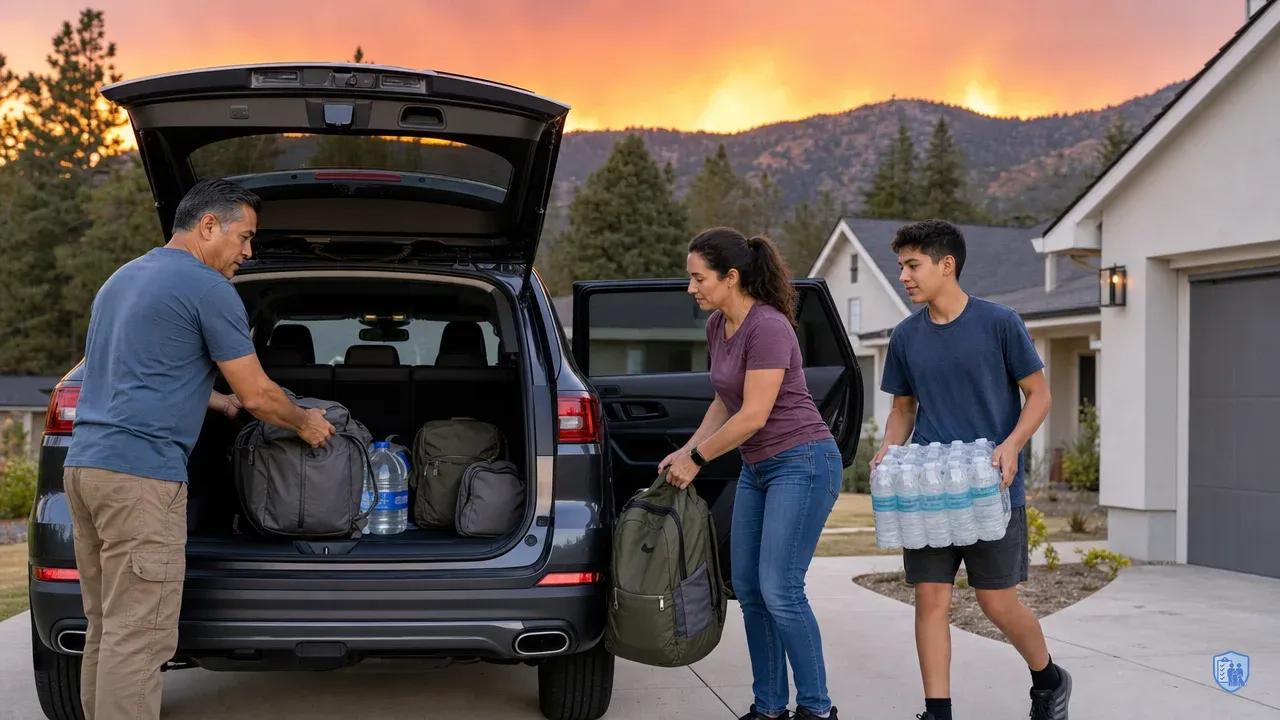
When that sheriff's deputy drives down your street announcing mandatory evacuation, you won't have time to think about what you need. You'll have time to grab pre-packed bags and go. That's it. Wildfire evacuations may allow very little time to leave, and people who try to gather items during those precious minutes often make fatal decisions: going back inside for one more thing, spending five minutes searching for car keys, or trying to pack too much and running out of time entirely.
Your go-bag should live in a specific, accessible location. Not buried in a closet, but near your most-used exit. Many people keep theirs in the garage near the vehicle or by the front door. Everyone in your household should know exactly where it is.
Start with important documents in a waterproof, fireproof container or bag. Include copies (or originals if you can't get copies) of insurance policies, property deeds, birth certificates, passports, medical records, and recent photos of your property for insurance claims. Add a USB drive with scanned copies of everything. These documents are nearly impossible to replace and critical for rebuilding your life after a fire. Keep a list of your insurance agent's contact information with these documents.
N95 or P100 masks protect against smoke inhalation, which can cause serious lung damage. Smoke from wildfires contains particulate matter, carbon monoxide, and toxic chemicals. Store at least two masks per family member in your go-bag. During evacuation, you may be driving through heavy smoke for extended periods, and these masks make the difference between breathing relatively clean air and inhaling dangerous toxins.
Water and non-perishable snacks keep you functional during what might be a long, stressful evacuation. Pack several bottles of water per person and high-calorie snacks like energy bars, nuts, or dried fruit. You might be sitting in traffic for hours or staying in an evacuation center with limited supplies. Dehydration and low blood sugar impair decision-making when you need to think clearly.
Flashlight and extra batteries, or better yet, a hand-crank flashlight that doesn't need batteries. Wildfires often cause power outages, and you may be evacuating at night or navigating through smoke so thick it blocks out the sun. Include a headlamp if you have one. Keeping your hands free matters.
Cash in small bills is essential because ATMs may not work during power outages, and credit card systems can be down. You'll need cash for gas, food, and temporary lodging. Small bills are crucial because businesses may not have change during emergencies. Even keeping 100 to 200 dollars in your go-bag can make a significant difference.
Add medications for at least a week, along with copies of prescriptions. Include any medical equipment you depend on. If you wear glasses, pack an extra pair. These items are as essential as food and water.
Photos and irreplaceable items should be digitized and backed up to cloud storage, but if you have time and space, grab a small box of physical photos or heirlooms. Just remember: your life is more valuable than any object. Never risk your safety going back for possessions.
Take 30 minutes this weekend to identify your two evacuation routes and pack a basic go-bag. You don't need a perfect kit. You need something ready now. Start with documents, water, and masks, then add other items as you can. The best go-bag is the one that's actually packed and ready when you need it.
If you can't get out: last resort survival tactics
Let's be absolutely clear: staying in place during a wildfire is extremely dangerous and should only happen if you have no other choice. If you're reading this section because you're curious about worst-case scenarios, good. That means you're thinking ahead. But if you're reading it during an actual fire, you're in a life-threatening situation that requires immediate, decisive action.
If you are advised to evacuate, do so immediately and follow designated evacuation routes . This is always your safest option.
If you find yourself unable to evacuate because roads are blocked, your vehicle won't start, or fire has surrounded your location faster than expected, your survival depends on understanding how fire moves and where it moves fastest. Fire moves fastest uphill and through canyons , and it accelerates through dense vegetation. Your goal is to get as far from these danger zones as possible.
When evacuation is not possible, go to an area with the largest footprint and least vegetation, like a parking lot or athletic field . Safety zones should be at least four times larger than the height of surrounding vegetation . If you're near 50-foot trees, you need a clearing at least 200 feet across. These areas have minimal fuel for fire and create a buffer between you and flames.
Avoid canyons, ravines, and steep terrain at all costs. Fire accelerates dramatically going uphill compared to flat ground. Canyons create a chimney effect where superheated air and flames funnel upward with devastating speed. If you're on a hillside, move downhill and away from the fire if possible.
If you're caught in an open area as fire approaches, look for a depression, ditch, or low spot in the ground. Lie face-down with your feet pointing toward the fire , covering as much exposed skin as possible. If you have water, wet any clothing and cover your head and body. Breathe through a wet cloth if you have one, taking short breaths close to the ground where air is coolest and smoke is less dense. This is a survival position of last resort, used by firefighters when they're overrun.
If you're in a vehicle and can't drive away, stay in the vehicle. Roll up windows, close vents, turn on headlights [9] so you're visible through smoke, and lie on the floor covering yourself with a blanket or jacket. Vehicles provide more protection than being outside, though they're not fireproof. The metal body offers some shielding from radiant heat, and the enclosed space contains breathable air longer than open air filled with smoke.
If you're in a building, move to the center of the structure away from windows. Fill sinks and bathtubs with water. Wet towels and place them around doors and vents to keep smoke out. Stay low where air is clearest. Don't go outside unless the building catches fire. Even then, moving outside into an active fire may be more dangerous than staying inside as long as possible.
The most important thing to understand about these last-resort tactics is that they're exactly that, last resorts when all better options have failed. Your survival odds are exponentially higher if you evacuate early when you first recognize warning signs. Every piece of advice in this section is about buying yourself minutes or hours until the fire passes, not about safely riding out a wildfire. These tactics have saved lives, but they're desperate measures for desperate circumstances.
After the fire: getting back safely
The fire has passed, and you're desperate to see your home, assess damage, and begin recovering. That urgency is completely understandable. But post-fire hazards can be as dangerous as the fire itself. Rushing back too soon has resulted in injuries and deaths from hazards people didn't see coming.
Wait for official all-clear announcements before returning to evacuated areas. Fire officials need time to ensure the fire is fully contained, not just knocked down. Hot spots can reignite, structures can collapse unexpectedly, and hazardous materials may have been released during the fire. Local emergency management will announce when areas are safe for re-entry, usually through emergency radio broadcasts, social media, and local news. Trying to sneak back early puts you at risk and diverts emergency resources from people who need help.
Watch for damaged power lines both overhead and on the ground. Fire can burn through insulation while leaving wires energized. Assume any downed line is live and stay well away from it. Experts recommend maintaining significant distance from any downed power line. Report downed lines to utility companies immediately. Also watch for damaged gas lines. If you smell gas or hear hissing, leave the area and report it. Don't use open flames, matches, or anything that could create a spark.
Structural damage may not be obvious. Fire can weaken buildings, making them prone to collapse even if they look intact from outside. Chimneys, walls, and roofs may be unstable. If your home is damaged, have it inspected by professionals before entering. Ash can hide holes in floors or weakened structures. Wear sturdy boots and gloves if you must enter a damaged building.
Document everything with photos and video before you clean or move anything. Your insurance claim depends on thorough documentation of damage. Photograph the exterior from multiple angles, then document every damaged room, item, and area. Make detailed lists of damaged or destroyed property, including approximate age and value. Contact your insurance agent as soon as possible. They'll guide you through the claims process and may send an adjuster to assess damage.
Check air quality before removing masks. Ash and debris can affect air and water quality after a fire, and disturbing ash during cleanup releases particles into the air. Continue wearing N95 masks during cleanup, especially when sweeping or moving debris. Wet down ash before disturbing it to minimize airborne particles. If you have respiratory conditions, consider having professionals handle ash removal.
Be aware that ash contains toxic substances including heavy metals and chemicals from burned structures, vehicles, and household items. Don't let children play in ash. Wash skin and clothing thoroughly after contact with ash. Keep pets away from ash-covered areas. Dispose of ash according to local guidelines. It may be classified as hazardous waste depending on what burned.
Water systems may be contaminated with ash, debris, or chemicals. Don't drink tap water until authorities confirm it's safe. Even after official clearance, run taps for several minutes to flush pipes before using water for drinking or cooking. Boil water if there's any question about safety.
The aftermath of a wildfire is emotionally overwhelming, and it's normal to feel grief, anger, or numbness. Take care of your mental health along with physical safety. Reach out to family, friends, or professional counselors. Community support systems often emerge after disasters. Don't hesitate to accept help or ask for what you need.
Your recovery will take time, much longer than you expect. Be patient with yourself and others. The same planning and preparation that helped you evacuate safely will help you rebuild. You've already demonstrated you can handle a crisis by getting out safely. That resilience will carry you through what comes next.
Your first step: start small, stay safe
Wildfire preparedness doesn't have to be overwhelming. You don't need to do everything at once. Start with one simple action this week: pack a go-bag with your important documents, some water, and a few masks. Next week, drive your two evacuation routes. The week after that, set up your family meeting points and outside contact person.
Breaking it down into small steps makes it manageable. Each action you take increases your safety and gives you more control over what happens if wildfire threatens your area. You're not preparing for disaster. You're preparing for peace of mind.
The families who evacuate safely aren't the ones who had perfect plans. They're the ones who had any plan at all, practiced it even once, and acted quickly when warning signs appeared. That can be you. Start today with just one step, and you're already ahead of where you were yesterday.